

Not Just U2 Duet: 4 Dolly Parton Songs That Prove She Had The Chops For Rock All Along
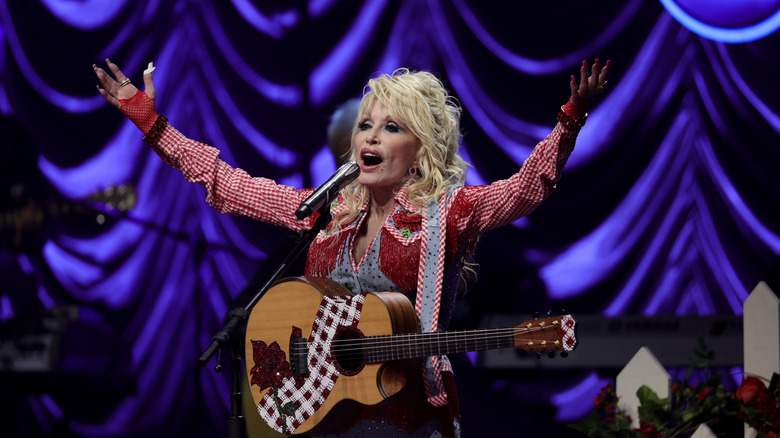
Singer and philanthropist Dolly Parton died at age 80 in August 2026, and about two months later, her last recording was publicly heard for the first time. Rock band and fellow Rock & Roll Hall of Fame inductee U2 released their 16th studio album, "Carnaval De Luz," in November 2026. Its final track, "Torn," preserves Parton's final singing performance, and on the powerful rock ballad, Parton trades off on lead vocal duties with U2's Bono. While Parton showed remarkable versatility over a six-decade career, she was primarily known for her work in country. "Torn" is the latest, and likely last, chestnut that proved the icon of country was a confident and capable rock singer.
In 2022, Parton tried to refuse her induction into the Rock & Roll Hall of Fame, believing herself to not have ever rocked hard enough to earn her spot. But she showed up for the honor, performed, and gave an acceptance speech in which she said, "I'm a rock star now!" (via Rolling Stone). She'd also promised to make more rock music, and she assembled the 2023 album "Rockstar" and then joined U2 for "Torn." It wasn't so much a new era as it was a deeper exploration of something in which she'd previously dabbled. Here are four songs, recorded and released from the 1950s until the 2020s, that show that Dolly Parton's collaboration with U2 was no outlier — the country and pop legend always rocked.
Puppy Love
It's a common misconception that Dolly Parton's musical career kicked off when she joined the country music variety program "The Porter Wagoner Show" in 1967. Parton actually got started in 1959, when at age 13, she recorded and released "Puppy Love," a song she co-wrote with her uncle, Bill Earl Owens. That same year, Parton performed the song at Nashville's storied Grand Ole Opry country music theater, even though the song is way more of a rock tune.
In the late 1950s, rock 'n' roll was the music of teenagers like Parton, and she composed and performed "Puppy Love" as if it were in the same vein as an Elvis Presley or Brenda Lee work. After all, in 1959, rock 'n' roll was still emerging and finding its bearings, and there was a lot of overlap with the rockabilly and country music that influenced its sound. Other parts of '50s rock that Parton loaded into "Puppy Love" — exuberance, yelping vocals, and lyrics about early, innocent romance, all propelled by a bouncy, stop-and-start guitar.
Jolene
"Jolene" marked the first time that Dolly Parton crossed over from the country chart to the pop chart, and the hard-charging plea to a potential marriage-ruining woman peaked at No. 60 in 1974. One of the singer-songwriter's best-known and most-loved songs, it climbed to No. 16 after Parton's death in 2026. It's presented as a country tune, and there are lots of traditional elements of that form in "Jolene," but Parton and her backing musicians play it like it's a folk-rock song heavy on the latter. "Jolene" is most recognizable for its circular and repeating acoustic guitar line, aggressively strummed with passion and desperation, and a simple and propulsive drum beat. Parton portrays a frantic character, delivering vocals that beg and plead with Jolene to not steal her partner, even though she easily could — the kind of thing one might find in a rock song.
Just a little bit later in the '70s, Heart would be a foundational classic rock band with songs like "Crazy on You" and "Magic Man." And both of those songs feel rooted in "Jolene," with singing that approaches a hard rock bleat and pained, explanatory vocals, respectively. Parton would later cover "Magic Man" on her 2023 album "Rockstar," but she evoked Heart's hard but dreamy arena rock much more so with "Jolene."
Great Balls of Fire
Throughout the '60s and '70s, Dolly Parton left traces of country-adjacent early rock in her works. But in 1979, when she covered Jerry Lee Lewis's 1957 primordial piano rock classic "Great Balls of Fire" for the album of the same name, Parton went modern-futuristic and made a rock song that could've only been conceived and recorded in the late 1970s. Under Parton's command, "Great Balls of Fire" becomes a horn-soaked but still jagged and thrilling stab at new wave.
New wave stripped down rock music to its basics and added in occasional extra instrumentation. That's what Parton did on "Great Balls of Fire." Staccato guitar, strummed hard, turns into an electric growl on the track in which Parton's voice shines through, with the singer adding casual improvisations to make it her own. The simple drums and guitar solos add to some old-fashioned piano, while saxophones bray in the distance. Parton updated and transformed the song, and "Great Balls of Fire" is as pure rock and ultra-hip as Parton would ever get in that late 1970s era in which she flirted with pop superstardom.
I Hate Myself for Loving You
The second-to-last album that Dolly Parton made in her lifetime was 2023's sprawling, ambitious, and celebratory "Rockstar." A tribute to rock music and the people who make it, Parton gathered luminaries of classic and contemporary music to write and sing newly conceived rock songs and covers of classics. The one song on "Rockstar" that shreds more than any other is "I Hate Myself for Loving You." Joan Jett and the Blackhearts had a Top 10 hit in 1988 with the song, a tightly-wound, down and dirty, self-deprecating kiss-off that evenly combines '80s hair metal, anthemic arena rock, and punk. All those disparate parts remain in Parton's version, presented as a duet with Jett herself.
Parton manages to outperform the snarling and bombastic Jett, delivering a faithful cover, if not precise re-creation, of the original song. Parton's earnest, warm, and inviting warble rarely attempted such abrasive material, and her ability to sell the song — and the embarrassing frustration of the tune's narrator — is a delightful surprise. Everyone knew Parton could sing ballads, but it's on tracks like "I Hate Myself for Loving You" where she showed she could also wail like a classic rock star.