

The 5 Greatest Scat Singers In Music History
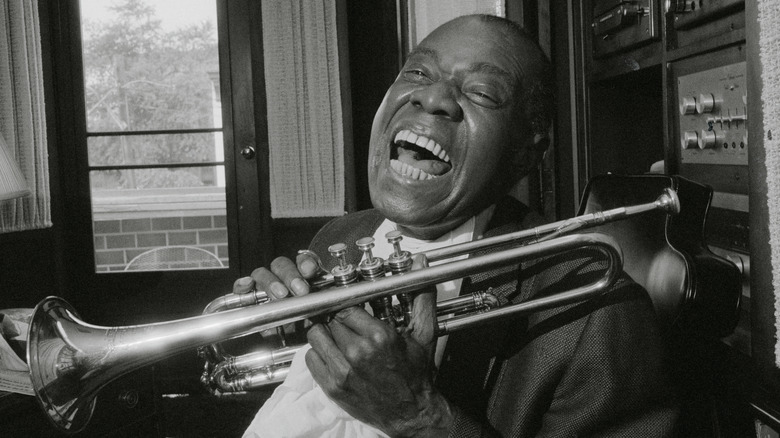
Jazz music has been around for over 100 years, and it was one of the top musical art forms for most of the first half of the 20th century. It's changed much since its origin in New Orleans, going through growth cycles, tonal shifts, and differing iterations based on the popular music of a given era. As such, it's birthed subgenres and entirely new musical devices that hadn't been seen in popular music before. One of these is scat singing, and when it hit the mainstream jazz scene in the late '20s, it changed it forever, giving way to the legends of scat vocals.
When choosing the greatest scat singers in music history, we've picked those who popularized the art form, scatted incomparably entertaining performances, had the best and most beautiful scat-singing voices, and influenced future scat-singing jazz musicians. Each of our entries holds a special place in jazz history beyond scat singing, but this wasn't by design. It just so happens that the best scat singers also gained prominence as mythical figures of jazz for other reasons.
Even if you're not a jazz buff, you'll probably recognize some of these scat singers. And if you don't, you'll be glad we introduced you to them. So, without further ado, let's dive in and remember some of the greatest scat singers who ever lived.
Louis Armstrong
Those who know little about jazz music may think Louis Armstrong was simply a talented trumpet player — or, mistakenly, the first astronaut to walk on the moon — but the real Louis Armstrong was very much both a trumpet player and a vocalist. And, when it comes to scat singing, he's a key figure. Without him, scatting may never have caught on in the first place, and when it did, it changed vocal jazz forever by giving singers the laryngeal equivalent of a guitar solo.
Some anecdotes describe how Louis Armstrong invented scat singing by accident, but the truth is he didn't invent it at all. Even Armstrong told Dick Cavett on "The Dick Cavett Show" in 1970 that scat singing was around before he was born. Instead, he popularized the vocal technique, starting with his 1926 song "Heebie Jeebies" under Louis Armstrong and the Hot Five.
"Heebie Jeebies" is a classic piece of early jazz, utilizing bopping horns and piano alongside Armstrong's rasping vocals, which quickly transform from lyrics into melodic scatting. When this song came out, it stirred the jazz community and led to others adopting scat singing. One could say it set off a scat-singing craze of sorts, serving as an influence for the jazz musicians who came after.
Ella Fitzgerald
Ella Fitzgerald had one of the most beautiful voices of the '50s and one of the greatest in all of jazz, and her voice was an instrument she used in a variety of ways. The public called her "The First Lady of Song" and "The Queen of Jazz" back in her day, but she's also the matriarch of scat singing — and for good reason.
From the time Fitzgerald earned her big break in the '30s until shortly before her death in the '90s, she was active on the jazz scene. It's one of the longest active careers in music, and she released new albums throughout most of it. In that time, she secured 13 Grammys, had her music inducted into the Grammy Hall of Fame, and was inducted herself into the Jazz Hall of Fame. Some of her biggest hit songs, the ones that launched her career to such heights, were made all the better by her masterful scat singing.
Take "Mack the Knife," for example. Fitzgerald secured No. 27 on the Billboard 100 with this hit, and she famously improvised scat sections during live performances that easily match the other greats, her tone shifting from the pristine clean vocals of her singing voice to the deep rasp that makes jazz scatting hit like a gravel truck. Another of her scatting hits was a cover of "It Don't Mean a Thing (If It Don't Have That Swing)," which — though made popular by multiple artists before her — portrays one of the most complex and longest scat breakdowns in her discography.
Cab Calloway
When it comes to crowd favorites, few could bring the energy or the scat-singing talent of the great Cab Calloway. Though he's not the one who popularized it, he's easily in the running for "The King of Scat Singing" alongside Louis Armstrong. In truth, Calloway may have been the most talented scat improviser to ever take the stage.
Calloway's most famous song is likely the 1931 hit "Minnie the Moocher." The song is performed with his backing orchestra — he was a hybrid swing-jazz/big-band performer — and is still one of the most fun live performances to watch to this day. The song serves as a call-and-response performance, but every single one of those calls is increasingly complicated vocal scatting.
Of course, it's no surprise that Calloway had such a way with scat singing. He learned the art from Louis Armstrong himself. Then he took that scatting and pumped more energy into it than had graced the stages before, making him one of the most popular musicians of his time.
Sarah Vaughan
Sarah Vaughan had such an angelic voice that she was dubbed "The Divine One," and was one of the most influential jazz singers ever. Her fame started in the '60s and continued for decades, cementing a special place within jazz and music history where she'll never be forgotten.
Vaughan had an extraordinarily clean voice and truly immaculate control over it. When Vaughan scat sang, she turned her voice into a melodic instrument on par with any piano or guitar. One of the best examples of her abilities is "Scat Blues," a song that dates back to the '60s but doesn't seem to have been released on an official recording until 1985. This jazz song has no lyrics and uses Vaughan's scatting almost as if it's the highlight of the instrumental.
The performance was impromptu and changed each time, so even the recorded version is but one of many, yet each of them showed why Vaughan was one of the best scat singers in music history. The rest of her catalog, however, proves she was one of the best jazz singers of all time, so it shouldn't be a surprise.
Dizzy Gillespie
Jazz legend and one of the cofounders of the bebop subgenre, Dizzy Gillespie, may be best known for his work with the trumpet, since he's generally considered one of the best jazz trumpet players of all time. With his distinctive puffed-out cheeks, Gillespie could play his bent-bell trumpet at a speed comparable to scaling guitar solos or with a smooth jazz melody that took the soul on a groove. There were few who could keep up with him. And he played his scat voice the same way he played his trumpet: masterfully.
Gillespie's scat singing wasn't just comparable to his trumpet playing in terms of skill; he also mimicked the style in which he played his brass. From the sounds he made to the speed, tone, and rhythm, Gillespie's voice was the scat-singing version of a horn section. You can hear this unique style of scat singing with recordings like "Dizzy's Scat Intro" — which some believe was recorded in 1989, though nobody knows for sure — or during live performances, a common example being the bebop standard "Oo Pa Pa Da." Both tracks are meant to put Gillespie's scat vocals on display, and they certainly achieve that goal. They're exceedingly fun scat performances that show exactly why he's considered one of the masters.