

5 Classic Singles That Define Hard Rock
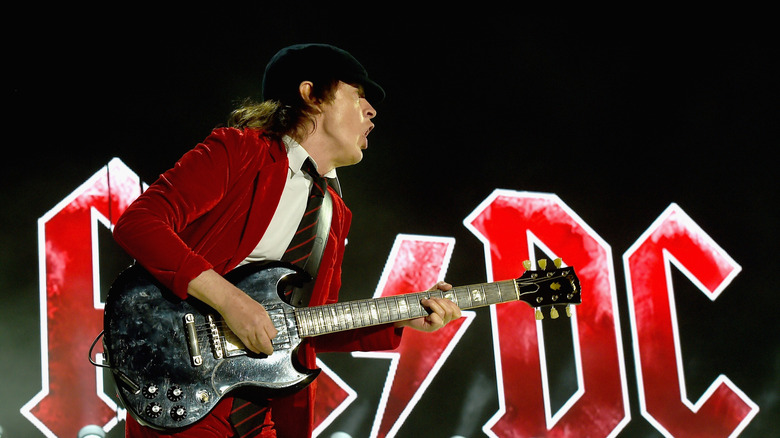
At this point, the hardest of hard music has become so hard that the word "hard" hardly has any meaning. That wasn't always the case, though. Distorted riffs, driving rhythms, and glorious, head-banging tomfoolery traces its lineage back to the mid-'60s, when hard rock-foundational bands like the Kinks and their primitive chords and energy-first songwriting really stood out. Hard rock came into its own from then on, defined by specific tentpole tracks.
But which songs did the heavy lifting when defining what was heavy? The answer to that question first depends on the definition of "hard rock," which we touched on above — riffs, rhythm, distortion, and a general emphasis on building songs around guitar work above other elements. Think AC/DC vs. Queen and you'll get the idea (an apples-to-oranges comparison, but it works). As for what songs best define hard rock, we've got to look at the flow of rock over time from the '60s to the present — British Invasion, psychedelia and prog, stadium rock, glam, grunge, indie, etc. — to find songs that captured the harder trends of the time, and even guided them.
At this point, and much to the justified annoyance of purists, "classic rock" can also encompass anything from the Beatles through Nirvana (about 1963 to 1994, though classic rock's golden era ended about 1984). We're casting our net over these three decades. So bearing all this in mind, let's don our best stank faces and get to rockin'.
Whole Lotta Love (1969) — Led Zeppelin
Despite veering into mystical stuff, folk, and even that one reggae song that drummer John Bonham hated, Led Zeppelin's a hard rock outfit through and through. If we've got to reduce their hard rock-defining sound to one song, it'd be "Whole Lotta Love" from their second 1969 album, "Led Zeppelin II." This is the point where Zeppelin cohered into the band we know, where they bundled up their various rock and blues influences into a punchy, riffy statement that hit No. 4 on the Billboard Hot 100 (their highest-charting song) and paved the way for hard rock to come.
While attitude and overall swing rhythm play a big part in the hard rockiness of "Whole Lotta Love," the lion's share of its impact comes from the more technical elements of Jimmy Page's main pedal tone riff. This kind of riff is a staple of hard rock and metal at this point, and involves the guitarist going back to the same picked low note in between playing clusters of higher notes. Following Zeppelin, pedal tone riffs crop up extensively in the mid-70s to '80s New Wave of British Heavy Metal (NWOBHM) in bands like Judas Priest (e.g., "Painkiller") and Iron Maiden (e.g., "Number of the Beast"). They also played a massive role in the '00 U.S. metalcore scene (e.g., Trivium's "Pull Harder on the Strings of Your Martyr"), and continue popping up again and again to the present just because they sound so sonically interesting and driving.
Other bands might have deployed similar play styles before Zeppelin. But Zeppelin's fame ensured that "Whole Lotta Love" left a permanent impact on musicians of the heavier persuasion since then.
Paranoid (1970) — Black Sabbath
Whoa, whoa, whoa, metalheads: Yes, Sabbath is the goat of OG metal bands, no matter what other bands aided in metal's rise. But back when Sabbath was getting all heavy, there was no such label as "metal." Sabbath was just a particularly hard form of rock twisted by witchy tritones, brooding melodic lines, and an often slower tempo that cascaded onwards into modern metal and its litany of sub-genres, especially doom. But out of all of their songs from the 1970's landmark, "Paranoid," it's the title track that defined hard rock more than anything.
"Paranoid's" influence on hard rock boils down to Tony Iommi's guitar work. Setting the opening riff and solo to one side, Iommi plays a progression of simple, downstroked power chords that chugga-chugga though the verse and end at a three-chord variation that loops the whole thing around again. With that blueprint in mind, we could basically be talking about Green Day or any punk, pop-punk, hard rock, hard rock-adjacent, etc., band since then (no offense meant to Sabbath or Ozzy's ghost). "Paranoid" is also a bit more up-tempo than many Sabbath songs, which makes it feel more like a hard rock groove-along than a grimy, detuned metal affair.
It's ironic that "Paranoid" has proven so influential, as it was basically a throwaway song cobbled together last minute out of contractual obligations (and a song which Iommi hated, solo and all). In what's become a well-known story, Iommi stayed behind one day while the other guys went to a bar, bashed out "Paranoid" as a three-minute filler track, and that was that. Their label, Vertigo, heard potential in the song, which is why Sabbath's 1970 album got named after it. Thus, we got our classic.
Smoke on the Water (1972) — Deep Purple
Apologies to anyone who's sick to death of "Smoke on the Water's" main, Ritchie Blackmore-played riff. But credit where credit is due. The Deep Purple song from 1972's "Machine Head" has left such a deep imprint on hard rock that rock's been feeling its way around the imprint ever since. Ask yourself, honestly: Has there been a more recognizable riff, ever?
Along with Led Zeppelin and Black Sabbath, Deep Purple are considered one of the "unholy trinity" of hard rock pioneers. Like Sabbath's "Paranoid," "Smoke on the Water's" primary, hard rock-defining riff is exceedingly simple, uncluttered, and serves as a home base for the song to return to. It's just five power chords played in an instantly recognizable rhythm (though you can play it in a variety of ways), where the riff's rhythm is just as important as its singability; the latter is a staple of hard rock riffs, too. But, even as "Smoke on the Water's" early '70s riff signaled the way forward for future bands, the song's entire, blues-based sound hearkened back to late '60s psychedelia. This is how Deep Purple, a band that always straddled the line between approachable and artsy, threaded older rock into something new. "Smoke on the Water" even reached No. 4 on the Billboard Hot 100.
"Smoke on the Water" also comes with a backstory that's way more literal than listeners might realize. The song is about actual smoke on the water from Lake Geneva. The "fire in the sky" was fire from the Montreux Casino, which went up in flames at a Frank Zappa show when someone in the audience fired a flare gun inside (as the lyrics chronicle). This tale has only added to the song's legend and influence.
Back in Black (1980) — AC/DC
If you're not bopping your head to AC/DC's "Back in Black," humming along to the main, Angus Young-played riff and swearing that this track is the quintessence of hard rock, heart and soul, then we're betting you're dead. That's because "Back in Black" from the 1980 AC/DC album of the same name took every rock lesson from preceding decades and distilled it into pure attitude. The easily followable riff, the sneering guitar tone, the snare drum on the 2 and 4, the rousing, anthemic chorus: This song from this album defined hard rock for the party hardy decade to come. It's also crunchy enough, guitar tone-wise, but still easy enough on the ears to capture multiple crowds.
That's quite a statement for an album that contains a bunch of bangers, like "Hell's Bells," "Shoot to Thrill." and "You Shook Me All Night Long," the last of which is basically made perfect because of its chorus. It's also quite a statement considering that AC/DC was operating with a brand new singer with this album, Brian Johnson, following the death of previous singer, Bon Scott. But in addition to being one of the most definitive hard rock albums ever, "Back in Black" is also a time capsule that reflects the shift into arena rock that started in the '70s with bands like Boston (the more corporate side) and Kiss (the more spectacle side).
"Back in Black," the album, represents rock shedding its final countercultural pretensions and admitting that it'd become a thing of yelling "woo!" at loud shows. AC/DC filled this niche with aplomb with "Back in Black," a song about ... What, exactly? Whatever, it doesn't even matter. Just nod along and go wild.
Welcome to the Jungle (1987) — Guns N' Roses
To say that Guns N' Roses made a splash on the music scene with 1987's "Appetite for Destruction" is a vast, vast understatement. They hit at the right time, building on the momentum of '80s glam, punk, and metal, capitalized on the bad boys trends of the day (hair, included), and produced volcanically hooky, hard rockin' party songs. Their debut remains the best-selling debut of all time (about 25 million copies sold), as well an album that overshadowed every GNR album to come by far. By numbers alone, and GNR's position in the zeitgeist, basically any big song from "Appetite for Destruction" could make our cut. That being said, "Welcome to the Jungle" beats out "Paradise City" and "Sweet Child O' Mine" because it's the most straightforward, rock-out song of the bunch.
"Welcome to the Jungle" bristles with attitude and encapsulates not just GNR's appeal to the public, but the appeal of hard rock, on a whole — at least in its late '80s form. The song is just as dumb as it is kick-a**, although the composition is certainly not dumb at all. Slash wrote the core riff, which like other songs in this article is singable, not overly complex, and boils down to a handful of easy-to-play power chords (with some lead line embellishments). You can hear elements of rock's entire history in the song, including other bands in this article, like Led Zeppelin and AC/DC. These classic rock elements connect GNR to the kind of basic, pentatonic-scale blues rock that's defined rock since its formative, '50s days.