

5 Songs That Prove 1982 Was The Best Year Of Duran Duran's Career
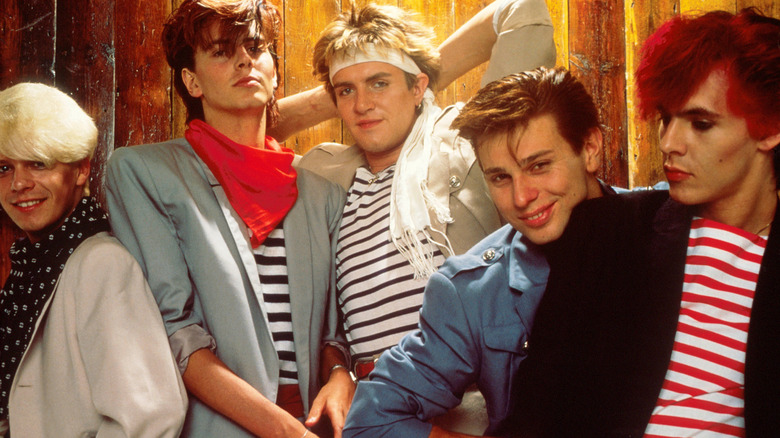
Duran Duran hit the scene in the early 1980s with a wave of danceable tunes bolstered by iconic, cinematic music videos and all wrapped up in a surplus of glamour. Their New Romantics fashion sense and ultra-feathered hair helped the members draw attention, and their sound, which blended new wave and synth-pop into a modern, catchy form of pop-rock, ensured that they held fans' attention. Duran Duran, whose name comes from the cult sci-fi classic Barbarella, mind you, were also at the forefront of the newly-emerging music video industry, with early videos of theirs like "Girls On Film" helping to take their snappy pop hits to the next level of international fame.
Though the band has continued making music up to this day, with a full studio album released as recently as 2023, and with a number of successful albums and singles throughout, they do nonetheless have a point at which their career was at its absolute best. That point was 1982, when they released their seminal album "Rio," which played a major role in defining New Wave and also in cementing the band's legacy forever. We gathered five tracks from the album that prove it was their best and most iconic year. These songs demonstrate how commercially successful, innovative, influential, genre-defining, and even decade-defining "Rio" truly was. Read on to dig into those five songs, all of which make a compelling case that '82 was Duran Duran at its peak.
Rio
The opener and title track off of the album, "Rio," was virtually guaranteed to be released as a single, and after just a single listen, its infectiousness suggests it was always destined to be a hit as well. Though it only managed to reach No. 14 on the Billboard Hot 100, it has all the energy and dynamism you'd expect from a No. 1. Also, like many No. 1s, it has survived in the public consciousness for decades after its initial release, and is now arguably the band's second most signature hit after only "Hungry Like the Wolf."
According to the band, the song was actually stitched together from two of the band's earlier songs — the verses adapted from "See Me Repeat Me" and the chorus reworked from "Stevie's Radio Station." That incongruity can be felt in the song's lack of a pre-chorus, which it replaces with a simple instrumental measure in order to let the verse's momentum die. That pause actually works out for the best, however, as it makes the chorus's big opening even splashier by contrast.
Asked by The Guardian about the song, bassist John Taylor (whose part in the song is surprisingly nimble and rarely lets up) proudly asserted that, "It's what happens when you have five guys raised on glam, punk and beat, with the audacity to think they have something to say, pushing into each other and causing an extraordinary chemistry. I find it remarkable."
Save a Prayer
When the least successful single from an album still reaches No. 16 on the charts, you know the album is something special. That No. 16 was attained by "Save a Prayer," though, oddly, not until three years after it was released as part of the "Rio" album. During the period in '82 and '83 in which "Rio" and "Hungry Like the Wolf" dominated the music video rotation, the "Save a Prayer" video did receive significant play, though it was the video shot for the U.K. single. It wasn't until '85 that the band officially released the song as a single in the U.S., this time with a concert video that helped reflect the song's tenderness and the personal relationship many fans had developed with it.
Unlike so many of Duran Duran's hits, "Save a Prayer" is hardly uptempo, playful, or youthful. Instead, it's a slow, mature, thoughtful ballad about the profound emotional effect a one-night-stand can have regardless of casual intent. It's been cited as one of the band's best, in part because it showed a different side to the group, and in part because of singer Simon Le Bon's poetic lyrics. The repeated refrain "Don't say a prayer for me now / Save it till the morning after," which is as crisp as it is concise, was certainly effective enough to influence younger bands. Case in point: "Teddy Picker," a single from modern rock gods Arctic Monkeys, which, before its solo, hangs on the familiar line "I don't want your prayer / save it for the morning after."
Lonely in Your Nightmare
Placed towards the front of "Rio" and sandwiched between upbeat bops "My Own Way" and "Hungry Like the Wolf," the relatively down-tempo and deeply melancholic "Lonely in Your Nightmare" was introduced to the world in an unusual spot. Yet the song succeeds on the album by offering some variation at its start, and succeeds on its own by still offering "pop thrills a-plenty," in the words of AllMusic.
As Duran Duran Producer Mark Ronson told Billboard about "Lonely in Your Nightmare," "If Duran Duran hadn't been so ridiculously good-looking, this would have been the coolest cool kids anthem in every goth disco this side of Deptford." In less British terms, he was suggesting that the quality and style of the song would have been enough to earn it the respect of hip counterculture youth everywhere if it didn't come from a band known more for their look and videos than their artistry.
Ronson has a point, as the song's artful lyrics about the difficulty of connection have helped the song endure as a fan favorite to this day. Just the chorus's plaintive appeal, "Because you're lonely in your nightmare, let me in," is impactful enough on its own, and the verses probe much more deeply. The band even rerecorded the song in 2023, more than 40 years after its release, for the album "Danse Macabre." They cheekily mashed it up with Rick James's "Superfreak" into a new song, "Super Lonely Freak," though the song's first half is almost entirely the original "Lonely in Your Nightmare."
The Chauffeur
A song like "The Chauffeur," with its innovative electronic instrumentation and arrangement, would be enough to add depth to almost any rock band's catalogue. For a band as synonymous with flashiness — both musical and aesthetic — as Duran Duran, however, a song like "The Chauffeur" is a revelation. There aren't many Duran Duran songs, nor many radio hits in general, like "The Chauffeur," and that is why it stands out so starkly on "Rio." Yet in addition to standing out, it also excels, thanks to some genuinely captivating melodies and the most memorable ocarina solo you may ever hear on a pop rock album.
When Stereogum asked founding keyboardist Nick Rhodes to name his top 10 Duran Duran songs, he immediately offered his first pick: "The Chauffeur." He explained, "Because I think it was an important stepping block in our sound during the making of the 'Rio' album. It was the first really completely electronic thing that we'd done, and it's turned into this sort of strange cult [hit]. I don't like all strange cults, but in this case, I do like this one." He added later that, "It really has developed that cult status ... the amount of kids who come up to me, male and female, who say — you know, young kids now — and say 'I love that video, and I love that song.' It's just sort of grown." The song was based on a poem by Le Bon, and its lyrics, evocative of classic Romantic poetry, prove the poem a more than worthwhile source.
Hungry Like the Wolf
Out of every song in Duran Duran's lengthy discography, no song has endured more, nor, in turn, caused the band itself to endure more, than "Hungry Like the Wolf." Over the decades, the band and song have become practically synonymous, and any mention of Duran Duran is likely to lead to the song. It reached No. 3 on the charts, spent an impressive 23 weeks charting, and quickly became a radio staple for decades, with no end in sight.
In addition, its video is one of the most recognizable of all time, and especially for the early MTV era, which is partly why the song is among those that define rock history. The video earned the band two Grammys, one for best video album and another for best video, short form, though the most telling evidence for its success lies in how fondly it is remembered and how often it is played, even to this day.
As Taylor told the A.V. Club, "[Hungry Like the Wolf] really was the video that sort of changed everything for the band. We went from being sort of like a club band, an underground band, to being, like, 'Wow!'" He went on to explain that the song's creation was a result of the band being at their peak, saying, "You're at that time in your career when you just don't have to think twice about anything, y'know? ... It's that combination of confidence and naïveté, actually, that allows you to just ... I call it surfing the zeitgeist. It's when everything you do is right."