

5 Albums From The '70s Every Country Rock Diehard Should Own
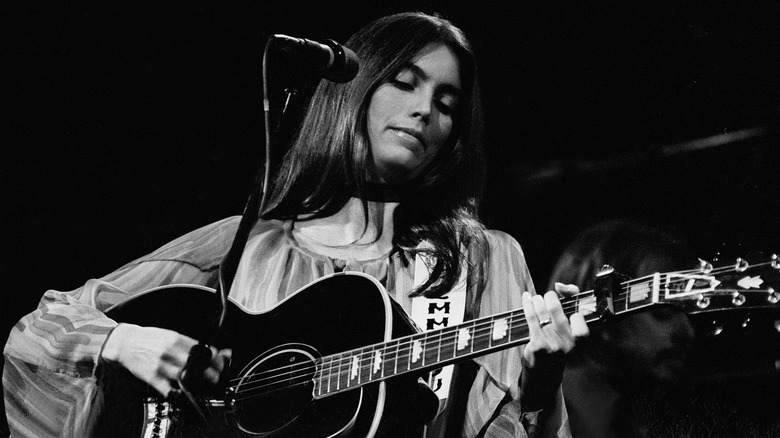
Looking for honky tonk but with fewer jugs? Country rock is here for you. Taking the down-home roots of country music and giving it an injection of rock rhythms and attitude, country rock took root in the late '60s with artists like the Byrds and the Flying Burrito Brothers (with members shared between them). By the time the '70s rolled around, this bona fide genre produced albums that every diehard fan ought to have.
But how do we choose only five of these albums? Some might say that diehard fans ought to have the most obscure albums in their collection, but we're going to say that diehards ought to have the biggest, most unignorable, universally agreed-upon classics in their collections — LPs that someone will call you out on if you don't have. In choosing these albums, we have to be careful to differentiate country rock from southern rock, as the two sometimes get confused with each other. If there are explosive lead electric lines and a grittier, up-tempo edge? That's southern rock, which comes with its own genre-defining hits of the '70s. If we're talking about more acoustic (but not exclusively), easier-going songs that sound like straight-up country cut with a bit of rock (but with much less accentuated percussion)? That's country rock.
Finally, even though some of the best-selling country rock artists come from later decades, we're focusing on classic albums from country rock's '70s heyday. So, let's grab a fiddle, maybe a slide guitar and a mandolin, and get ready to hoedown or throw down.
Harvest — Neil Young
Neil Young's "Harvest" was such a massive album that it breached country rock containment and went mainstream. It also breached folk rock containment, as Young is most closely associated with folk rock via his solo work and time with Crosby, Stills, Nash & Young. "Harvest" sold a staggering 7.5 million copies and landed Young his only No. 1 hit with "Heart of Gold." Basically, if you're a country rock diehard, you've already got this album in your collection.
Young had to plan for success on "Harvest," at least on the recording side. He hand-picked musicians he wanted to fill the album's various instrumental roles and quickly blazed through his time in the studio. "Heart of Gold," for instance, only took about two hours to record and produce — asynchronously, too, as Young did his part first before background vocalists listened and recorded theirs. Each song on the album likewise received Young's very specific attention to detail. "Harvest's" overall country angle was unintentional, however, as Young's back was hurting him during recording and stopped him from getting too electric with his guitar work.
When "Harvest" did become a smash, Young wound up hating "Heart of Gold" and attempted to flee from public life. Young's authenticity and cantankerousness, however, are part of what folks love about him, aside from the vulnerability of his lyrics and quavering voice. And so it was that his talents produced one of the best country rock albums ever.
American Beauty — Grateful Dead
Though it's commonplace to associate the Grateful Dead with tie-dyed shirts and that Ben & Jerry's ice cream, they were true vanguards of Americana. Sure, they had their "disco Dead" phase, but when they focused their sound into something constructively mainstream, as with 1970's "American Beauty," all of their bluegrass and folk influence spilled out. Songs such as "Box of Rain," "Sugar Magnolia," and "Candyman" prove our point, and the album's final track, "Truckin'," also doubles up as one of the Dead's best songs from the entire '70s.
Having struck gold with 1970's "Workingman's Dead," which reached No. 27 on the Billboard 200, the Dead upped the ante with their subsequent album, "American Beauty," released that same year. It's a bit mellower and gentler than "Workingman's Dead," and evocative of country livin' and sentiments. This sound comes directly from the album's songwriting process, which also explains the creative burst that led to the album being released so quickly. Jerry Garcia and Robert Hunter invited the rest of the band to contribute as they liked, which allowed various ideas to flow and brew quickly. Hence inclusions like the mandolin, courtesy of session musician David Grisman.
"American Beauty" went even higher on the Billboard 200 than "Workingman's Dead" and reached No. 19. It proved that the Dead could be a phenomenal studio band as well as they were live, and has been a country rock staple ever since.
Grievous Angel — Gram Parsons
Alongside his solo work, Gram Parsons was the country-rock glue between the Byrds, the Flying Burrito Brothers, and the very short-lived International Submarine Band, and was one of the most, if not the most, pivotal figures in the entire establishment of country rock. The timeframes of those projects tell us much of his story: a frenzy of creative work that burned bright from the mid-'60s and vanished with his untimely death in 1973. But out of his entire output, it's 1974's posthumous album, "Grievous Angel," that every country rock diehard ought to know and have, a release in no small part buoyed by Parsons' legend and early death.
Coming at the end of Parsons' life, "Grievous Angel" acts like a capstone of his musical life and lessons. No matter that the entire album was billed as a solo work, it 100% wasn't, especially because his protégé, Emmylou Harris, sings throughout. Her and Parsons' dual vocal lines do much to elevate songs like "Return of the Grievous Angel" to sublime status. But even without her voice, that song and others like "Love Hurts" are beautifully composed, heartwarming, sometimes heartbreaking, and rock-solid to the point of flawlessness, slide guitars and all. The whole album lands more heavily on the country side of country rock, but that's not exactly going to be a problem for country rock diehards.
Desperado — Eagles
Before the Eagles made it all the way west to "Hotel California," they had a mini-outlaw phase (bandolier and all) in the American Southwest with a country rock masterwork: 1973's "Desperado." There's a good case to be made that, compositionally, this is the best Eagles album, and not just a country rock album that all diehards ought to have on their shelf. Yes, it's very easy-listening, very inoffensive, and very uneventful — all criticisms that have been levied at the Eagles over the years. But we're betting that this is what country rock fans want. Released in the early '70s, it bridged country rock's '60s origins with mainstream rock, opened fans of both to each other, and solidified the identity and sound of country rock, especially its harmonies and instrumental layering.
"Desperado" is a rare example of a musical outfit achieving precisely the thing they set out to do. Eagles founder, lifetime member, and co-chief songwriter, Glenn Frey, wanted to do a concept album inspired by the American Old West. He and Don Henley solidified the songwriting process they'd begun with the Eagles' self-titled 1972 debut the year prior, and did the lion's share of "Desperado's" creative legwork. The result was a mature-beyond-their-experience assortment of thematically linked songs steeped heavily in country influences. It did well, but not smashingly well for the Eagles, meaning it still sold 2 million copies and went to No. 41 on the Billboard 200.
But because this is the Eagles we're talking about, everything they did left a disproportionately large impact than other artists. As such, "Desperado" is a must-have for fans of country rock, even those who own no other Eagles records.
Pieces of the Sky — Emmylou Harris
If it's possible for an album to sound fully country, fully folk, and fully country rock all at once, it'd be "Pieces of the Sky." Emmylou Harris' 1975 album is truly remarkable for its singular blend of musical elements, though we're grateful it's country rock enough to make our cut. Some songs like "Before Believing" hearken back to Harris' folk roots, while "Bluebird Wine" sounds very much like a country jam in a barn, fiddle included. Her cover of the late, great Dolly Parton's "Coat of Many Colors," meanwhile, is squarely country rock. Across each song, Harris' voice rings like crystal, full of confidence and beauty.
Harris' musical partnership with Gram Parsons overhauled the face of country rock. In what's become something of a legendary tale, the two met through Chris Hillman, bassist for one of Parsons' bands, the Flying Burrito Brothers. Hillman recommended that Parsons check out one of Harris' shows, which he did, and was blown away. Parsons took Harris under his wing, worked with her on albums like the aforementioned "Grievous Angel," and when he died in 1973, Harris embarked on her own career that she remains proudly good at.
"Pieces of the Sky" was also personally important to Harris. She considered it her first real debut, no matter 1970's "Gilding Bird," since it was released after she'd gotten divorced, moved back in with her parents, and had her first child (not in that order). She rose above it all, though, which might be reflected in the quality of "Pieces of the Sky." Country rock diehards ought to hang their heads low if they don't own this album.