

5 Rock Band Members With Beautiful Voices Who Rarely Sang Lead
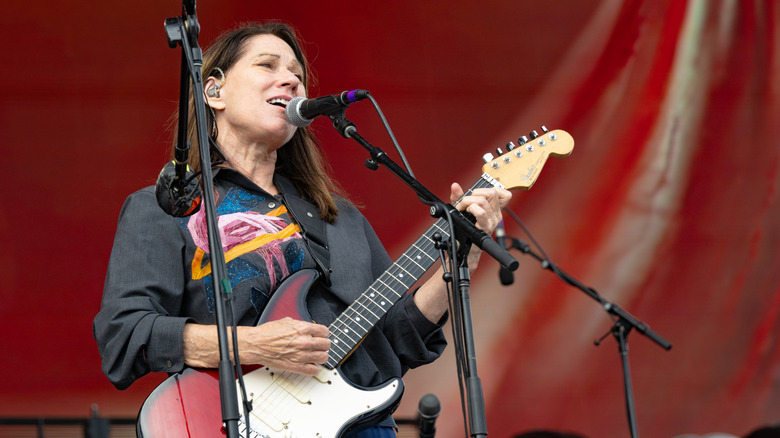
As the face and focus of a rock band, the lead singer gets the lion's share of the accolades and glory. But these musical units have always been more than their frontpeople, and many ensembles have secret weapons: musicians in their ranks who rarely sing lead or grab the spotlight, yet have gorgeous, unforgettable voices. From the '60s to the '90s, these band members have lent crucial harmonies to beloved songs, cut hidden gems, and even helmed outright hits. Without these underappreciated voices, some of the most iconic rock 'n' roll tunes simply wouldn't sound the same.
Freddy Mercury's unforgettable and powerful singing is probably what most associate with Queen, yet some of their most enduring songs needed drummer Roger Taylor's high harmonies, and a few of their classic cuts feature him in front. Bassists Tiran Porter of the Doobie Brothers and Kim Deal of the Pixies similarly filled out classic tracks and had iconic moments in the driver's seats of their bands. And non-lead-singing but central members of both Pink Floyd and Heart were instrumental to both massive hits and criminally underrated classic rock songs.
In assembling this roundup, we wanted truly powerful and exceptional singers — vocalists with range and command, who you'd hire for your band. It's subjective, of course, but while we love Ringo Starr's charming, unvarnished singing on The Beatles' "Yellow Submarine" or Kim Gordon's cool and detached delivery on certain Sonic Youth songs, they're not making this list. What you will find are voices that were load-bearing for beloved songs and that, when called upon by their band members, truly shone.
Tiran Porter — The Doobie Brothers
Bassist Tiran Porter joined the Doobie Brothers in 1971, just in time for their seminal second album "Toulouse Street." On "Jesus Is Just Alright," one of the band's breakthrough songs, his voice blends beautifully with those of Tom Johnston and Patrick Simmons to deliver powerful group lead vocals. He added harmonies to the anthemic choruses of early hits such as "Listen to the Music" and their first Billboard Hot 100 No. 1, "Blackwater." As the band shifted from boogie rock to a poppier sound in the '70s, vocal arrangements remained a big part of the band's sound, and his voice was often in the mix.
However, it wasn't until the Doobie Brothers' 1976 album "Takin' It to the Streets," the first with their second frontman, Michael McDonald, that Porter's singing and songwriting took center stage. On the track "For Someone Special," his rich mezzo tenor pulls on every heartstring. In addressing a friend going through hard times, lyrics like "For the look in your eyes was the same / Empty high that you'd shown" make this one of the Doobies' heavier, more emotional songs.
Porter also takes the reins on "Need a Lady," off 1977's "Livin' on the Fault Line." Extra impressive here is that it's a bass-driven song, with his own playing forming a bedrock for his seductive croon: funky meets smooth. In a band with many great singers at the helm during their voyage — McDonald, Johnston, and Simmons — Porter found ways to stand out.
Richard Wright — Pink Floyd
Keyboardist Richard Wright's atmospheric playing and sonic textures are essential features of Pink Floyd's groundbreaking psychedelic sound. One of the band's founding members, he co-wrote several of the band's masterpieces, including "Interstellar Overdrive" and "Shine on You Crazy Diamond," but often underappreciated were his high harmony vocals and occasional turns in front. His voice blends beautifully with Pink Floyd's first frontman, Syd Barrett, singing co-leads on "Astronomy Domine," the opening track of "The Piper at the Gates of Dawn." And his ethereal harmonies with David Gilmour on "Echoes," the closer of 1971's album "Meddle," add to the haunting textures of the over-23-minute prog-rock epic.
Listening to the scattered tracks that Wright does sing lead vocals on, you fully appreciate what he brought to the table. On one of his own compositions, "Remember a Day" off the 1968 album "A Saucerful of Secrets," his mellow tenor perfectly matches the song's dreamy, psychedelic overtones. And on "Division Bell," the band's 1994 return to form, he sings in a huskier, lower register, gorgeously complementing Gilmour's guitar riffs.
Aside from a spell in the early '80s, when Roger Waters kicked him out before he also left the band, Wright's contributions to Pink Floyd were consistent and impressive. "Rick's enormous input was frequently forgotten," read David Gilmour's statement following Wright's death in 2008 (via The New York Times). "He was gentle, unassuming and private but his soulful voice and playing were vital, magical components of our most recognized Pink Floyd sound."
Kim Deal – Pixies
Bassist Kim Deal held down the low end of the highly influential alternative rock band, the Pixies. While guitarist and singer Charles Thompson, aka Black Francis, wrote most of their material and was their lead voice, Deal's vocals added breadth and character to their surf-punk-meets-indie-rock sound. Whether adding "oohs" to the verses of "Where Is My Mind?" or filling out the titular chorus of "Here Comes Your Man," her breathy soprano served as the perfect contrast to Francis' whispers, growls, and yowls.
Many Pixies fans got to know Deal's singing on "Gigantic," which she co-wrote with Francis, off their 1988 debut full-length "Surfer Rosa." With lyrics that deal in sexual innuendo and desire — and ferocious choruses — the song grazed the U.K. singles charts, reaching No. 93, and became a college radio staple in the U.S. Among her admirers was Kurt Cobain, who admitted that Nirvana's "Smells Like Teen Spirit" was his attempt to mimic the Pixies' loud-quiet-loud song structure. "I wish Kim was allowed to write more songs for the Pixies," he told Melody Maker (via Live Nirvana!) in 1992, "because 'Gigantic' is the best Pixies song ..."
When Francis announced that the Pixies broke up in 1993, Deal was already writing, playing guitar, and singing in the Breeders. In that group, which rode the alternative rock wave that she'd helped kick off, her voice truly soared.
Roger Taylor — Queen
Without Roger Taylor's ringing contra tenor and falsetto, we wouldn't have the iconic operatic breakdown of "Bohemian Rhapsody" and, by extension, one of the most unforgettable scenes in "Wayne's World." In fact, the Queen drummer was the only one in the group actually able to hit the essential very high "Galileo" responses in the third verse. "It seemed to go on forever," Taylor recalled of the recording sessions to Rolling Stone. "The way we would do it, all three of us would sing every part, which gave it a real thickness, a body." Whether singing backup or taking the occasional lead — often on songs he wrote — Taylor's shimmering voice added layers and depth to the classic rock giants' output.
While it's fair to say that no one in Queen could hold a candle to Freddy Mercury as a singer, the quality of Taylor's voice is different. His vocal range is higher, and his delivery oscillates between ragged and pristine — perfect to back up the band's iconic frontman. And when given lead vocal duties — most notably on the mid-tempo rocker "I'm In Love With My Car" — he always put his own stamp on the sound. On "The Loser in the End" from the LP "Queen II," Taylor's voice erupts into an almost Robert Plant-like "Ooh-ooh, ooh we hear you talking now" right before a Brian May guitar solo. It's pure and uncut rock 'n' roll.
Nancy Wilson – Heart
With one of the most beautiful voices in rock history, Ann Wilson was undoubtedly the focal point of Heart, but the band always revolved around her collaboration with her younger sister, guitarist and vocalist Nancy. The siblings co-wrote the bulk of the classic rock outfit's original material, including their iconic '70s hits "Crazy On You," "Barracuda," and "Magic Man." In addition to supplying crucial harmonies, Nancy would occasionally take over lead vocal duties, yielding not only a few hits, but also some of the band's most interesting and evocative material.
Her first foray into lead singing came on "Treat Me Well," off Heart's legacy-making second album "Little Queen," released in 1977. Showcasing the band's mellower, folkier side, Nancy's singing is calm and cool, lending a detached, mournful quality to a song about anxiety within a relationship. The way she delivers lines like "Now what good does feeling strong do / When I am here without you?" gives us goosebumps every time. And as the band pivoted to a more produced, glam rock sound in the '80s, her vocals powered "These Dreams," the band's first No. 1 on the Billboard Hot 100.
On every song that the Wilson sisters sang together, you can hear the deep bond between them. There's something about siblings making music together. "[T]he true artistic center is our blood relationship, the calm eye of the hurricane," Wilson remarked in an interview in Oldster. "Everything else is just chaos sometimes, but the creative center is strong, peaceful, and magic."