

5 Love Songs That Nearly Broke The Musicians Who Made Them
Sappy, overly emotional love songs are a dime a dozen. But amidst all the pursed brows, quavering voices, and hands reached towards the sky, some singers really, really feel what they're singing. Sometimes, they feel it so much that it nearly breaks them. This could happen while singing a swooning, sweeping ballad about florid and romantic feelings, yes, but also tried-and-true breakup songs, songs about love grown entangled and complex over time, songs of love from parent to child, or even songs of love between people and a public figure, including a singer.
When choosing love songs for this article, we're going to keep things open to all of the above possibilities. Our task is a bit difficult because we're talking about songs from the perspective of the writer or performer, not the listener. No one has precise, perfect insight into how a song makes an artist feel because artists are, by definition, performing. But, we can take knowledge of the topic that inspired the song into account, plus testimonials from artists regarding their feelings, and perhaps most importantly, what we see when a singer is performing.
In a case like Sinead O'Connor's "Nothing Compares 2 U," the song's entire, close-up video hinges on the evolution of O'Connor's moment-to-moment feelings, right down to her tears. In other cases, like Eric Clapton's "Tears in Heaven," Slowhand keeps his feelings in check. But, considering that the song was written in honor of his dead 4-year-old son, it would be a mistake to think that he isn't undergoing a hurricane of emotions. Other songs reflect the bittersweetness of love lost ("Someone Like You" by Adele), love losing its luster ("Both Sides Now" by Joni Mitchell), and more.
Nothing Compares 2 U — Sinéad O'Connor
Few music videos could be as iconic and memorable as the late Sinéad O'Connor's "Nothing Compares 2 U," released in 1990. And we say video as opposed to song, because the song and its video are all but impossible to disconnect from each other. The video is basically a five-minute, unmoving close-up of O'Connor's face as she shifts from feeling to feeling, lockstep with her delivery of the song and its lyrics. The video, which went on to inspire later artists like Miley Cyrus in her "Wrecking Ball" video, demonstrates precisely how deeply O'Connor felt what she was singing, even to the point of breaking down and crying.
We know that O'Connor wasn't one to feign emotions or fake anything, for that matter. Her infamous 1992 SNL performance led to a lifetime ban because she tore up a picture of Pope John Paul II on live TV. In other words, either O'Connor 100% felt the tears that she eventually cried during the video for "Nothing Compares 2 U," or she was an exceptional actress. This is quite the feat, either way, because O'Connor didn't even write "Nothing Compares 2 U;" Prince did in 1984.
But, Prince was happy for O'Connor, whose rendition of the song stayed at the No. 1 spot on the Billboard Hot 100 for four weeks and earned her a Grammy (that she rejected). Still, O'Connor felt connected to the song, telling The New York Times in 2021, "As far as I'm concerned, it's my song."
She said one part really resonated, reminding her of her mother, who died when O'Connor was just 18: "All the flowers that you planted Mama/In the backyard/All died when you went away." O'Connor said, "Every time I perform it, I feel it's the only time I get to spend with my mother and that I'm talking with her again. There's a belief that she's there, that she can hear me and I can connect to her."
Tears in Heaven — Eric Clapton
From the very first time that Eric Clapton performed "Tears in Heaven" live in 1992, it was clear that the song was a masterpiece of immediate, moving, and haunting beauty. But when we remember that Clapton wrote the song following the death of his four-year-old son the year prior in 1991, one wonders how Clapton even got through the song once.
When Clapton's son, Conor, fell through an open window on the 53rd floor of his apartment building, Clapton rushed into a scene of ambulances and fire trucks as though he'd "walked into someone else's life," per Biography. The grief was so profound that he shut off, isolated himself, and during his period of recovery wrote the first verse of "Tears in Heaven." He never intended for the song to be anything but private. But, because work must go on, he was also writing music for the soundtrack to the 1991 film, "Rush," at the time. Co-writer Will Jennings encouraged Clapton to include "Tears in Heaven" on the soundtrack, and the rest is history.
While it should be obvious that writing and performing "Tears in Heaven" nearly broke Clapton — or rather, the death of his son did — Clapton implied as much in 2004. Speaking to the Associated Press and quoted on Today, he said that he has to feel the feelings of a song in order to be able to play it. But, he stopped playing "Tears in Heaven" and "My Father's Eyes" — also about his son's death — that year because he "didn't feel the loss anymore." This, too, is part of grief. All of us listeners, however, can still feel the loss anytime we hear "Tears in Heaven."
Candle in the Wind — Elton John
It only takes one look at Elton John's face during Princess Diana's 1997 funeral to know that he was marshalling every ounce of composure to hold it together. As Ultimate Classic Guitar quotes him, he just kept thinking to himself, "Don't break down and just do it to the best you can possibly do it without showing any emotion whatsoever."
Diana had died a mere two weeks earlier, the U.K. was reeling, and a million teary-eyed people lined up to view Diana's funeral procession. It was in the middle of this maelstrom of circumstances and feelings that John played his memorial version of "Candle In the Wind" for the first and last time, publicly. As he later said, "Unless I'm specifically asked by either her family or her children, I think it's time to put it to rest. I don't want to keep evoking that memory" (per Ultimate Classic Guitar).
Realistically, John was able to play "Candle In the Wind" so well and on such short notice because he reworked the song from an earlier 1973 version. That version, from his album, "Goodbye Yellow Brick Road," was about Marilyn Monroe and started with, "Goodbye, Norma Jeane" (Monroe's birth name) rather than "Goodbye, England's Rose." Co-written with Bernie Taupin, this earlier version was originally meant to be about actor Montgomery Clift, who died suddenly in 1966, but Taupin thought that Monroe's fragile-seeming public persona better suited the "candle in the wind" hook. Fast forward almost 25 years, and Taupin re-wrote the lyrics to suit Diana, such as, "You called out to our country / And you whispered to those in pain." Not only did John feel it, but so did the world.
Someone Like You — Adele
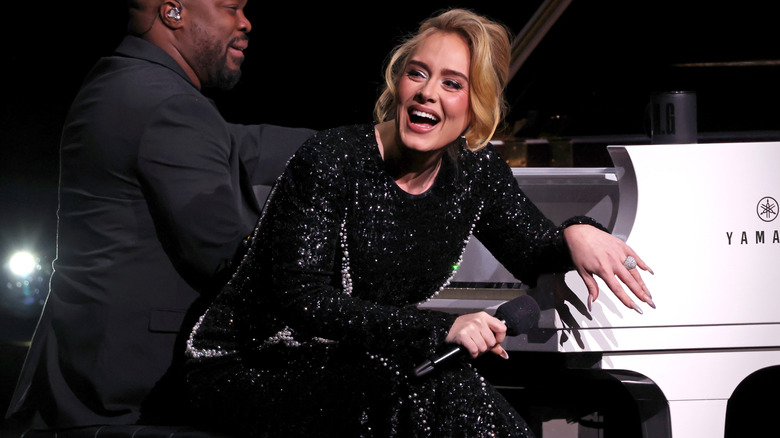
Few artists in recent memory moved people like Adele, who at the time of writing is the 46th most listened to musician in the world on Spotify. But as often as Adele moved others, she herself was moved. The internet is full of clips of her coming to tears during performances, like when her son saw her in concert for the first time in 2016. But in many of these cases, it wasn't just the song that moved Adele. It was how the audience responded to her and her authenticity, a dynamic which we could argue underpinned Adele's entire success.
In no concert was this more evident than at one of her last, highly emotional 2024 concerts in Munich — her last for "an incredibly long time," at least, as Gulf News quoted her. During the final chorus of "Someone Like You," Adele hands over the mic, so to speak, to the audience and promptly starts crying at the sound of the stadium singing her song. The same thing was caught on video during a 2022 Hyde Park performance in London. In this song's case, "Someone Like You" is already deeply personal and confessional. But when the focused energy and feelings of Adele's crowd get added to the mix, lines like "I wish nothing but the best for you, too," might have taken on more universal meaning outside of the song's lost love story.
Indeed, we know that Adele poured her heart and soul into her music and vocal delivery, which is why her "tank is quite empty," as the BBC quoted her in 2024. Perhaps when the tank gets full, fans might get to sing and cry with her again.
Both Sides Now — Joni Mitchell
When a nearly 80-year-old person sings, "It's love's illusions that I recall / I really don't know, I really don't know love at all," it's time to pay attention. When that person is legendary singer-songwriter Joni Mitchell, you'd better pay extra special attention, especially when she sings those lines at a surprise 2022 set at the Newport Folk Festival. When she does so after a 20-plus year hiatus from performance and following a 2015 brain aneurysm that left her unable to walk or talk, let alone play the guitar or piano, you know you're witnessing a historic moment. And when she chokes up and her voice tapers off towards the end of "Both Sides Now," the song that included the above lyrics, you know you're seeing something that you won't see again.
All of this happened exactly as written. While Mitchell did break down any time she tried singing "Woodstock," a song about universal, human love named after the 1969 festival that she was unable to attend, the impact of an elderly Mitchell getting emotional while singing is too powerful to not choose for our article. This is especially true because she was singing a song that her 21-year-old, extremely precocious self wrote. That's quite a feat for a song that muses on how disillusionment over time impacts one's ability to love.
It's no wonder that Mitchell choked up while singing "Both Sides Now" in 2022, no matter that her sunglasses shielded her eyes and such feelings from view. She didn't fully break down and weep, but that would have been a bit on-the-nose, anyway. It's hard to imagine exactly what she was going through, though.