

The 5 Biggest Grammys Snubs Of The '70s
In the 1970s, the Grammy Awards mostly got it right, recognizing the timeless efforts of the most important musicians of the era — except when it didn't, and egregiously snubbed more deserving acts. The Grammy Awards are annually handed out to the parties responsible for the previous year's greatest songs and albums, according to a voting body of music industry professionals. Every list of annual Grammy winners becomes a time capsule of what music was most popular at that moment in time — but that doesn't mean it's an accurate predictor of what award-winning songs will remain in the collective public consciousness.
For example, so many Grammy Award for Best New Artist winners turned out to be one-hit wonders who ultimately vanished, while the hype and momentum for some artists factored prominently in voters' minds at the time, dooming what time and reputation would later declare to be the most obvious and rightful winner. It seems like in the '70s, voters from the Recording Academy often checked the box next to the name of the biggest hit, the entries most representative of passing and dying fads, or those contributed by the biggest stars of the past, thereby failing to reward innovation or recognize progress. Here are five of the worst Grammy snubs from the 1970s, when the award voters just couldn't seem to consistently get it together.
When Debby Boone and Barbra Streisand crowded out the rockers
The 1978 Grammy Awards Song of the Year category – a prize for the songwriters — resulted in a rare tie, but neither of the winners were whom history or contemporaneous relevance would suggest they should've been: rocker-turned-country star Glen Campbell or Rock and Roll Hall of Fame member Carly Simon. Voters instead split the prize between two corny, overwrought, and generic love ballads from movies that were basically forgotten by the end of the '70s. Song of the Year went to Paul Williams and Barbra Streisand for the latter's "Evergreen (Love Theme from 'A Star is Born')" and Joe Brooks for Debby Boone's take on "You Light Up My Life," a love song that held the No. 1 spot the longest in 1977.
Left behind as losers were a few other songs that have been immensely more well-received and remembered since the late '70s, such as "Southern Nights," a glitzy and joyful bit of rock-inflected country written by R&B legend Allen Toussaint and popularized by Campbell, which presaged the coming country-pop crossover boom and topped the Hot 100 in 1977. And then there was Simon's anthemic and sexy James Bond movie song "Nobody Does It Better, one of the quintessential '70s singer-songwriter's biggest hits ever.
Those two winning dreary and mawkish ballads also defeated the Eagles' delightfully inscrutable and eternal rock classic "Hotel California," but at least that one grabbed the Record of the Year Grammy.
When Boston lost Best New Artist
The story of the band Boston begins with a rapid ascendance to fame, the kind that often and deservedly results in a Best New Artist win. But Boston didn't secure that Grammy, nor any others, ever. The group released its first, self-titled album in 1976, which rapidly became the greatest-selling debut LP so far. Virtually inventing the genre of arena rock — soaring, acrobatic vocals matched with thundering drums, hook-laden rhythm guitar parts, and blistering lead guitar solos — "Boston" sold over 17 million copies and generated hit singles still played on classic rock radio today, such as "More Than a Feeling" and "Peace of Mind."
By any metric, Boston was the biggest new band in the country in 1976, and when the Grammy nominations commemorating that year were announced, it indeed scored one for Best New Artist Of The Year. Boston looked like a lock to win, especially considering the mostly lackluster competition, which included disco-funk one-hit wonder Wild Cherry and the novelty act Dr. Buzzard's Original Savannah Band, the latter of which melded big band music with disco. But the winner of the category? Not Boston. The Best New Artist prize went to the Starland Vocal Band, a weird four-part singing group and one-hit wonder with "Afternoon Delight," a creepy and off-putting song about daytime lovemaking.
Robert Palmer lost a rock Grammy to a non-rock song
With the 1980 ceremony, the Grammy Awards had one last chance to recognize the monumental music of the 1970s. In honoring the best of 1979, the Recording Academy finally acknowledged that rock 'n' roll, around since the mid-1950s, was here to stay, and instituted the first categories specifically for that genre. In the Best Male Rock Vocal Performance in particular, it could've nailed the landing and awarded the win to Robert Palmer, one of the best singers in the game. Instead, voters went with the biggest name on the ballot, who didn't deserve the victory.
The nominations for Best Male Rock Vocal Performance were all over the place. Rod Stewart received a nod for the '50s throwback "Blondes (Have More Fun)," and iconoclast Frank Zappa was recognized for his non-rock disco-satirizing "Dancin' Fool." The song that actually rocked, and which boasted a stellar vocal performance, was Robert Palmer's hard-charging, blistering, and soulful masterpiece of a single, "Bad Case of Loving You (Doctor Doctor)."
However, the guy that won out in the category was Bob Dylan for "Gotta Serve Somebody," taken from one of his least critically adored albums, "Slow Train Coming." Written and recorded during Dylan's brief era as a purveyor of spiritual music, "Gotta Serve Somebody" is a little bit gospel set to a jazzy-disco backbeat. Voters likely wanted to pay tribute to an influential figure like Dylan, since "Gotta Serve Somebody" isn't even a rock song, unlike Palmer's track.
Joni Mitchell lost her only shot at Record of the Year
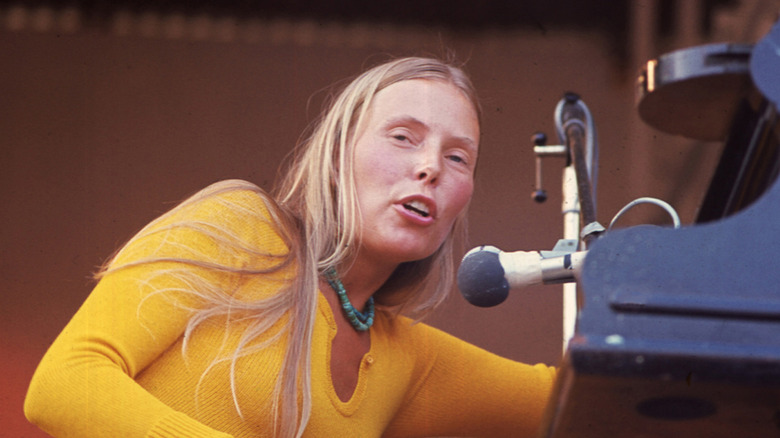
Joni Mitchell has won 10 Grammy Awards over the course of her long and influential career, but never on her own in a major category. Furthermore, none of her classic songs from the 1960s and 1970s, when she was among the premier and most influential singer-songwriters of her generation, ever took home the coveted Record of the Year prize. She was never nominated for "Big Yellow Taxi," "Free Man in Paris," or "You Turn Me On, I'm a Radio," but she finally scored a nod in 1975 for "Help Me," the only single Mitchell ever took to the Top 10. It's a standout on Mitchell's classic and universally acclaimed 1974 album "Court and Spark."
A timeless and complex love ballad characterized by Mitchell's honest and layered songwriting, with some of the performer's best examples of her signature and distinctive vocal theatrics, "Help Me" still couldn't win Record of the Year. Instead, Grammy voters gave the trophy to Olivia Newton-John's "I Honestly Love You," a vaguely country ballad so slow and sleepy that it barely gets started, and so generic that it's been totally forgotten in the wake of Olivia Newton-John's shift to pop just a couple of years later with the "Grease" and "Xanadu" soundtracks.
Two new wave legends lost Best New Artist to a disco also-ran
Ideally — and logically — the Grammy Award for Best New Artist should go to acts on the cutting edge of the musical vanguard, those that will dictate what pop and rock will sound like in the coming years. In the late '70s, voters should have bestowed the prize on an artist from the new wave, an all-encompassing musical trend that sped up the demise of disco. Instead, at the 1979 Grammys, voters honored a minor player in that dying dance craze.
New wave came along in 1978, and the music world couldn't stop raving about it, with fans and writers dazzled by the rock sub-genre's merging of punk attitude with early rock 'n' roll simplicity and hooks and, more often than not, keyboards. When it came time to nominate the recordings of 1978 for the 21st Annual Grammy Awards, two of the most important and popular new wavers received a nomination for Best New Artist: Elvis Costello and the Cars. But neither of those groups, which would go on to shape rock in the '80s, won — A Taste of Honey did. That group would only ever score two Top 40 hits, and it secured its major Grammy on the strength of its silly dance smash "Boogie Oogie Oogie."