

Bizarre Things That Never Made Sense About The Karen Read Case
If you talk only to people on one side of the Karen Read case, it may seem obvious what happened. But talk to another group, and it may seem that something entirely different occurred the night that Boston police officer John O'Keefe died. The bare bones of the case: In January 2022, O'Keefe met his end after a night of drinking. His body was found in the snow outside the home of Boston police officer Brian Albert early the next morning. A broken cocktail glass and pieces of a vehicle taillight were found on the scene, while physical evidence on O'Keefe's body indicated that he experienced major cranial injuries and hypothermia, along with other, more superficial wounds.
But how did he get those wounds? Whose taillight was that? How did partygoers in the Albert home repeatedly miss seeing O'Keefe as he lay dying in front of the house? In the two trials that followed — the first, in 2024, ended in a mistrial — the prosecution alleged Karen Read had let her boyfriend O'Keefe out, hit him with her SUV, and driven away. The two did have a tumultuous relationship that, fueled by alcohol, may have ended in one final, violent argument.
Read's defense team argued that O'Keefe died otherwise, even suggesting he was involved in a fight in the home and that evidence was covered up. In a 2025 retrial, Read was found not guilty of second degree murder. Despite the jury's verdict, some lingering facts of the case and the actions of those involved remain deeply confusing.
One key statement can be interpreted in multiple confusing ways
In the immediate aftermath of a deadly accident or crime, anyone involved may find themselves in a state of shock. Perhaps there's some truth to the notion that a guilty party may tell on themselves in such a state, but that doesn't necessarily hold up in the case of Karen Read. Yes, it appears that Read repeatedly said, "I hit him," as Katie McLaughlin, a paramedic who was among the first responders on the scene, testified at the 2025 trial. As McLaughlin recalled, Read repeated this seemingly incriminating phrase multiple times. Yet, as the trial wound on, it became less and less clear just what Read was thinking when she uttered those words. McLaughlin noted that she did not ask Read to specify just what she meant, given how upset Read appeared at the time.
This left room for a surprising amount of interpretation. Did Read mean she hit John O'Keefe with her car? Or could she have been referring to some other incident in their often-antagonistic relationship, perhaps when she may have slapped or punched him? It appears also that Read was initially asking if she was possibly to blame. "Did I hit him? Could I have hit him?" she asked, at least as witness Jennifer McCabe testified. The transformation of Read's words from question to statement introduces even more uncertainty into the situation.
O'Keefe's injuries don't necessarily add up

One of the key sources of physical evidence — John O'Keefe's body and the injuries it bore — generated more questions than answers. At Karen Read's second trial, medical examiner Dr. Irini Scordi-Bello, who performed the autopsy on O'Keefe, testified that she concluded he experienced blunt force trauma to his head. That, combined with hypothermia, led to his death. Scordi-Bello noted that none of this meant she knew how O'Keefe received that trauma — that's the difference between cause and manner of death — and therefore she couldn't rule it a homicide. She did tell the jury that she did not find evidence of injury to his legs, common in vehicle strikes. Meanwhile, she said that a laceration to his right eyelid wasn't necessarily consistent with someone falling backward and striking their head.
Wounds to his O'Keefe's generated even more confusion. Some have suggested that these were caused by a German shepherd at the Albert residence, including dog bite expert Dr. Marie Russell, who told the jury at Read's retrial that, in her opinion, the wounds "were inflicted by the teeth and claws of a dog" (via CNN). Yet Dr. Russell was a first-time expert witness on dog bites, and DNA sampling from O'Keefe's clothing found no dog DNA. However, the sampling did uncover pig DNA, a truly bizarre finding that introduces doubt by undermining trust in the sampling process and highlights how strange and confusing the physical evidence surely seemed to the jury.
How did so many witnesses miss seeing O'Keefe?
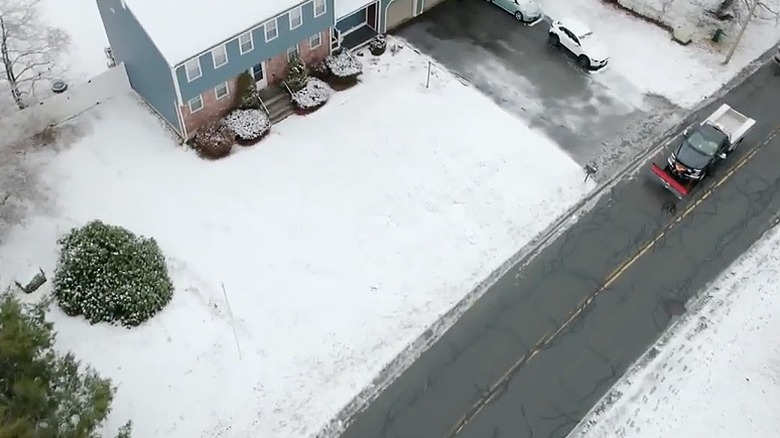
Despite the intoxicated nature of the night on which John O'Keefe died, it seems odd in the extreme that no one in or around the Albert home spotted his body until it was far too late. Whatever happened to O'Keefe, we definitively know that his body ended up in the driveway of the Albert home (pictured), very close to where multiple people entered and exited the house over the next few hours. At least six known people left the home over the course of a few hours and would have passed very near O'Keefe, yet none recalled seeing anything beyond one witness's very vague report of a "black blob" toward the end of the driveway. Likewise, a snowplow driver — whom one presumes would have no connection to anyone at the scene and no interest in lying to authorities — also failed to spot O'Keefe while he passed by that morning.
Perhaps the combination of the group's drinking and the accumulating snow really did make it so multiple people walked past a dying person without knowing it. If, as some witnesses claim, O'Keefe never entered the house at all, it may be all the more likely that the deadly incident and its aftermath were missed almost entirely. But it's still struck many as odd that such a group could still have missed so many cues that O'Keefe was there, leaving him to remain in the driveway for as long as he did.
Evidence collection was odd in the extreme
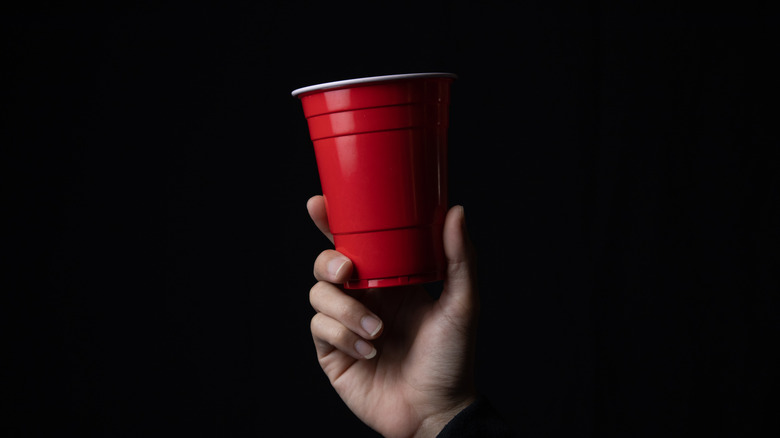
It's not as if most people really expect police evidence collection to be some sort of high-tech affair, but the way in which evidence was taken from the scene of John O'Keefe's death has struck many as odd indeed. Evidence collection vessels included paper grocery bags and red Solo cups, which were apparently borrowed from a nearby household when the police had no collection materials of their own. Meanwhile, one officer used a leaf blower to clear snow and search for evidence, striking many as unusual and potentially entering the whole affair into the list of botched police crime scene investigations.
Lt. Paul Gallagher, formerly of the Canton Police Department, was in charge of evidence collection at the scene. When called to account for the rather unusual investigatory methods at Karen Read's 2025 trial, he justified the use of the leaf blower because he was concerned that using a snow shovel would disturb evidence. He also argued that grocery bags weren't all that different from standard police evidence bags, but it wasn't entirely clear why he didn't have evidence bags in the first place. Upon further questioning, Gallagher blamed his unorthodox materials decisions on the snowy blizzard conditions and confusion as to whether or not O'Keefe's death might be due to accident or murder. Read's defense also pointed out potential problems with the odd evidence collection, including a shaky chain of custody and allegations that samples in the Solo cups may have been contaminated.
Why was the Albert residence never properly searched?
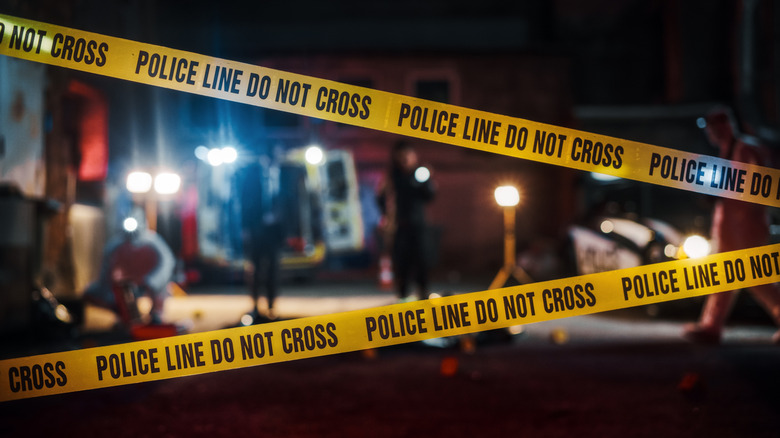
One might expect that the police team sent to investigate the scene would have searched inside the Albert home. Yet, at no point did investigators search the residence for additional evidence. Furthermore, some felt that suspicions were raised considering that homeowner Brian Albert was a Boston police officer (who has since retired from the department). Police seemed initially indifferent about Albert's German shepherd dog, which may or may not have made wounds observed on John O'Keefe's arm. Neither does it seem to have raised any comment when the same dog was rehomed months later.
This was, of course, a matter that came up for questioning during Karen Read's 2025 trial. Lt. Paul Gallagher, the Canton Police officer who led the crime scene investigation (and who has also now retired), told prosecutors that he never pursued a search warrant or even asked Albert for permission to search the home and check for common crime scene hallmarks. Gallagher claimed that he had no basis for getting a search warrant, given the lack of evidence that O'Keefe had entered the home. Neither did he or any officers who stepped into the house spot anything awry. "I have a good faith obligation to present the truth to a judge" who would sign a warrant, he said (via NBC10 Boston). If he failed to do so, Gallagher said, his professional credibility would be irreparably damaged. For the defense, however, that seemed little more than weak justification for a huge oversight.
Wait, who's Turtleboy?
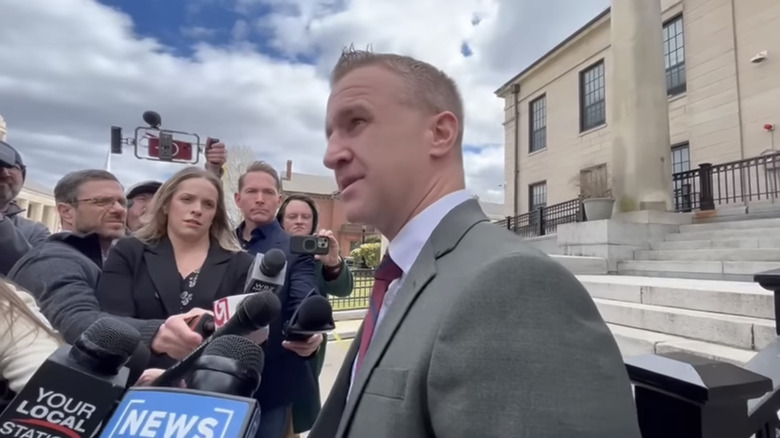
With modern cases, it's often very easy for true crime aficionados to become wrapped up in the proceedings. Some keep their obsession confined to social media, some even become unexpected crime solvers, and others take it too far. That's certainly what the Massachusetts State Police and local courts think about the oddly named "Turtleboy."
"Turtleboy" is actually blogger Aidan Kearney of "Turtleboy News," a Massachusetts-based outlet that avidly followed the Karen Read case. Kearney became an advocate for Read herself and a proponent of the theory that John O'Keefe had been murdered and the crime covered up. To that end, he established a private Facebook group that accumulated tens of thousands of members, who then raised hundreds of thousands of dollars for Read's defense.
If you're sympathetic to Read, that may sound fine, but Kearney also confronted witnesses and even recorded himself doing so. He also allegedly obtained and released sensitive data, including a state trooper's phone number and motor vehicle information. Kearney and his legal team allege that he's just been lawfully investigating and expressing himself as per the First Amendment, while prosecutors say he's guilty of interfering in an investigation and alarming, and perhaps even criminally intimidating, witnesses. Kearney himself has said that "reporting the news is not harassment. Asking questions is not harassment" (via BBC). Still, he was charged with witness intimidation and conspiracy to intimidate. A trial is set for the end of 2026, though a myriad of legal actions can happen before that date that may affect the outcome.
Why does the matter of the taillight remain so confusing?

One of the clear facts of the case is that a taillight on Karen Read's Lexus SUV was broken. But how it was broken and what evidence it's yielded is unclear. More specifically, the right rear taillight showed damage, per Massachusetts State Police Crime Lab forensic scientist Maureen Hartnett's testimony. Hartnett also reported that she saw scratches along with traces of what appeared to be glass and human hair on the SUV's bumper. Another forensic scientist from the same crime lab, Andre Porto, told jurors that DNA found on a broken cocktail glass at the scene belonged to John O'Keefe; two other scientists testified that O'Keefe's DNA was found on taillight pieces recovered outside the home.
This may seem pretty straightforward, but Karen Read's defense team raised questions about the damage and those recovered taillight fragments, even wondering if they could have been planted. Accident reconstruction specialist Daniel Wolfe testified that his tests with a similar SUV produced results inconsistent with the marks on Read's vehicle. However, the prosecution called out Wolfe's use of a lightweight test dummy compared to the heavier O'Keefe.
What's more, that DNA evidence may not have been such a slam dunk; trace DNA was also found on an intact taillight and could have been from O'Keefe ... or one of two other unknown men. Delays in finding the taillight fragments didn't help, and neither did video evidence submitted to the court that accidentally included mirrored footage of the SUV, potentially misleading viewers as to precisely which taillight was broken.
One web search in particular muddies the waters

So, if taillights can be broken otherwise and even DNA evidence can be used in bizarre situations and not always in useful ways, what can be relied upon? A web search may sound likely — after all, digging into the data often pulls up very handy timestamps — but even that has proven oddly contentious in the hands of attorneys at the Karen Read trial. The search in question was done on the phone of Jennifer McCabe, sister-in-law of Brian Albert and one of the group members at the home that night. In fact, McCabe told John O'Keefe where the Albert home was and repeatedly texted and phoned him throughout the night (though McCabe and others claimed the calls were inadvertent "butt dials"). McCabe's search: "hos [sic] long to die in cold." That search was later deleted, though investigators were able to recover it.
Given the state of O'Keefe when he was found, that string of words can be very interesting indeed ... if only investigators could pin down when McCabe typed it in. One analyst testified that McCabe made the search at 2:27 in the morning, well before O'Keefe's body was found. But the prosecution has alleged that the search actually happened about four hours later, after O'Keefe's discovery. McCabe herself testified that Read asked her to make the web search after O'Keefe was found. She also denied making the search in the wee hours of the morning, suggesting that she had conducted the search in an already-opened tab, which accounted for the earlier timestamp.
Why was the lead investigator so free with his opinions that he lost his job?
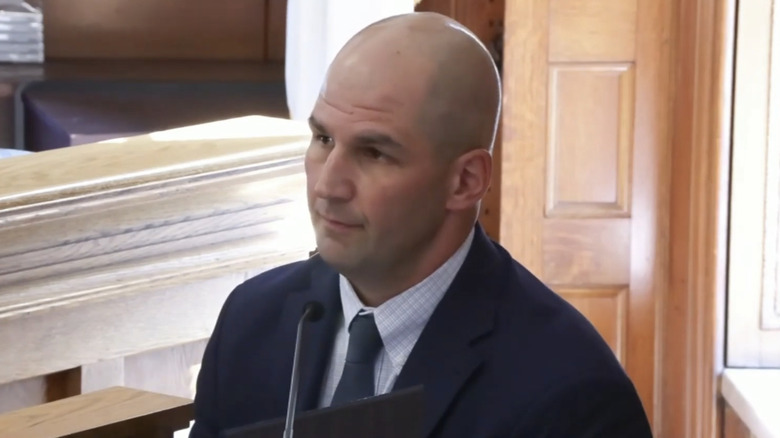
Massachusetts State Police Trooper Michael Proctor was once the lead investigator in the Karen Read case ... at least, until he couldn't stop talking. Proctor not only allegedly contacted non-police friends to relay sensitive information, but he did so on his personal cell phone via text.
In some texts, Proctor discussed his contempt for Read in vulgar terms, even going so far as to wish that she would harm herself. He also used crass language to discuss Read's body and shared an image of her being escorted from a police building. The defense team used this cascade of deeply unprofessional communications (including similar texts between Proctor, his wife, family members, and police colleagues) to lend further weight to the cover-up narrative. After all, they argued, Proctor had colorfully said that she was done for long before trial. If nothing else, it was a sign of blatant bias.
Proctor's behavior was so bafflingly bad that he was not only fired by the State Police, but saw his certification suspended by the state standards and training board in December 2025, meaning he's been barred from working as a police officer in the state. This is quite rare indeed, as a 2020 Boston Globe investigation found that Massachusetts State Police troopers facing potential criminal charges more often kept their jobs. Yet an alleged culture of shielding badly-behaved officers didn't protect Proctor's job, further underlining his bizarrely bad choices.
Do the corruption and conspiracy allegations really make sense?
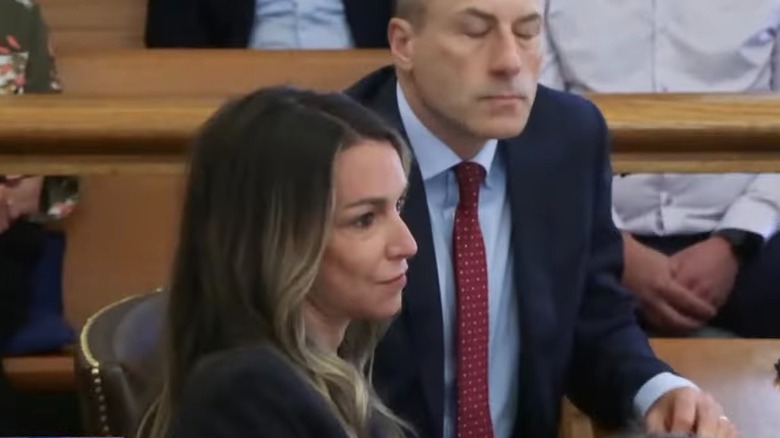
Throughout her two trials, Karen Read's defense team repeatedly argued that there was a conspiracy to frame her, to the point where she filed a 2025 civil lawsuit against both police investigators and some witnesses. But is there any truth to such claims? Like so much else in the case, there are enough confusing details to make either side seem almost reasonable ... or totally nonsensical.
If, as Read alleges, she really did drop off an intoxicated but otherwise whole John O'Keefe at the Albert home and his injuries really weren't consistent with a vehicle strike, then perhaps there's something to the allegations. Indeed, police departments in the Boston area have been linked to shady business before, including the death of Sandra Birchmore, who was also killed in Canton in 2021. In 2024, charges were brought against Stoughton police officer Matthew Farwell, claiming that he killed Birchmore to conceal her pregnancy, then covered up evidence. Farwell was also indicted for the death of Birchmore's unborn child in 2025 and was decommissioned by the state police board that December.
However, in Read's case, the conspiracy allegation demands accepting a scenario filled with unknowns. Brian Albert himself has said that this stretches the bounds of imagination. "You do realize, for this conspiracy to be true, it would take 30 to 50 people," he told ABC Nightline, noting it would have required the collaboration of officers from two departments, civilians, emergency responders, and the medical examiner.