

11 Hidden Truths About Pink Floyd's Dark Side Of The Moon
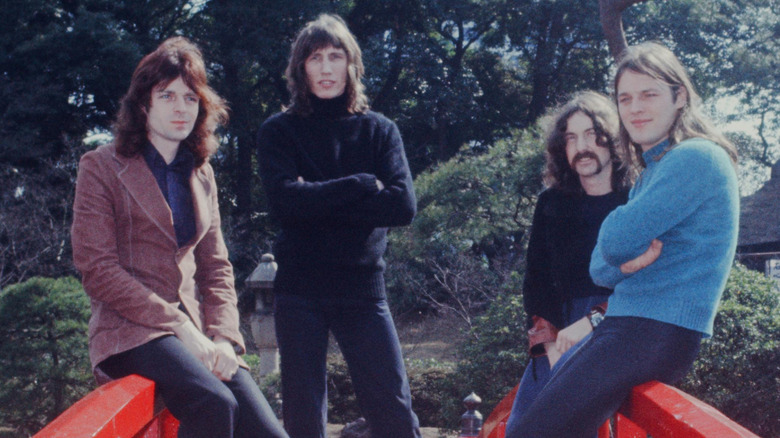
Pink Floyd's classic 1972 album "The Dark Side of the Moon" is among the most progressive, mind-boggling, and mysterious musical works ever released by a rock band. Unsurprisingly, its creation is as shrouded in secrets and complications as its content. After breaking through in the late 1960s as a lightly psychedelic pop-rock band, Pink Floyd quickly evolved into a highly experimental and ambitious outfit under the direction of bassist Roger Waters and guitarist David Gilmour after frontman Syd Barrett left the group. After getting weird on "Meddle," Pink Floyd embraced soundscapes and used the recording studio as a tool to deliver a sprawling and thoughtful piece that expounded on nothing less than the meaning of life. It's also the source of several classic rock staples and some of Pink Floyd's biggest and best-known songs, like "Us and Them," "Time," and "Money."
A peak moment for Pink Floyd, which would later break up after crushing animosity, "The Dark Side of the Moon" resonated with millions despite, or perhaps because of, its strangeness. It's psychologically, artistically, and emotionally alluring, and it took a lot of effort and creativity to craft. It requires a deeper analysis and exploration both because of its popularity and its enigmatic nature. Here's a dive into what might be Pink Floyd's best, most iconic album.
Before it was an album, it was a conceptual performance piece
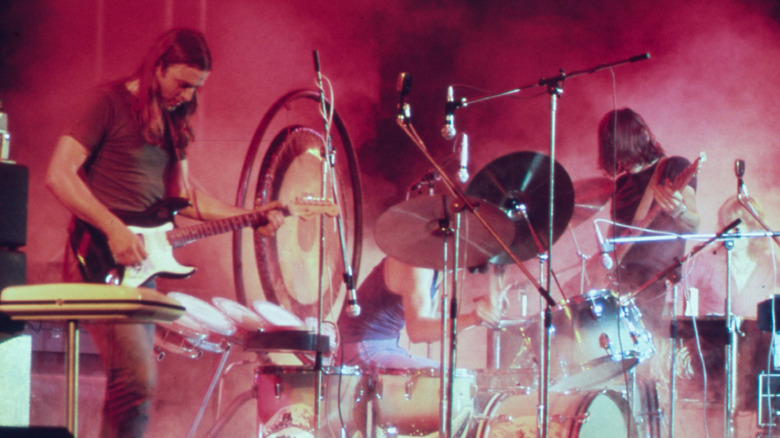
Pink Floyd spent 12 days in 1971 in a London studio to build a multi-part musical project with the working title of "Eclipse" from a collection of old song fragments. "We had quite a few pieces of music, some of which were left over from previous things," guitarist David Gilmour told Classic Rock. "I think we had already started improvising around some pieces," bassist Roger Waters said. He'd already written some lyrics, and from those little bits, a theme had emerged early on: "I suddenly thought, I know what would be good: to make a whole record about the different pressures that apply in modern life."
After jamming and developing the piece for less than two weeks, Pink Floyd was ready to take "Eclipse," retitled "Dark Side of the Moon — A Piece for Assorted Lunatics," on a 16-show tour. The first public performance supplemented the songs with an extensive, electronics-derived stage show replete with lights and effects. Unfortunately, it was a technical disaster — the band called it off after about 30 minutes during the song "Money" due to an abundance of glitches. Pink Floyd kept workshopping the songs during live sets before heading into the studio and formally recording them. One song, "Eclipse," which would've been the title track, was a late-tour addition. "I can remember one afternoon rolling up and saying: 'I've written an ending,'" Waters recalled.
It marked a personal and professional moment of bliss for Pink Floyd
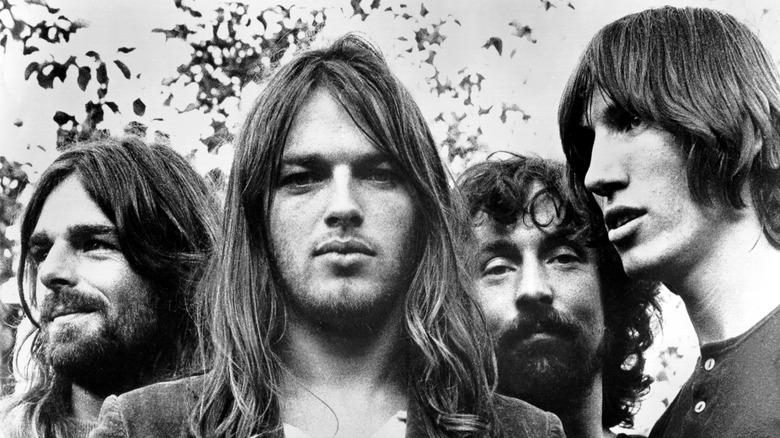
While Pink Floyd gelled the songs that would comprise "The Dark Side of the Moon" on a short tour, it couldn't immediately record them as an LP. Its 1972 was very booked, as Pink Floyd had committed to tours of Japan, the U.S., and Europe and to making the soundtrack album for the film "Obscured by Clouds." In early 1973, the album was finally completed at the Beatles' Abbey Road studios in London.
In a band whose existence was often fraught with creative and personal tension, and despite the dark and despondent thematic content of the material, recording "The Dark Side of the Moon" was a fulfilling period of joy and unity for Pink Floyd. "'Dark Side,' I think it felt like the whole band were working together," keyboardist Richard Wright said in the band-authorized documentary "The Story of The Dark Side of the Moon." "It was a very creative time. We were all very open as well." "All four of us were there, and there was a discussion about putting the album together and making it into this themed, I mean what is now called a concept album," added drummer Nick Mason.
How Clare Torry stole the show and didn't get credit

When Pink Floyd started to record "The Great Gig in the Sky," the all-male band realized it needed a powerful female voice to sing some sensual and operatic runs. Engineer Alan Parsons brought in Clare Torry, who he liked after hearing her album of covers, which included a take on "Light My Fire" by the tragedy-beset band The Doors. Torry needed only three or four takes to complete the assignment, which was to be totally wordless. "They explained the concept of the album to me and played me Rick Wright's chord sequence," she told Classic Rock. "The only thing I could think of was to make myself sound like an instrument." She received a payment of £30, double the £15 session fee she regularly commanded, because the recording took place on a Sunday.
"There was no real direction — she just had to feel it," Parsons told Rolling Stone. And feel it she did. Torry improvised so much of her performance that she felt she'd co-authored "The Great Gig in the Sky" in its final form. In 2004, she sued Pink Floyd, asking for songwriting credit on the song as well as a 50% stake in the copyright and half of all royalties ever generated. After an out-of-court settlement was agreed to by record label EMI, "The Great Gig in the Sky" has since been credited to Wright and Torry.
New techniques were invented for Dark Side of the Moon
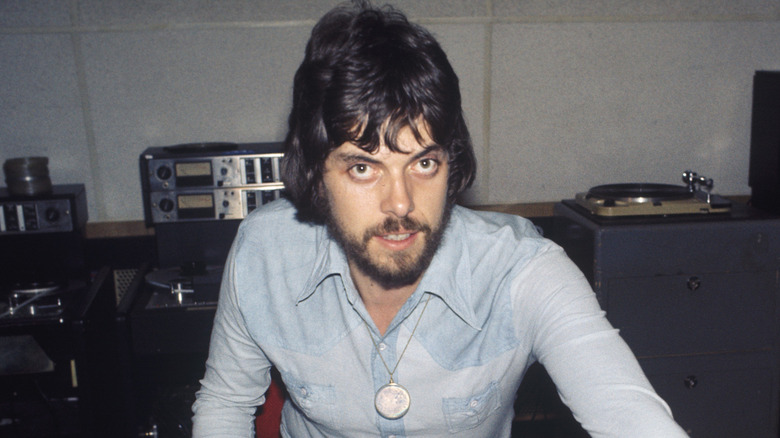
Pink Floyd had big and far-reaching ideas about how "The Dark Side of the Moon" should sound — so ambitious that they challenged presiding recording engineer Alan Parsons. He was up to the task, however, and rather than rely on the old ways, he devised new methods to get the desired effects. To help build the audio chaos of "On the Run," David Gilmour played his guitar with a microphone stand, and then Parsons played the recording in reverse and threw on a delay effect to make it sound like screaming. The creepy footsteps that move in and out of the song were obtained by a studio employee moving around an echo chamber.
"Us and Them" features extensive and haunting vocal echoes, achieved with the use of multiple tape machines. "Every sort of time-based process was done with tape — there were no digital boxes then." Parsons told Premier Guitar. "We might have had as many as five or six tape machines doing various delays, reverb delays, and so on."
Other elements were captured in a much more practical fashion. Notably, the pervasive, money-evoking sound effects on "Money" came courtesy of Roger Waters and Nick Mason. "I had drilled holes in old pennies and then threaded them onto strings," Mason told Classic Rock. Meanwhile, Waters taped himself shaking a bowl full of coins. "The tearing paper effect was created very simply in front of a microphone, and the faithful sound library supplied the cash registers," he explained.
Brain Damage is about Syd Barrett
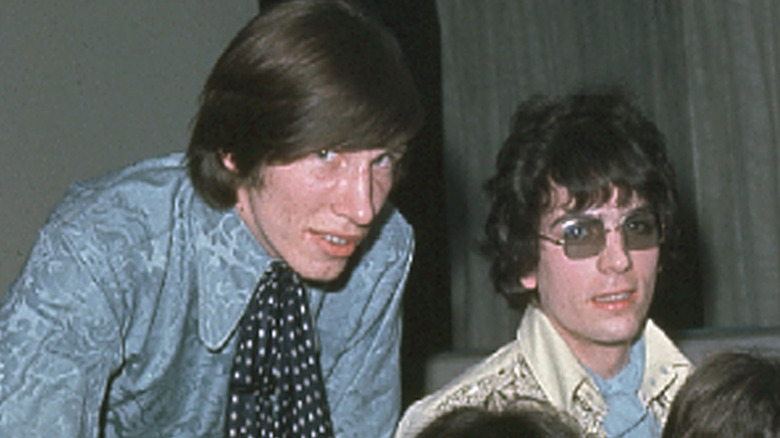
When the members of Pink Floyd gathered in the studio to record "The Dark Side of the Moon," founding frontman and songwriter Syd Barrett had only been forced out of the group about four years earlier. He was unable to create or perform at a high level due to extensive drug use and a schizophrenia diagnosis, much to the frustration of his bandmates. "We had a style: 'Ignore it,'" Nick Mason told Mojo. "Finally we ignored it by not picking Syd up one day. I remember the relief, after Syd had gone."
Barrett had retreated into obscurity and private life, and the rest of Pink Floyd missed him and worried about him while also processing their complicated feelings on "Brain Damage." Roger Waters had created the track (under the name "Lunatic") while recording the band's previous studio album, "Meddle," and it was very much at home on the introspective "The Dark Side of the Moon." "There was a residue of Syd in all this," Waters said. "When you see that happening to someone you've been very close friends with, it concentrates one's mind on how ephemeral one's sensibilities and mental capacities can be."
On the Run was written on the fly
"On the Run," a bewildering and futuristic musical odyssey, is both a pre-"Dark Side of the Moon" sessions song and one that would come together in its polished, finished, and fully artistically realized version after some extensive in-studio tinkering and evolution. When recording on "The Dark Side of the Moon" began, Roger Waters brought to the rest of Pink Floyd a piece called "The Travel Sequence," an instrumental with flourishes of jazz and rock that sounded like a generic jam session. It wound up with a sound awash in electronics, a fairly alien approach and result in 1972.
Responsible for the transformation: Waters got his hands on an EMS VCS3 model synthesizer, an early analog version of the electronic, piano-derived instrument that would help define Pink Floyd's sound in the years that followed. "It's a danger that we could become slaves of all our equipment," Waters said in "Pink Floyd: Live at Pompeii," hinting at some apprehension about embracing new technology. "But what we're trying to do is sort it all out so that we're not. It's just a question of using the tools that are available when they're available."
Those interviews are real
One of the most striking and novel elements of "The Dark Side of the Moon" isn't even musical: Pink Floyd laced spoken-word portions throughout the record. The speakers weren't identified on the recordings or credited in the LP's liner notes, but they're all real people, providing their off-the-cuff answers to some of life's big questions and some provocative ones, too. It was one of the last things recorded for "The Dark Side of the Moon," and it was primarily Roger Waters' idea. "We did about 20 people," the bassist told Classic Rock. "The interviewees all had cards with questions printed on them like: 'Have you ever been violent?', 'When was the last time you thumped someone?' and 'Were you in the right?' and so on."
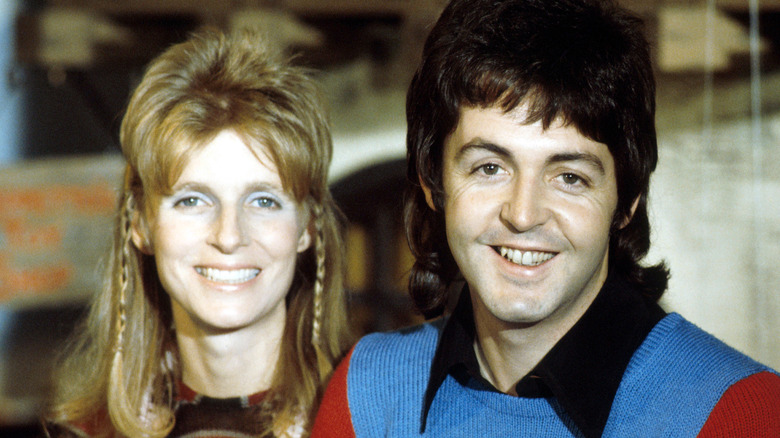
Waters wanted to include anyone in the band's orbit during production of "The Dark Side of the Moon." They talked to studio staffers like doorman Gerry O'Driscoll; Pink Floyd roadies like Chris Adamson and Roger Manifold; partners of roadies; and guests who swung. Notably, they also interviewed Paul and Linda McCartney, who were in the same complex recording an album by Wings, one of the most important rock bands of the 1970s. The McCartneys' recorded replies didn't make it into the final cut, though — Waters determined that the former Beatle tried to give a humorous response, and it didn't fit the tone of the project.
The cover is iconic
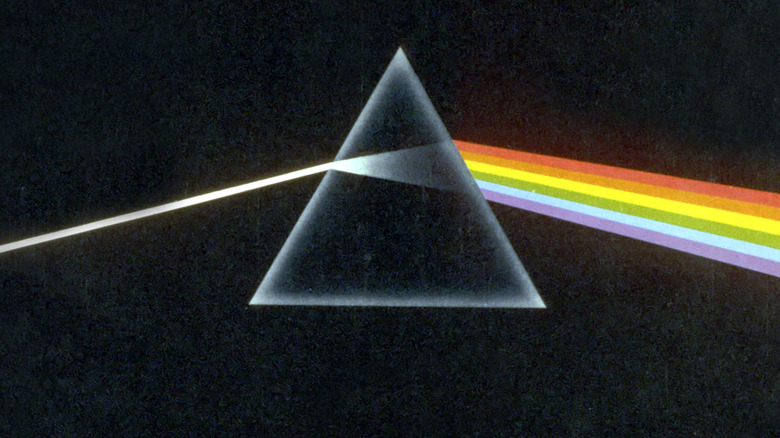
The album cover of "The Dark Side of the Moon" is as simple as it is world-famous. On a black background, a beam of light shines into a triangle, which is actually a prism because it transforms the white line into a vibrant rainbow. It was designed by Storm Thorgerson, Pink Floyd's preferred graphic designer and frequent visual collaborator. The band got the artist started on the cover before it was done with the LP, playing Thorgerson a portion of it. "I never say anything, really, about the music," he told Rolling Stone. "I just let it go over, really, I suppose. It's my job to reinterpret it." Thorgerson later added: "And with 'Dark Side' it was very much about the madness of the lyrics." He'd also been given a cryptic instruction from Richard Wright — to not use any "funny pictures."
Ultimately, Thorgerson got the idea for the prism from the light shows Pink Floyd was putting on during its initial "Dark Side of the Moon" live presentations. "The other thing was the triangle," he explained. "I think the triangle, which is a symbol of thought and ambition, was very much a subject of Roger's lyrics." That all pleased the band, which had soundly rejected another idea Thorgerson proposed: A photo rendering of the comic book character the Silver Surfer.
It's among the most successful albums ever
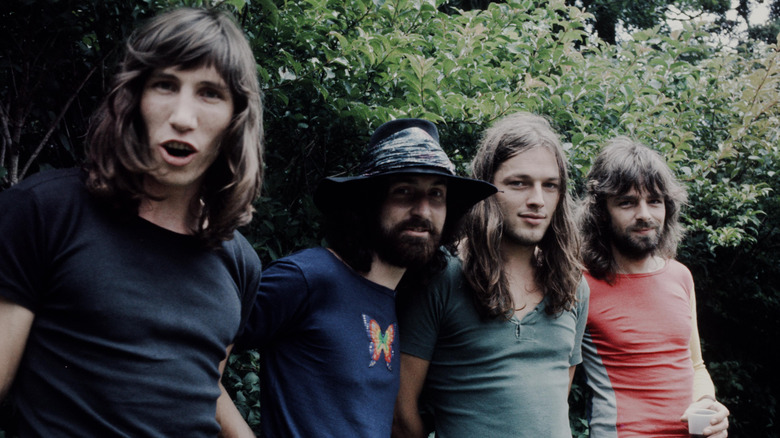
Not only is "The Dark Side of the Moon" one of the top rock albums of all time, but it's also an all-time blockbuster. Released to stores in March 1973, it spent 741 weeks on the Billboard 200 album chart, only occasionally falling off. It finally dropped off that list of the U.S.'s best-selling albums in October 1988 — a period of 15 years in which Pink Floyd released five studio LPs. Billboard then changed its chart rules and created a special list for older, or catalog albums, where "The Dark Side of the Moon" regularly appeared and dominated until 2009, when another shift allowed it to reenter the main albums chart. People just keep buying and streaming "The Dark Side of the Moon," so much that it's a common entry on the Billboard 200, and it will spend its 1000th overall week on that list in 2026.
All of those sales over the past 50 years have added up in a big way. According to the Recording Industry Association of America, "The Dark Side of the Moon" is among the best-selling rock albums and studio albums ever in the United States, with confirmed sales of 15 million units. Worldwide, "The Dark Side of the Moon" is estimated to have been purchased over 45 million times.
The Dark Side of the Rainbow isn't really a thing
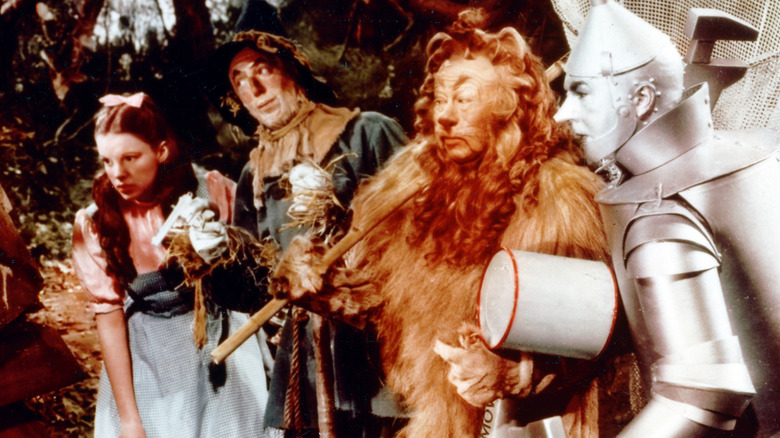
A bizarre and fascinating idea spread through the U.S. in the late 1990s. Supposedly, if one queued up "The Dark Side of the Moon" to play alongside a VHS cassette of the 1939 film version of "The Wizard of Oz," the LP worked as a spooky soundtrack for the movie. Lyrics describing on-screen happenings were so voluminous and undeniable, the story held, that Pink Floyd must have written and structured the album that way on purpose. Even better: It had all been a secret, and only in the '90s had amateur sleuths uncovered and cracked the case of what became known as "The Dark Side of the Rainbow," revealing an elaborate Easter egg like the ones commonly missed in movies. For example: Dorothy Gale carefully walks along the top of a fence while David Gilmour sings "balanced on the biggest wave."
The truth lies somewhere between a coincidence and nonsense. Putting such a time-incumbent project together would've required in-studio video playback, and that wasn't available in 1972. "There simply wasn't mechanics to do it," engineer Alan Parsons told MTV. "If you play any record with the sound turned down on the TV, you'll find things that work," he quipped to Rolling Stone.
'Dark Side' inspired light shows and remakes

"The Dark Side of the Moon" never left the public consciousness. The album led to laser light shows across the U.S., some of which have run continuously for decades, staged at entertainment centers, planetariums, and other public places where lasers, lights, and images can be displayed while "The Dark Side of the Moon" plays. This is all full circle for the project, which in its early days was a touring Pink Floyd concert experience complete with original laser light effects.
Pink Floyd's Roger Waters was crucial in the creation of "The Dark Side of the Moon," and 50 years after the album's release, he rerecorded it. Waters justified 2023's "The Dark Side of the Moon Redux" by claiming a new perspective on the original's themes. "The original 'Dark Side of the Moon' feels in some ways like the lament of an elder being on the human condition," Waters said in a press release (via Rolling Stone). "[C]learly the message hasn't stuck," he later added. "That's why I started to consider what the wisdom of an 80-year-old could bring to a reimagined version."
Waters completed "Redux" with studio musicians — no other Pink Floyd members participated. That was fine with Waters, because he acted like "Dark Side of the Moon" was all his to begin with. "Not enough people recognized what it's about, what it was I was saying then," Waters said, explaining why he made "Redux."