

Rock Stars Whose Egos Spilled Over Into Their Lyrics
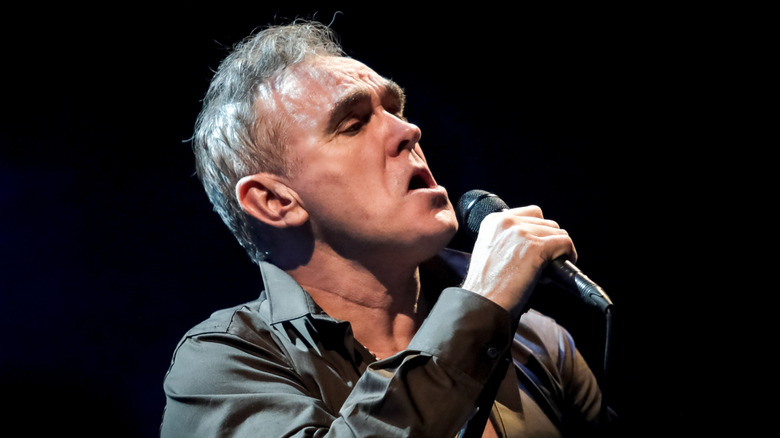
By the time John Lennon declared The Beatles "more popular than Jesus" in 1966, it was clear that big egos and rock go hand in hand. It takes confidence and self-belief to put your music out there, and with any success comes adulation, prestige, and money. The already outsized egos rockers need for success in the first place only grow with the trappings of fame, swelling every night in the spotlight. No doubt this is why some song lyrics come off as cocky, condescending, and self-aggrandizing. You can just tell they come from planet-sized egos.
It's hard to find a rock song that doesn't, in some way, reflect the rock musician's sense of themselves. But the lyrics of some artists are infused with especially high-grade self-regard and self-mythology. Massive, swollen egos seep into the lyrics of artists ranging from David Bowie and punk's "antichrist" Johnny Rotten to Smashing Pumpkins' crooner Billy Corgan. Now, that self-obsession is part of what makes some songs and artists gripping. Just don't tell the songwriter — they don't need any more encouragement.
Countless artists' lyrics are cocky and conceited. In assembling this list, we looked for the most egregious examples: Rock stars who are convinced they're saviors or the sexiest or that no mere mortal could understand them. In addition, we sought songwriters working in a range of musical styles. In their lyrics, these artists peer down at us from the clouds, riding high on their massive egos.
Billy Corgan
As guitarist and frontman of The Smashing Pumpkins, Billy Corgan joined the likes of Kurt Cobain and Eddie Vedder as a defining grunge and alternative rock lyricist. In "Bullet with Butterfly Wings," off 1995's "Mellon Collie And The Infinite Sadness," the lyrics are deceptively self-aggrandizing. "And what do I get / For my pain?" Corgan sings, "Betrayed desires / And a piece of the game." Trapped like "a rat in a cage," the narrator adopts an outsized sense of self. He suffers like the Biblical Job in the pre-chorus before casting himself as a savior: "Tell me I'm the chosen one / Jesus is an only son, for you." Coming from the gilded cage of fame and fortune, the rock 'n' roll savior act falls a bit flat.
A similar, egocentric perspective drives "Zero" off the same album. The lyrics more directly comment on the nature of celebrity, taking the perspective of the rock star whose art comes from suffering. "Intoxicated with madness / I'm in love with my sadness," Corgan sings, before dismissing his audience: "Bulls*** fakers, enchanted kingdoms / The fashion victims chew their charcoal teeth." Here, too, he recruits religious imagery to drive in the point: "Emptiness is loneliness / And loneliness is cleanliness / And cleanliness is godliness / And God is empty just like me." Depicting himself as holy and alienated from society because of his depth of feeling and brilliance, Corgan comes off as cloistered and self-involved: A rock star with a swollen ego.
David Bowie
David Bowie's ego spilled into his lyrics through the prism of his many alter egos. Personas he adopted throughout his career like Aladdin Sane and the Thin White Duke allowed him to explore the power and adulation that comes with stardom. In the song "Ziggy Stardust," the titular androgynous alien rocker gains fame but loses his band and identity in the process. "Making love with his ego / Ziggy sucked up into his mind," becoming "a leper messiah" as his fans abandon him. Through the glitter mask, Bowie turns the rockstar into a savior that, as he sings in "Starman," would "like to come and meet us / but thinks he'd blow our minds."
While he may have been commenting on stardom and ego through his personas, he did so by embodying them. On the "Ziggy Stardust Tour," Bowie transformed into Ziggy, adopting one of his most famous looks as a glam rock icon. But in a move only a healthy ego could pull off — one sure of what it wants from art — he laid the persona to rest on stage of the Hammersmith Odeon in London on July 3, 1973. "Not only is it the last show of the tour," he announced, "but it's the last show that we'll ever do." This was news not only to shocked fans but also to his backing band, The Spiders from Mars. As it was for his alter ego, things had gone too far, the band was blowing up, and it was time for changes. With David Bowie, life always seemed to imitate art.
Morrissey
Few rock stars are as polarizing and outspoken as Morrissey, solo artist and former frontman of The Smiths. Over the years, the indie pop songwriter has never shied from sharing his opinions and has repeatedly courted controversy. Among highlights are his outspoken veganism, telling Melody Maker in 1986 that he hated "black modern music," and his opposition to immigration in the U.K. (via The Guardian). Holding court to whoever will listen — and buoyed by an undeniable body of work — Morrissey seems a textbook case of outsized rockstar ego. And this certainly has trickled into his lyrics.
One especially ego-driven song is "Bigmouth Strikes Again," off The Smiths' "The Queen Is Dead" album. Playing off his image as a loudmouth in the media, Morrissey's narrator is a crybully, mocking those who've taken offense to his words. Dark sarcasm permeates lines like, "I was only joking when I said / By rights you should be bludgeoned in your bed." By the pre-chorus, he becomes a martyr: "Now I know how Joan of Arc felt / As the flames rose to her Roman nose." It's a lyrical image, no doubt, but it feels overwrought, especially knowing the reputation of the songwriter.
In Morrissey's songs, the narrators are romantic figures, often misunderstood loners. You can't help but map his public image — as an opinionated, cranky '80s indie rock legend — onto his songs. Only someone like Morrissey could come up with a song called "How Can Anybody Possibly Know How I Feel?" And only he would fill it with self-aggrandizing lines like, "But even I, as sick as I am, I would never be you."
Johnny Rotten
The Sex Pistols' Johnny Rotten (real name John Lydon) set a high bar for punk poetry. Against the backdrop of chugging, distorted guitar, songs like "God Save the Queen" are anti-authoritarian, snotty, and confrontational. Criticizing the foolishness and hypocrisy he saw around him, Rotten positions himself above the hypocrisy and degradation of it all. "Oh, God save history / God save your mad parade," he sings, thumbing his nose at patriotism and conformism. Later, he seems to steal the queen's crown and claim her country for himself: "We're the flowers in the dustbin / We're the poison in your human machine / We're the future." Delivered with characteristic intensity, the lyrics are colorful, cutting, and conceited: The outsized ego makes the song sound even cooler today.
Like others on this list, Johnny Rotten flirts with the image of a rock 'n' roll savior, though as a punk, he inverts it. "Anarchy In The UK" starts off somehow both nihilistic and self-aggrandizing: "I am an anarchist / I am the antichrist / Don't know what I want, but I know how to get it." Lines like "I want to destroy passersby" and "Your future dream is a shopping scheme" drip with derision. And in bashing everything and everyone around him, Rotten can't help but look down at the masses he's pegged as irredeemable. It takes a big ego to do that.
David Lee Roth
Any list of ego-driven rock stars would have to include Van Halen frontman David Lee Roth. In the late '70s and '80s, the hard rock group made a name for themselves with songs like "Runnin' With The Devil" and "Jump." Along with lead guitarist Eddie Van Halen's virtuosic playing, Diamond Dave's wail and stage swagger entranced fans. The band's best-selling album, "1984," reached No. 2 on the Billboard albums chart, though it was edged out of the top slot by Michael Jackson's "Thriller." No doubt, mass adulation and success inflated David Lee Roth and the rest of the band members' egos. In the mid '80s, it seemed like you'd find a picture of Van Halen in the dictionary next to the entry for "cocky."
You have to be sure of yourself and your prowess to come up with "Panama," a single off the album "1984" and one of the most popular Van Halen songs. On the surface, it's a high-powered ode to driving over the speed limit and the thrill of piloting a sports car. Roth sings: "Got the fearing, power steering / Pistons popping, ain't no stopping now." But this isn't just a man(child) enthusing about a toy — pop the hood, and you'll find the song's about making love. The car is described as a woman, and the imagery is full of unsubtle innuendo. Lines like "Ain't nothin' like it, her shiny machine / Got the feel for the wheel, keep the moving parts clean" crash into the pre-chorus' "Don't you know she's coming home to me?" Roth positions himself as the ultimate rock star: A distillation of partying and excess. You can't do that without a well-oiled, high-performance ego.