

1974 Flopped Harder Than Any Other Year In Classic Rock History
Look back through the history of rock and you'll notice a number of years that can be considered "flops." For one, there's 1963, the year before the Beatles became international superstars. We could also mention the years in which certain rock legends died, such as 1980 for John Lennon and 1994 for Kurt Cobain. Or how about most years from the 2010s and beyond? There doesn't seem to be much room for crunchy guitars and angsty lyrics in the modern musical zeitgeist. But with that last thing in mind, it's best to stick to classic rock when talking about the genre's worst years, and as far as classic rock is concerned, no year epitomizes the term "flop" more so than 1974.
This isn't really a hot take — the likes of YouTube music critic Todd in the Shadows once referred to 1974 as the "worst year in pop music history," and they're not alone in thinking so. But for the purposes of this article, we'd like to focus on the rock side of things and not popular music in general. Why was classic rock — or simply "rock" back then — in such a bad place in 1974? Let's look at some of the biggest reasons, along with a few example songs as proof of why we think that year was a bad one for good tunes.
Some of hard rock's finest had already peaked
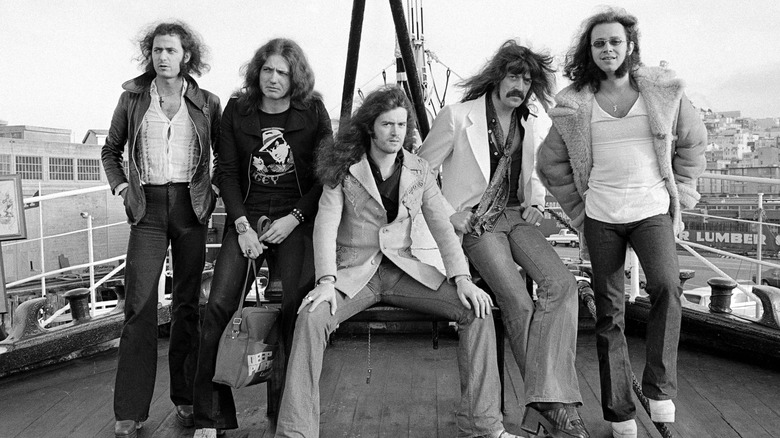
The first few years of the 1970s were an incredible time for a number of bands that are now considered beloved classic rock acts, including British hard rockers Led Zeppelin, Black Sabbath, and Deep Purple. Unfortunately, these bands had largely peaked by the time 1974 rolled around.
Led Zeppelin was fresh off yet another commercial and critical success with 1973's "Houses of the Holy," but it's fair to say their 1971 self-titled album (aka "Led Zeppelin IV") was their absolute peak when it came to enduring classic tracks. Black Sabbath had also come off a streak of four great albums before releasing a merely good one in 1973's "Sabbath Bloody Sabbath." And while Deep Purple had one of their biggest hits that same year with "Smoke on the Water," 1973 was also the year when frontman Ian Gillan left the band over creative differences with guitarist Ritchie Blackmore. Both Zeppelin and Sabbath didn't release albums in 1974, and Deep Purple released two with new singer David Coverdale — "Burn" and "Stormbringer" — but neither were anywhere as impactful as Gillan-era fan favorites "Deep Purple in Rock" and "Machine Head."
Meanwhile, things were hardly better for hard rock bands in the U.S. Mountain, best known for their 1970 hit single "Mississippi Queen," failed to crack the top 100 of the album charts in two attempts, just three years after their biggest success. And while Grand Funk Railroad remained relevant in 1974 with their album "Shinin' On," it was a departure from their older, heavier sound — the title track rocks hard enough, but their chart-topping cover of Little Eva's early '60s hit "The Loco-Motion" was a curious and divisive choice.
Schmaltz was in full swing in 1974
Throughout the history of music, schmaltz has had many a moment, from the proliferation of "teenage death songs" (Mark Dinning's "Teen Angel," Ray Peterson's "Tell Laura I Love Her") in the early '60s to actor Richard Harris' unlikely success later in the decade with the maudlin (despite the unintentionally funny cake analogy) "MacArthur Park." But if there was a peak year for schmaltz on the charts, it would have been 1974.
It generally wasn't the tolerable kind of schmaltz either, as evidenced by major hits such as Paul Anka and Odia Coates' stomach-turning duet, "(You're) Having My Baby," and Terry Jacks' "Seasons in the Sun." The former has some of the cringiest lyrics ("Whoa, the seed inside ya / Baby, do you feel it growing?") ever put on record, while the latter strips the humor and pathos away from Jacques Brel's French-language original, "Le Moribond." And speaking of songs centered around people dying young, Bo Donaldson and the Heywoods proved that cheery melodies and tragic lyrics are often a bad mix with yet another fixture of worst-songs-of-the-'70s lists, "Billy, Don't Be a Hero."
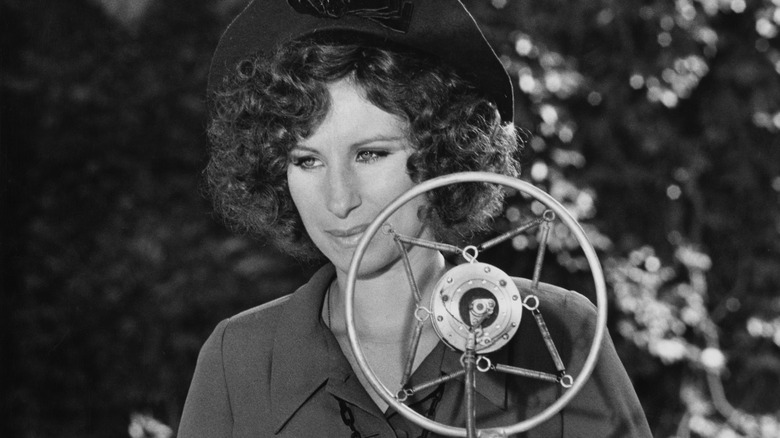
While the aforementioned songs all topped the charts in 1974, there is probably no better evidence of the domination of schmaltz than the year's No. 1 overall song: Barbra Streisand's "The Way We Were." The tune is as far removed from a rock song as you can get, and proof positive that slow and sentimental ballads were running roughshod over rock music in 1974.
Some big names in mainstream rock underperformed on the charts
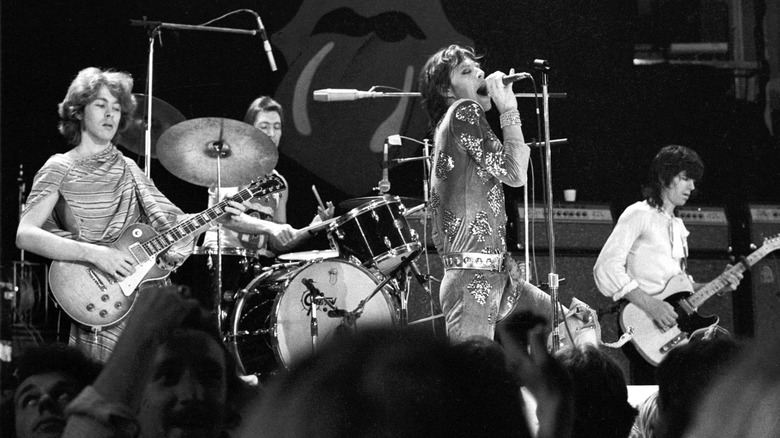
In a broader sense, the Billboard Hot 100 wasn't too kind to a number of mainstream rock acts in 1974, and this is best seen in the slightly underwhelming chart performances of the Rolling Stones. Granted, placing in the top 20 can be quite the accomplishment for almost any rock band, but not the Stones, who, along with the Beatles, were at the forefront of the British Invasion in the previous decade. All three of their Billboard Hot 100 hits in 1974 — "Doo Doo Doo Doo Doo (Heartbreaker)," "It's Only Rock 'N Roll (But I Like It)," and their cover of the Temptations' "Ain't Too Proud to Beg" — peaked between No. 15 and No. 17.
Also mired in a bit of a singles chart slump were the Eagles, who had two top-15 hits in 1972 ("Take It Easy" and "Witchy Woman") but couldn't crack the top 30 with their first two singles of 1974, "Already Gone" and "James Dean." Sure, they ended the year with a bang with "Best of My Love," but aside from the fact that it reached its peak position of No. 1 in early 1975 and not in its year of release, it was considerably mushier and mellower than previous Eagles hit singles.
Rock was still a few years away from its next exciting new sub-genre
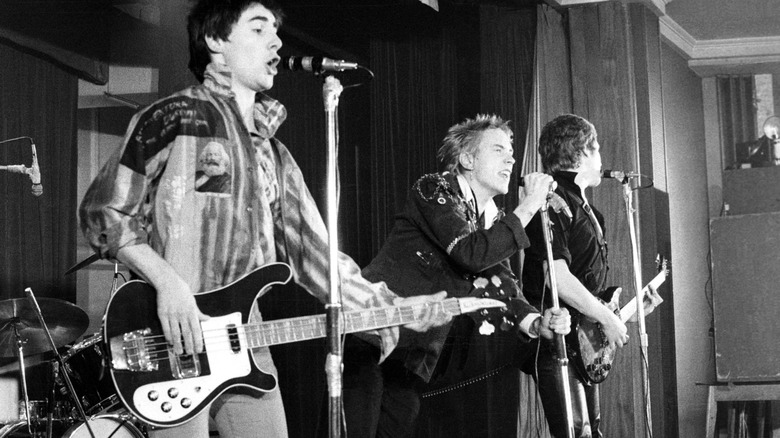
When the Beatles broke out in America in early 1964, they revitalized a stale music scene by launching the British Invasion. In the late '60s, psychedelic rock took guitar sounds, lyrical content, and song arrangements to new places, and in the early '70s, bands like Black Sabbath and King Crimson were paving the way for heavy metal and progressive rock, respectively. You can also include the singer-songwriter boom of that same era, but mellow acoustic guitars and gentle crooning aren't exactly what you first think of when the word "rock" is mentioned. By 1974, it had been a few years since those two juxtaposing trends continued rock music's evolution, and the genre had that "been there, done that" vibe to it once again.
It wasn't helping that prog rock, which was essentially an alternative to the more mainstream rock on the radio, had arguably become bloated and pretentious, what with its 10-minute-plus epic story-songs and extreme focus on technicality over hooks and sing-along choruses. Mainstream rock needed a new kind of alternative, but as of 1974, it was still a few years away from truly entering the zeitgeist.
That new kind of alternative, as you may have guessed, was punk rock. The sub-genre wasn't as radio-friendly as many of the bands that helped pave the way for punk about five to 10 years prior, but it didn't have to be. Its back-to-basics rawness was the antithesis of the prog and mainstream rock that was leaving more and more fans bored and disillusioned.
Thankfully, 1974 still had some glimmers of hope for rock
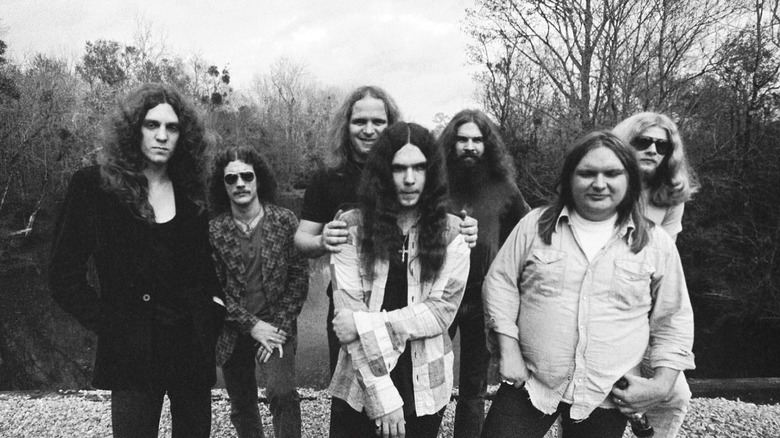
While 1974 saw rock music in a poorer state than it had been in its then two-decade-or-so existence, it wasn't all doom and gloom. Ironically, it was the Beatle best known for his "silly love songs," Paul McCartney, who was among those who played a huge part in keeping rock relevant during a down year, as "Band on the Run" topped the charts and remains one of his most beloved post-Beatles songs to this day. It may be one of McCartney's darker songs, too, but it's easy to imagine being a rock fan in 1974 and feeling hopeful for the state of the genre each time the song played on the radio.
It wasn't just veterans like McCartney keeping the torch burning for rock in 1974, as there were some promising young acts on their way to long-term success. Chief among these up-and-coming bands were Lynyrd Skynyrd, whose hitmaking story was just getting started, and Aerosmith, which didn't have any hits in 1974 but was on the way to breaking out with their third album, 1975's "Toys in the Attic."
Sure, 1974 was the year we had joy, fun, and seasons in the sun while reminiscing about the way we were. But rock music survived it all, and ultimately found ways to reinvent itself and, on many an occasion, return to prominence with the music-listening masses.