

5 Songs From 1979 That Define Rock History
Rock was in an odd place come 1979. New wave, punk, and arena bands were displacing OG classic rockers, while massive mainstays like Led Zeppelin were imploding through substance misuse. Bands like the Clash, Talking Heads, and the Cure were in, The Rolling Stones had gone disco with "Miss You" the year prior (a track that showed that classic rock had burned out), and The Beatles were almost a decade gone. In this environment, certain songs defined rock history.
When we say "defined," we don't mean that these songs shaped rock history, although they may have. We mean that they represent a perfect snapshot of the times — a portrait of the state of rock come 1979. This means focusing on the aforementioned changing of the musical guard from classic rock's golden era to the '80s, including the adoption of new musical styles into existing rock frameworks, plus the link between cultural and musical changes. We don't need to go into those cultural changes in detail, but we might need to touch on them here and there. Also, these aren't the only songs from 1979 that define rock history; they're just a top-tier sample of them.
On that note, we've got songs from two classic rock outfits that define the end of an era, albeit in very different ways: "All My Love" from Led Zeppelin and "Another Brick in the Wall, Pt. 2" by Pink Floyd. We've also got two songs that represent a changing of the musical guard: "Highway to Hell" by AC/DC and "London Calling" by the Clash. Finally, we've got a weird, experimental track from that most protean of stars, David Bowie, which showed that rock's more creative impulses lived on.
All My Love - Led Zeppelin
If "All My Love" came from another band besides Led Zeppelin, no one would have cared. The second-to-last track from Zeppelin's final studio album, 1979's "In Through The Out Door," sounds like a pale, mid-tempo, enervated ghost of the band's glory days. It's even got that lifeless synth chord progression that marks its place in time at the onset of the '80s. With "All My Love," the world's biggest rock band piled the stones of its own burial cairn, built in large part by absurd, superstar lifestyle-driven excesses.
Overall, "All My Love" is more bleh than bad. It's less exciting blues-rock, like 1970's Norse mythology-themed "Immigrant Song," and more humdrum dad rock. A track like "Fool in the Rain" from the same album is at least a little weird, druggy, and has a disgusting John Bonham drum groove — it also reached No. 21 on the Billboard Hot 100, expending Zeppelin's last bit of steam with it. But that brings us to Bonham, whose unparalleled rhythmic chops propelled much of Zeppelin's energy. And when Bonham tragically died in 1980, not only did Zeppelin collapse, but perhaps the entirety of classic rock's golden era died with him.
We can also take a limp, milquetoast track like "All My Love" as indicative of the lackluster quality of musical outings from other '70s-era bands that year (not all, but some). This includes Kiss' "Dynasty," The Beach Boys' "L.A. (Light Album)," and Aerosmith's "Night in the Ruts." All in all, "All My Love" articulates the trajectory of rock history come 1979: The times had well and truly changed, and there was no going back.
Another Brick in the Wall, Pt. 2 - Pink Floyd
Even as Zeppelin disintegrated in 1979, Pink Floyd swung for the fences. The '70s prog titan had already made history by putting out the highest-selling album of the decade with "The Dark Side of the Moon," which sold some 50 million copies. It followed it up with 1975's "Wish You Were Here," an outré work built from the space and money that success afforded. There really was nowhere for Pink Floyd to go from there except to phone it in or push further. So it released a double-album rock opera with a hidden meaning about a musician destroyed by fame, 1979's "The Wall," featuring Pink Floyd's biggest ever hit, "Another Brick in the Wall, Pt. 2."
Given its subject matter, it's absolutely ironic that "Another Brick in the Wall, Pt. 2" took off in such a big way. It's also ironic that it took off so well — staying No. 1 on the Billboard Hot 100 for four weeks — given that the late-'70s musical zeitgeist had pivoted from rock and landed squarely on disco (at least until 1979).
Unlike a disco-drenched song like "Miss You" by The Rolling Stones, "Another Brick in the Wall, Pt. 2" was written as an aggressively non-trend-chasing track. It's groovy as hell, yes, but that's just a result of Pink Floyd following its own musical instincts and doing its own thing, same as what made it so famous to begin with. In this way, "Another Brick in the Wall, Pt. 2" serves as a symbolic last hurrah for the rock of an era that, by 1979, was already bygone.
Highway to Hell - AC/DC
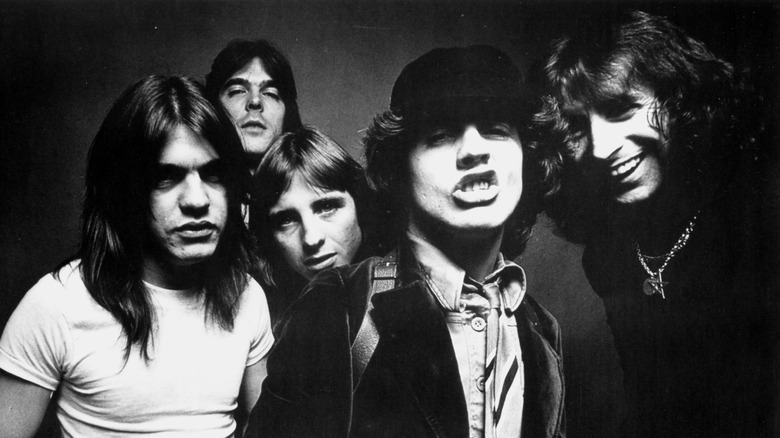
We can safely say that the 1980s were a time of massive, hooky arena bands riffing and romping their way through an endless ocean of sex, drugs, and rock 'n' roll. Big chords, big choruses, and flashy showmanship were in, and subdued songcraft was out. This is the scene into which AC/DC stepped, a band perfectly tailored for and from its time, starting with its 1975 Australia-only debut, "High Voltage." In 1979, it released "Highway to Hell" from its album of the same name, a song that exemplified rock history's transition into the '80s.
In terms of function (revelry) and form (mostly chorus), "Highway to Hell" stands in not just for other rock-out tracks from 1979 (such as "I Was Made for Lovin' You" by Kiss and "Dance the Night Away" by Van Halen), but basically any other AC/DC track. The song's lyrics summarize the entirety of AC/DC's catalogue and also the rock decade to come: "Don't need reason, don't need rhyme / Ain't nothin' I'd rather do / Goin' down, party time / My friends are gonna be there too, yeah." That's pretty much it.
Okay, there was a bit more going on behind the scenes with "Highway to Hell." Focusing on groove and rhythm over other aspects of songwriting, producer Robert John "Mutt" Lange wrung as much from the track as possible (and went on to work with bands like Def Leppard). Then there was the response from the band's American record label, which freaked out about the word "hell" in the title — pre-1980's Satanic Panic, mind you. Even this kind of lip-pursed response amongst certain sectors of the public jives with rock's history.
London Calling - The Clash
Few bands captured the new, exciting energy of punk and pop-punk than the Clash. Vibrant, energetic, and of-the-moment, the London-based band directly confronted topical issues in its music, like Cold War paranoia. This is certainly the case with the Clash's 1979 album and song of the same name, "London Calling," which also takes pot shots at the emptiness of worshipping musical gods, with its famed "Phony Beatlemania has bitten the dust" line. For young people coming of age in the late '70s, a track like "London Calling" was way cooler, punchier, and fresher than any last-gen classic rock band.
But the Clash and "London Calling" stand out from its punk peers because it wasn't merely loud, ragged, and defiant like The Sex Pistols once were. It was articulate and tempered, while also not overcomplicating its music, which made it accessible and aspirational at the same time. The band members even looked like cleaned-up rockability punksters, rather than haggard youths waiting to terrorize a young listener's parents. And with "London Calling," the Clash did all this while composing a cataclysmic portrait of the rot and fear underpinning modernity via a catchy, singable track.
"London Calling" also defines rock history in 1979 because it, and the Clash as a whole, looked to eclectic influences to write its music, including non-rock influences. This meant truly classic acts like Bo Diddley and proto-hip hop acts like Grandmaster Flash and the Furious Five. In this way, it also presaged the hybridized future of rock that continues to this day, while simultaneously mirroring a similar range of influences amongst contemporary, new wave bands like the Police. Bravo, fellas.
African Night Flight - David Bowie
With all this talk of rock trends, sub-genres, and musical evolution, it's good to have someone like David Bowie around to remind us that an artist, even one categorically definable as "rock," can truly march to the beat of his own drum regardless of whatever else is happening in the zeitgiest. That's why we're choosing David Bowie's "African Night Flight" from 1979's "Lodger," not only as a track that defines rock in 1979 (of the avant-garde strain), but as a stand-in for any odd musical foray that, while naturally evolving with the age, also resists it through an inherently unique creative vision.
Where can we possibly start with "African Night Flight"? It's possibly the weirdest and most experimental song in Bowie's entire catalogue, and definitely belongs in any list of Bowie songs that sound even cooler today. It's not weird in the way that Ziggy Stardust was a weird character, but straight-up musically weird. Replete with dissonant harmonies, a gonzo array of bizarre percussive layers, laser-like sound effects mixed with guitar licks, and strange rap-like sing-speaking, "African Night Flight" could've been released last Tuesday and still sound like alien music from the future. It's basically a pre-Björk Björk cut. In fact, the song ought to give you the sense that Bowie could've really pushed the weirdness on a lot of other tracks, but went with a middle ground that the general public could actually grok.
So where was musical experimentation come 1979? It wasn't in anthem rock, punk, or new wave — not really. It lived in stupendous tracks like "African Night Flight" that test the limits of what "rock" actually was.