

'80s Breakup Songs That Will Never Leave Our Playlist Because They Hurt So Good
There's no denying the power behind recent breakup anthems like Gotye's "Somebody That I Used to Know" or Adele's "Hello," but there is just nothing like the '80s when it comes to heartbreak. Hard rock had its soaring power ballads, new wave had the haunting wails of the newly-popularized synthesizer, and it seemed like every pop singer had their own unique take on love and its crushing loss.
Everyone has felt their share of heartache, and luckily, a massive catalog of breakup songs from the '80s exists to meet them at their lowest and reveal, if nothing else, that someone else has been there, too. Moreover, the best breakup songs also put those swirling, complicated emotions into words, telling timeless truths about pain and resilience, or at least a bit of petty revenge. As permanent fixtures of our most heartsick soundtracks, here are five '80s breakup songs that will never leave our playlist because they hurt so good.
George Michael — Careless Whisper
There's more to George Michael's 1984 ballad "Careless Whisper" than just being a mega-hit, even if that hit was No. 1 in 25 countries and dominated the year of its release. There's also more than just its signature saxophone riff, even if it is possibly the most famous saxophone riff in pop history. And, there's more than just its exceptional meme-ability, which has helped the song survive into a new generation as an instantly recognizable soundbite. Behind its flashiest elements, "Careless Whisper" is, at its core, an expertly written breakup song.
Despite being written by Michael when he was only 17, the lyrics to "Careless Whisper" demonstrate a decidedly adult level of poeticism and insightfulness. From the first verse, which goes in part, "As the music dies, something in your eyes / Calls to mind a silver screen and all its sad goodbyes," it's clear that Michaels intends to paint with his words more than merely explain. The second verse is really the song's thesis, as succinct as it is devastating, reading, "Time can never mend / The careless whispers of a good friend / To the heart and mind, ignorance is kind / There's no comfort in the truth, pain is all you'll find." The lines are both brutal and, for many, ring with truth, making Michael's ballad an easy commiseration.
Bonnie Tyler — Total Eclipse of the Heart
There's a strong case to be made that Bonnie Tyler's "Total Eclipse of the Heart" is the definitive '80s heartbreak song, or at least the most epic. It is every bit as delicate and mournful as its soft rock peers, and yet as soaring and electric as any hard rock power ballad, especially the full, almost-seven-minute album cut. Every instrument is used to its utmost effect, from the fragile, unadorned piano to the drum fills that enter like knockout punches to Tyler's rasping, almost cracking voice, used in opposition to the famous choir-like backing vocals.
Part of what makes "Total Eclipse of the Heart" so impactful is that its story is an understandable descent into hopelessness and despair following a lost love, and that its dynamic arrangement both counters and complements that story. In between its quiet bouts of bitter mourning, "Total Eclipse of the Heart" leaps into giant, screaming pleas for love, and it gives the song the sense that it doesn't know how to feel at all, which is its own additional type of pain.
The Greg Kihn Band — The Breakup Song (They Don't Write 'Em)
"The Breakup Song (They Don't Write 'Em)" by the Greg Kihn Band is not the typical fare for sobbing one's eyes out at their lowest post-breakup point. Instead, it's the soundtrack to that moment when someone has had enough moping, cranks up the speakers, and fist pumps through the tears. "The Breakup Song" is faster and more raucous than most '80s heartbreak anthems, but it's no less accurate a soundtrack for battling rejection.
Part of the magic of "The Breakup Song" is that it's as middle-of-the-road as it gets when it comes to lyrics, never daring to get any more intricate than "We had broken up for good just an hour before / And now I'm staring at the bodies as they're dancing 'cross the floor / And then the band slowed the tempo and the music took me down / It was the same old song, with a melancholy sound / They don't write 'em like that anymore."
It may not be novel or profound, but it's a real reflection of the type of subtle, wistful moments that define many breakups. Kihn uses the smallest moments of sadness to illustrate the larger idea that breakups can take any number of memories and recontextualize them, and sometimes, that hurts.
Joy Division — Love Will Tear Us Apart
In 1980, legendary post-punk pioneers Joy Division released "Love Will Tear Us Apart," which would come to be their biggest hit, and even go on to be listed as one of the most influential songs of all time for its role in defining the genre. Singer/songwriter Ian Curtis wrote the song, and it shows off all the bleak introspection and uncommon eloquence for which he came to be known, making it a wholly singular heartbreak song.
For one thing, "Love Will Tear Us Apart" is one of a rare subset of breakup songs told in the future tense, and somehow it's still a true story. When Curtis wrote it, he was very openly and directly admitting to his wife Deborah that their relationship was dying, and it shows in dour lines like "There's a taste in my mouth / As desperation takes hold / Is it something so good / Just can't function no more?" Typical of a lot of post-punk, the instrumentation is basic and repeats its minimalist motif again and again, but that only hammers home even harder the constant thrum of heartache that Curtis must have felt in living its doomed story.
Dire Straits — Romeo and Juliet
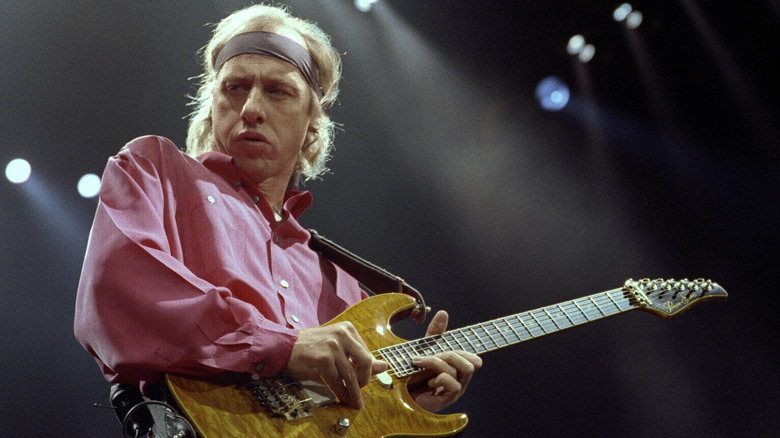
Mark Knopfler may go down in history as the man who shredded on "Sultans of Swing" and helped define the early days of MTV with the "Money for Nothing" video, but he is every bit as accomplished as a lyricist, a talent on full display in "Romeo and Juliet." As its name suggests, "Romeo and Juliet" is inspired by the Shakespeare play, but Knopfler flexes his storytelling muscles to give the tale a slick, hip update that somehow threads the needle between sarcastic and moving.
That sense of irony is best encapsulated when Knopfler sings "I can't do the talks like they talk on the TV / And I can't do a love song like the way it's meant to be," lines that prove themselves false when you hear artful passages like "And all I do is miss you and the way we used to be / All I do is keep the beat to bad company / And all I do is kiss you through the bars of a rhyme / Juliet, I'd do the stars with you anytime."
The song's emotional climax is its choruses, in which Romeo reflects on his lost Juliet with a crushing blend of grief and resignation, singing "Juliet, when we made love you used to cry / You said I love you like the stars above, I'll love you 'til I die" and "When you gonna realize / It was just that the time was wrong, Juliet?" That could reflect his acceptance or his denial, but it's precisely that ambiguity that makes the story in "Romeo and Juliet" so real and powerful.