

5 Songs From 1982 That Define Rock History
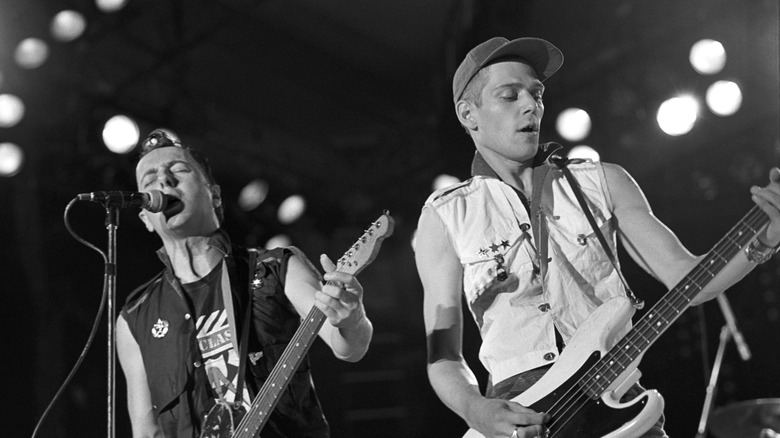
By 1982, a new wave (so to speak) of young, genre-blending groups like the Police and Talking Heads had displaced classic rock mainstays of the '60s and '70s. That year, new wave, punk pop, and synth-pop mishmashed with the last of the old vanguard, creating a unique period of time that transitioned into the '80s and defined rock history.
These rock-defining songs weren't necessarily the most influential, the most well-received, the most well-written, or the biggest hits, although this might be the case for some of them. It's more that they created a snapshot of the state of rock in 1982. They represent the diversity of rock's branches and take the aforementioned sub-genres into account (new wave, punk pop, synth-pop), as well as roots rock, arena rock, avant-garde/art rock, and whatever else accurately portrays the time. Unfortunately, we've got to omit some songs that fit the bill, like "Under Pressure" by Queen and David Bowie, because they were released in 1981 even though their albums came out in 1982. But plenty of songs remain, and this article highlights five of them.
Duran Duran and the Clash define rock history in 1982 possibly better than any other choices, as does an arena rock singalong from Scorpions. Meanwhile, lesser-known from tracks from Bruce Springsteen and King Crimson help sum up the year.
Hungry Like the Wolf — Duran Duran
Pop rock, new wave, synth-pop, boy band with instruments: Whatever you want to call Duran Duran, they were one of the most successful groups to fuse rock instruments with prominent synth lines and danceable pop tunes. They, their 100 million records sold, two Grammys, and 21 Billboard Hot 100 singles took off with their second album, 1982's "Rio." "Hungry Like the Wolf" led the charge of their success, aka, the song with the catchiest "Do-do-do-do" line ever.
"Hungry Like the Wolf" is catchy not just because of the "Do-do-do-do" bit, but because of its extremely tight core melody, which comes together in its smooth, then stuttered, chorus rhythm. The cadence sounds like someone stalking something — "In touch with the ground / I'm on the hunt, I'm after you – which is precisely what the song is about: a horny guy on the prowl. Singer Simon Le Bon (not Duran Duran's original vocalist) and keyboardist Nick Rhodes had gone out drinking the night before writing the song, perhaps with the song's topic on their minds, and wound up fashioning a hit unintentionally inspired by Little Red Riding Hood.
"Hungry Like the Wolf" also defines rock history because of its connection to MTV, a critical fixture in the music industry throughout the '80s and '90s. The song didn't gain any traction in the U.S. until MTV started airing its video, which featured a vaguely Indiana Jones-themed, exotic locale-filled adventure. The video fueled the song's success to No. 3 in the U.S. charts and led to Duran Duran earning one of their aforementioned Grammys. By 2009, the video became the 15th-most-played MTV video, ever.
No One Like You — Scorpions
Scorpions are probably a way more popular band than folks realize (unless you're a Scorpions fan). With 110 million albums sold worldwide and a discography that itself defines rock history, Scorpions have always leaned into anthem rock territory and been preoccupied with sex. Even only their album covers and names depict the latter: "In Trance," "Virgin Killer" (an especially controversial cover), "Lovedrive," "Love at First Sting," etc., all of which feature provocative art. In other words, Scorpions were well-positioned come 1982 to represent the arena/anthem/party-hardy branch of rock history with "No One Like You" off "Blackout," with lyrics like, "I can't wait for the nights with you / I imagine the things we'd do."
Musically, "No One Like You" sounds a bit diecast, driven by chunky, basic power chords, a hooky chorus, and harmonizing, dual-guitar lines. But that's why it works. It's the best of its ilk, demonstrating enough songwriting panache — largely through its well-written transitions and clean picking sections — to elevate it above other stadium songs. And when the second guitar comes in during its solo, rock's cockier '80s spirit soars. On TikTok, Scorpions guitarist Matthias Jabs calls the song one of his favorites.
We don't have too much insight into how Scorpions wrote "No One Like You," except that it came on the heels of singer Klaus Meine undergoing surgery on his vocal cords. Maybe it was a do or die moment for the band, we're not sure. But we do know that MTV played a huge role in the song's success, like Duran Duran, thanks to the song's Alcatraz-set video. There's even that brief dominatrix executioner scene. So hey, that worked.
Atlantic City — Bruce Springsteen
Bruce Springsteen was in an interesting place in the early '80s, career-wise, caught between a river and a flag – 1980's "The River" and 1984's monster hit "Born in the U.S.A." (with a title track that folks still mistake as patriotic). Right at this critical juncture, Springsteen pulled a move no one saw coming and made a thoughtful, fairly bleak, and unvarnished folk album. From this album, 1982's "Nebraska," we get "Atlantic City," a song that demonstrated that no matter all the '80s spandex, glam, light shows, and revelry, rock still had a sincere heart.
Springsteen really went minimalistic with "Atlantic City," which features only an acoustic guitar, Springsteen's vocals (and occasional backing vocals), intermittent harmonica, and late-song mandolin during the outro. Lyrically, it's Springsteen doing his thing of championing the unseen, unheard, working-class person: "Well, I got a job and tried to put my money away / But I got debts that no honest man can pay / So I drew what I had from the Central Trust / And I bought us two tickets on that Coast City bus." Sure, Springsteen tread this theme with more gusto and lyrical bite in 1975's "Born to Run." But in 1982, as other bands were bopping around and partying, Springsteen's serious, earnest, and pared-back roots-rock "Nebraska," including "Atlantic City," was exceptional to the point of bizarre.
With "Atlantic City," Springsteen also created a tether between rock eras, arguably all the way back to the American folk revival of the 1940s, which culminated in '60s musicians like Joni Mitchell and Bob Dylan. Reaching back to this history, Springsteen's dark horse of an album reached No. 3 on the Billboard 200.
Rock the Casbah — The Clash
It's not an exaggeration to say that the Clash were possibly the most influential punk band, ever, right down to their 1979 rock-defining track, "London Calling." Plenty of folks would probably object to that statement, citing the Stooges or volcanic bands like the Sex Pistols. But the Clash took punk energy and stabilized it. They were more focused, both in politically-minded ethos and in songwriting, and bridged the gap between punk and pop, underground and mainstream. And in 1982, they released an absolute banger that reached No. 8 on the Billboard Hot 100: "Rock the Casbah" from "Combat Rock."
No doubt, "Rock the Casbah" proved a bait-and-switch for some listeners who mumbled through the song's verses and belted, "Rocking the Casbah, rock the Casbah," mistaking "Sharif" for "sheriff" or something. After all, the song is really light-sounding and bouncy, unlike its message. It's even got that sweet, pew-pew laser sound, which connects to the lyrics, "The king called up his jet fighters / He said, 'You better earn your pay / Drop your bombs between the minarets / Down the Casbah way.'" Lyrics like these, plus others like, "By order of the prophet / We ban that boogie sound / Degenerate the faithful / With that crazy Casbah sound," make it pretty clear what "Rock the Casbah" is about. And to clarify, a casbah (or kasbah) is a kind of North African desert fortress town.
In this way, the Clash defined rock history in 1982 not just through their radio-friendly fusion of punk and pop, but through their subject matter. They had rock's gutsiest guts — not the sanctimonious kind, but the kind that makes you actually want to listen.
Neal And Jack And Me — King Crimson
Even as some musicians rode or made trends, or got plunked into various rock categories, other musicians were just doing their thing. So it was with King Crimson, which by the '80s had undergone a second birth under guitarist and mastermind Robert Fripp. They took the baton from bands like Talking Heads circa the late '70s and fused it with their own late '60s to mid-70s prog rock, auteur sensibilities. From that, they formed a more digestible, but still weird and intricate, version of themselves. And with 1982's "Neal And Jack And Me" off "Beat," they also made an uptempo, legitimately danceable '80s track that still qualifies as proggy and experimental.
The first few seconds of "Neal And Jack And Me" might leave you confused and wondering where the beat is. That's because we're hearing two guitars playing two different, mathematically interlocking musical meters; it's a polymetrical song, in other words. This music is meant to emulate the frantic, tire-spinning hustle of a road trip from one destination to another. As the lyrics (and title) say, the song describes the desire to join Neal Cassady and Jack Kerouac on their '50s road trip (the inspiration for Kerouac's legendary Beat Generation novel, "On the Road"). These details are probably going to go over the heads of many listeners. But, it's this precise attention to finely-crafted artistic nuances that makes a song like "Neal And Jack And Me" define auteur rock in 1982.
It might go without saying, but neither "Neal And Jack And Me" nor "Beat" went anywhere on release, commercially speaking. But this is also rock: following the drive that can't be ignored to make the music that means something to you.