

Legendary B-Sides That Made Rock Music History
Back in the halcyon days of what we now call classic rock, singles ruled the music industry, and each included at least one other song, known as the B-side, which ran the gamut from bad filler to decent almost-rans that didn't make the cut. But some of these discarded B-sides surpassed expectations by going on to become integral in the rich history of rock.
Regardless of their provenance, all B-sides shared one key facet: to the record label, these songs were seen as disposable throwaways that wouldn't detract from the A-side. Every once in a while, though, a strange occurrence took place when a song that had been relegated to the B-side emerged as a hit unto itself — sometimes even eclipsing the success of the single it was supposed to be supporting. It didn't occur that often, but it did happen, and even with some of rock's biggest acts. From one of the first true rock 'n' roll songs in the mid-1950s to perhaps the finest tune the Beach Boys created, these are some legendary B-sides that unexpectedly earned their place as a stepping stone in rock music history.
Rock Around the Clock — Bill Haley and the Comets
When Bill Haley and his backing band, the Comets, entered a New York City recording studio in 1954 to record their first single for their new label, Decca, the producer convinced them to record "Thirteen Women (And Only One Man in Town)." After recording enough takes that they felt they'd nailed it, they also recorded a second number in the short window of studio time they had left. Recorded in just two quick takes, "Rock Around the Clock" was released as the B-side of "Thirteen Women."
That single was hardly the blockbuster Haley had hoped, selling just 75,000 copies. That was that — until the following year, when "Rock Around the Clock" was featured during the opening credits of a new movie, "Blackboard Jungle." The film was groundbreaking and controversial, and its success propelled the overlooked B-side to No. 1, instantly becoming a bona fide teenage anthem. Practically overnight, Haley became one of rock 'n' roll's earliest and biggest stars — and the first rock act to play Carnegie Hall.
Recognized as a trailblazing rock 'n' roll single, the song re-emerged nearly 20 years later when it was included in the soundtrack for "American Graffiti," and then as the theme song for the 1950s-set sitcom "Happy Days," which became a massive TV hit. In 1974, "Rock Around the Clock" re-entered the Hot 100, charting at No. 39 in the U.S. in yet another history-making achievement for a song recorded two decades earlier.
You Can't Always Get What You Want — The Rolling Stones
A standalone single that wasn't included on a studio album, "Honky Tonk Women" was released in the summer of 1969, quickly becoming one of the Rolling Stones' all-time greats and hitting No. 1 in seven countries. As the B-side, the Stones selected a track off its yet-to-be-released "Let It Bleed" album, "You Can't Always Get What You Want," a key chapter in the untold truth of the Rolling Stones.
The anthemic ballad opens with a choir, courtesy of the London Bach Children's Chorus, before Keith Richards' acoustic guitar-strumming enters the scene. From there, front man Mick Jagger takes charge as the song gradually builds to an epic climax when he admits that, even though you can't always get what you want, "But if you try sometime / You'll find / You get what you need," a lyric that is as concise as it is profound.
When the song was released as a single in 1973, it spent eight weeks on the Billboard Hot 100, peaking at No. 42 — an impressive achievement for a B-side released four years earlier. In the decades after that, the track has remained a fan favorite at Stones shows while also permeating pop culture, setting the mood in film and television, ranging from "The Big Chill" to TV medical drama "House," and in TV commercials for Levi's jeans, Coke, and Motorola.
I Am the Walrus — The Beatles
Released in late 1967 as an EP in the U.K. and later as an LP in the U.S., the Beatles' "Magical Mystery Tour" was also the soundtrack to a TV special that followed the Fab Four as they hit the road in a psychedelic bus. The first single from the EP, "Hello Goodbye," hit No. 1, with John Lennon's "I Am the Walrus" as the B-side.
Lennon once professed his fondness for "I Am the Walrus" because it "has enough little bitties going to keep you interested even a hundred years later." Indeed, the nonsensical lyrics are steeped in silliness and psychedelia, with Lennon singing lines such as "Sitting on a cornflake" and "Semolina pilchards / Climbing up the Eiffel Tower." Its inherent weirdness has kept "I Am the Walrus" enduringly popular; in Rolling Stone's ranking of the top 100 Beatles songs, "I Am the Walrus" landed at No. 33, while "Hello Goodbye" came in at 100.
"I Am the Walrus" gave avant-garde surrealism broad recognition in the pop charts, and its impact continues to be seen in its enduring popularity with other artists. Brit-pop icons Oasis have regularly performed "I Am the Walrus" in concert, while the diverse array of artists who've covered the song includes U2, Frank Zappa, Flaming Lips, and even comedian Jim Carrey.
How Soon Is Now? — The Smiths
Even for those who were only marginally familiar with the Smiths, the shimmering guitar riff that opens "How Soon Is Now?" has become iconic, leading many to laud the song as one of the band's best. Yet despite the love fans have for "How Soon Is Now?," it was initially released as the B-side of one of the pressings of the 1984 single "William, It Was Really Nothing."
Radio deejays could hear what the label guys couldn't, and played the B-side instead. However, by the time "How Soon Is Now?" was eventually released as a single, the moment had passed, and it stalled at No. 24 on the U.K. charts. "It's hard to believe that 'How Soon Is Now?' was not a hit. I thought that was the one," Morissey told Creem in 1987 (via Eclectic Music Lover). "I thought they were crazy putting this out as a B-side," the song's producer, John Porter, told Guitar World. "I thought they'd wasted it ..."
Yet the song has endured, largely due to the sonic innovation of Smiths guitarist Johnny Marr's instantly recognizable tremolo-heavy guitar sound, which sliced through the synth-pop clutter of that era and remains singularly unique in rock history. Over the years, the song has come to be viewed as a classic, epitomized best by Sire Records' Seymour Stein description of it as the "'Stairway to Heaven' of the '80s" (via Simon Goddard's "The Smiths: Songs That Saved Your Life").
Yellow Ledbetter — Pearl Jam
When recounting the untold truth of Pearl Jam, it all comes back to the band's 1991 debut album, "Ten." Bursting with hit singles such as "Even Flow," "Alive," and "Jeremy," it catapulted Seattle's grunge scene into mainstream America, helping to introduce the gritty new genre of rock to the wider world. When "Jeremy" was released as a single, its B-side was "Yellow Ledbetter," a song that hadn't made the cut for inclusion on the album.
While "Jeremy" has remained a favorite with fans, so too has the song the band considered a throwaway; decades after its first appearance, "Yellow Ledbetter" has remained a staple at Pearl Jam concerts. The song also made its mark on rock history by demonstrating fans' ability to make a song a hit, even when it hadn't been intended to become one. Speaking with Billboard, Pearl Jam guitarist Mike McCready recalled that a Seattle radio station had recently ranked "Yellow Ledbetter" fifth in a countdown of Pearl Jam's top 99 songs. "I was just like, 'Wow,'" he said.
Over the years, despite zero promotion, "Yellow Ledbetter" has become such a fan favorite that Pearl Jam has performed it live more than 400 times, despite it not appearing on an album until 2003 (the outtakes and rarities collection "Lost Dogs"). "It turned into something without us even trying," McCready reflected.
Honey Don't — Carl Perkins
Released in 1956, Carl Perkins' "Honey Don't" has since attained the status of a rockabilly classic. Recorded at Sam Phillips' legendary Sun Records, the song was not deemed strong enough to be released as a single, instead utilized as the B-side to "Blue Suede Shoes." While the latter went on to become an early hit for Elvis Presley, the B-side became part of Beatles history when it was covered for its "Beatles for Sale" album, one of only 11 Beatles songs to feature Ringo Starr on lead vocals.
As Starr recalled in "The Beatles Anthology," "Honey Don't" had been in the band's repertoire since its days as a club band. "We all knew 'Honey Don't'; it was one of those songs that every band in Liverpool played," he said of why he wound up singing that particular song. "It was comfortable. And I was finally getting one track on a record: my little featured spot."
Over the years, "Honey Don't" has been covered by numerous other artists, ranging from Wanda Jackson to the dynamic duo of Joe Walsh & Steve Earle. It's also appeared in several films, including "Diner" and "The Prince of Tides." Paul McCartney's MPL holds the publishing rights to the track (Sir Paul purchased Perkins' entire catalog in 2003), which has become his go-to song for sound-checks. Interestingly, "Honey Don't" is also one of the few songs that all four Beatles have performed as solo artists.
Mr. Soul — Buffalo Springfield
In 1967, prior to its 1968 breakup, Buffalo Springfield released "Bluebird," a Stephen Stills-written single from the band's "Buffalo Springfield Again" album. The song performed decently, peaking at No. 58 on the Billboard Hot 100, yet it was the B-side, "Mr. Soul," that would ultimately come to overshadow it.
Written and performed by Neil Young, "Mr. Soul" boasts a catchy guitar riff that bears more than a passing resemblance to that of the Rolling Stones' "Satisfaction." The song has remained an in-concert favorite; Young has regularly performed it over the years, and its stature within his canon has grown considerably. Mojo rated it Young's eighth-best song, and it's been covered by a diverse range of artists, spanning from Rush to Cher and Black Oak Arkansas. The song has even been covered by Young himself, recording a synthesizer-heavy version when he joined the ranks of rock stars who tried to reinvent themselves but flopped with his robotic-sounding "Trans" album.
During the 1990s, Young was dubbed the "godfather of grunge," largely due to his raw, distorted guitar sound on "Rust Never Sleeps" and other albums featuring his shambolic backing band Crazy Horse. That said, it's easy to draw a direct line from "Rust" to "Mr. Soul," which also boasts Young's jarring guitar solos that sound like the aural equivalent of a metal-twisting car wreck. And if Young's hard-rock output did indeed influence the grunge movement of the 1990s, it could be argued that the sound made its debut with "Mr. Soul."
God Only Knows — The Beach Boys
Anyone who's listened to the Beach Boys' 1966 masterpiece "Pet Sounds" will surely attest that "God Only Knows" is the standout track on the album. The band's visionary songwriter, Brian Wilson, certainly recognized that and believed it should be issued as a single. That, however, never happened in the U.S., because the word "God" was used in the title. Fearing the song could be considered blasphemous in the American Bible Belt, plans to release it as a single were scrubbed; instead, it was issued as the B-side to "Wouldn't It Be Nice."
"I was scared they'd ban playing it on the radio because of the title ..." Wilson recalled (via BBC), and he was right to be concerned. In several markets in the American South, "God Only Knows" became one of the classic rock songs that were once banned from the radio.
Even though it was only the B-side, that didn't prevent "God Only Knows" from becoming a classic; more than 40 years after its release, the song was used as the theme song for HBO's polygamist drama "Big Love." Meanwhile, the song has been covered by artists ranging from David Bowie to the Chicks' Natalie Maines, and remains a favorite of Paul McCartney. "I just think it's a great song — melody, harmonies, words, you know," he said on "The Ronnie Wood Show." "It's a great song, I love it, you know, it's my favorite Beach Boys song."
Maggie May — Rod Stewart
When Rod Stewart released his third album, 1971's "Every Picture Tells a Story," he was doing double duty as front man for the Faces while also building his own solo career. He'd released solo singles before, although none of them went anywhere. For his third kick at the can, Stewart's label decided "Reason to Believe" should be the single, and "Maggie May" was chosen for the B-side.
Of course, it was the B-side that became a rock milestone by marking Stewart's first No. 1 single, cementing his status as a solo artist by spending a whopping 21 weeks on the Billboard Hot 100. When the Faces broke up in 1976, the success of "Maggie May" had laid the foundation for a solid solo career that was poised to reach even greater heights of success. Meanwhile, Faces guitarist Ronnie Wood had already become part of an entirely different chapter in rock history when he joined the Rolling Stones — a scenario that may not have unfolded had Stewart's solo career not become so fruitful.
Looking back at the unexpectedly successful B-side that set everything in motion, Stewart recalled learning an important lesson. "At first, I didn't think much of 'Maggie May.' I guess that's because the record company didn't believe in the song," Stewart told the Wall Street Journal. "I didn't have much confidence then. I figured it was best to listen to the guys who knew better. What I learned is that sometimes they do and sometimes they don't."
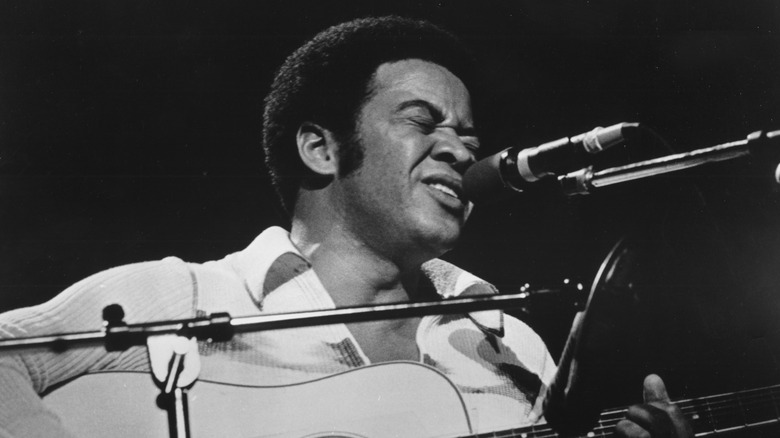
Ain't No Sunshine — Bill Withers
Bill Withers was a 30-something factory worker who'd spent nine years in the Navy when he released his first album in 1971, "Just As I Am." His label chose "Harlem" to be the album's first single, with "Ain't No Sunshine" as the B-side. While "Harlem" failed to gain much traction, a silver lining emerged when DJs discovered the B-side, giving "Ain't No Sunshine" enough airplay that it was eventually rereleased as an A-side. The new single, essentially flipping the old one upside down and placing "Harlem" as the B-side, did the trick. "Ain't No Sunshine" proved to be a breakthrough hit, peaking at No. 3 on the Billboard Hot 100 and putting Withers on the map — along with earning him the first of his three Grammy Awards.
Among his various hits (an impressive list that also includes "Lean On Me," "Just the Two of Us," and "Use Me"), "Ain't No Sunshine" entered the official annals of music history when the song was added to the National Recording Registry by the Library of Congress. In an essay written about "Ain't No Sunshine" being added to the registry, Scott Bradlee (creator of musical collective Postmodern Jukebox) weighed in on the historical and cultural significance of this one-time B-side, stating: "While this record's impact on popular genres like hip hop and acid jazz is undeniable and certainly worth examining, its sonic contributions are secondary to its contribution to humanity at large."