

5 Songs That Prove 1971 Was The Best Year For High School Hits
At its inception in the mid-'50s, rock 'n' roll was geared toward teenage audiences, and by 1971, artists were still writing songs that would resonate with people in high school. To hear those hits today likely brings back memories for those who were still working toward their diplomas back then, but even if you were born decades after the release of songs like David Bowie's "Changes" or Don McLean's "American Pie," the songs on this list are still likely relatable to your teen sensibilities.
High school is a time of exploration, rebellion, and finding your identity. For some, it can also be our earliest experiences with romantic situations. These songs delve into those themes, but also into the loss of innocence teens experienced, which by 1971, was reflected in songs that were less of the bubble-gum variety that was more common in the '50s and early '60s. By the beginning of the '70s, young people had experienced recent tumultuous times, including the Vietnam War and ongoing civil unrest, multiple assassinations of prominent leaders, and the rise of drug culture. The music reflected the times, which often meant non-conformity to social norms.
Three Dog Night's "Never Been to Spain" taps into the yearning for exploration, while The Who's "Baba O'Riley" was originally written as a reaction to the strung-out teens at Woodstock, yet the youth embraced the lyrics "teenage wasteland" as a badge of honor. And then there was Melanie's "Brand New Key," which is the kind of song you can read into, but it's also just the kind of light and silly song that high schoolers may have needed.
Changes — David Bowie
David Bowie's song "Changes" off of his fourth album "Hunky Dory" is a bona fide classic today, but in 1971 when the song was new, it's easy to imagine high schoolers feeling seen and understood by the lyrics: "And these children that you spit on / As they try to change their worlds / Are immune to your consultations / They're quite aware of what they're going through" — especially given the divide between counterculture kids and the adults of the time who gave them little credit.
According to Far Out Magazine, Bowie thought of the song as "kind of throwaway." It was among his first tracks written on piano, and the upbeat rhythm alternates with spare parts, weaving a compelling sonic experience that even incorporates some silky saxophone at the end, possibly to the delight of the high school band kids. While the song didn't make much of a splash upon its initial release, over time, it's become something of an anthem for teens who are in the midst of figuring out who they are as they grow into adulthood.
Brand New Key — Melanie
Melanie's "Brand New Key" was somewhat of an anomaly. The singer-songwriter had been around for a minute, with a couple of minor hits in the late '60s culminating in a performance at Woodstock, and she even went overseas to play the Isle of Wight and Glastonbury music festivals. Then, in 1971, she released "Brand New Key." The song went to No. 1 in December and stayed there for three weeks.
The song sounds poppy and bright, but also unlike other songs of the time. In 1971, "Brand New Key" was considered daring because the lyrical innocence on the surface belied what some read as sexual innuendo, and even though males had written plenty of songs that referenced their desires, when it came to the ladies, that was new. The thing was, even though people read into the lyrics, Melanie said she didn't write it for that reason. She told the website Where Music Meets the Soul, "I was just having a romp through my memory of learning how to ride my bike and roller skating," and remembering early crushes.
If you didn't know, back in the day, roller skates strapped over shoes and needed adjusting; hence, they came with a key. Melanie sang, "Well, I got a brand new pair of roller skates / You got a brand new key / I think that we should get together / Try 'em out and see / I've been looking around awhile / You got something for me ..." The song's catchiness, combined with its innocence veiling perceived innuendo from a female point of view, was enough to get the attention of high schoolers in the early '70s.
American Pie — Don McLean
Don McClean's "American Pie" is a song of lost innocence, famously based on the plane crash that killed early rock stars Buddy Holly, Ritchie Valens, and the Big Bopper (J.P. Richardson), along with their pilot. While that tragedy, forever known as "the day the music died," happened in 1959, kids in high school in 1971 would have grown up knowing of the historical event and having heard those artists' music, and maybe it even resonated that Valens was only 17 when he died in that crash.
"American Pie" was a song with strong ties to youth, as it was young people whose idols were killed, and for whom grappling with such a thing was likely a first, as illustrated in the lines, "Oh, and there we were all in one place / a generation lost in space / with no time left to start again." It also speaks to coming of age in the usual ways, only to have a catastrophe change everything.
The roughly 8-minute-long song was released in October of 1971 and made its way to No. 1 on Billboard's Hot 100, where it stayed for four weeks in 1972. Its success in wrapping up pop-culture history as felt by the youth of America has earned the song many accolades over the years, including being called one of the five greatest songs of the 20th century by the Recording Industry Association of America and the National Endowment for the Arts.
Baba O'Riley — The Who
Why a song that repeatedly says the edgy and provocative words "teenage wasteland" but never says "Baba O'Riley" is named "Baba O'Riley" is its own story, but for the purposes of this article, just accept that it is so. After all, "teenage wasteland" are the words that make the song anthemic, and have done so since The Who released it in 1971. The first track on the band's sixth album, "Who's Next," "Baba O'Riley" calls out the dark side of rock 'n' roll, specifically the way the young audiences over-indulged to the point of self-harm.
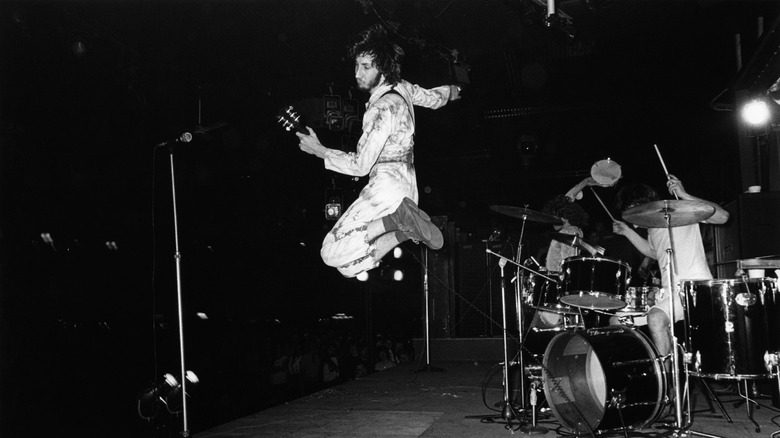
The Who guitarist Pete Townshend said (via Rolling Stone Australia) the song was inspired in part by "the absolute desolation of teenagers after the second Isle of Wight festival, and after the Woodstock festival, where everybody was smacked out on acid and 20 people had brain damage. People were already running toward the culture and its promise of salvation. But not everyone survived."
"Baba O'Riley" may be about kids messing up, but instead of anyone really looking at it as a cautionary tale, the song rocks so hard that it became more of a fist-pumping anthem for young people to own the fact that "they're all wasted!" as the song goes. But if we know anything about songs, it's that often the audiences take whatever meaning they want, regardless of the writer's intent or lack thereof, and it's impossible to imagine a world in which high schoolers in the 1970s wouldn't embrace a song that puts heavy emphasis on the words "teenage wasteland." Because, kids.
Never Been to Spain — Three Dog Night
Three Dog Night's "Never Been to Spain" starts out slow and melodic, but the song builds into one that lends itself to singing loudly in the car with your friends by the end. Though the lyrics are simple and straightforward, they also likely resonated with high schoolers in 1971. By the early 1970s, teens had been exposed to the idea of a wider world thanks to the British Invasion and knowing people a little older than them were being shipped off to Southeast Asia during the Vietnam War, so it's easy to imagine why the lyrics of "Never Been to Spain" were a hit with teens, especially those who may have spent their whole lives in one town. It tapped into those moments when you think about all the places you'd like to see one day.
The song speaks of having been born in Oklahoma but not remembering the state. The narrator also ruminates about the places they haven't been, like Spain and England, saying, "Well, I never been to England / But I kinda like the Beatles / Well, I headed for Las Vegas / Only made it out to Needles." "Never Been to Spain" was released in 1971 and rose to No. 5 on Billboard's Hot 100 in 1972, another of many songs from the 1970s that may stir up emotions in boomers.