

These Musicians Doubted They'd Sing Again After A Health Crisis — Their Comebacks Proved Otherwise
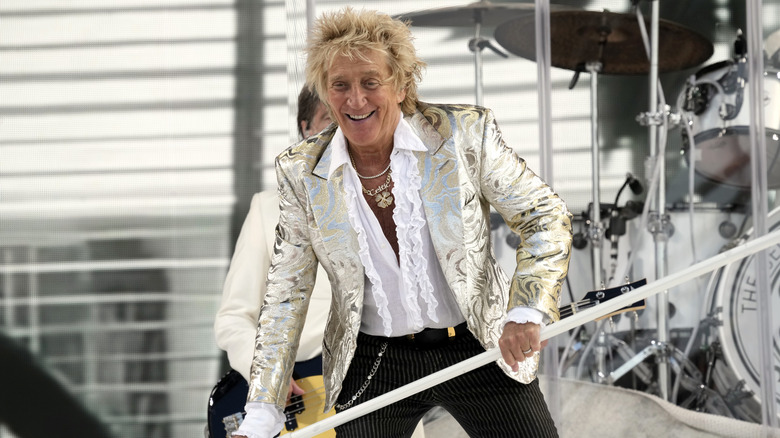
Singers are people, too, meaning they get sick just like everyone else. The stress and strain of touring tax the voice and vocal apparatus on top of diseases and conditions that crop up out of nowhere, especially with age. Some singers have even feared they'd never sing again as a result of their health problems but have come back stronger than ever.
The truth is, musicians of all stripes have experienced health problems, including life-threatening illnesses. In some cases, like Linda Ronstadt's, she completely retired because of Parkinson's. Ozzy Osbourne also had the disease but came back for one final, glorious farewell — the "Back to the Beginning" bash in 2025 — before he died. Famous '80s crooner Michael Bolton is currently experiencing glioblastoma, an aggressive type of brain cancer, while the legendary Bob Marley died because of acral lentiginous melanoma, a type of skin cancer that started on his toe (a tragic detail people tend to forget).
Singers, however, most often have health problems with their instrument: Their throat and all the delicate components of the human voice. While a vocalist like Aerosmith's Steven Tyler never fully recovered from a 2006 vocal injury (incurred while belting that memorable section from "Dream On"), other vocalists did recover and come back — to varying degrees. Bret Michaels of Poison, meanwhile, survived a brain hemorrhage in 2010 and made a full recovery, while Rod Stewart survived cancer — twice.
Klaus Meine — Scorpions
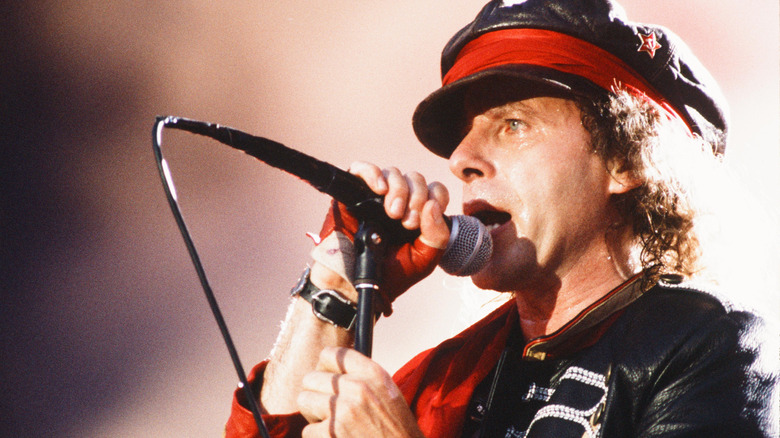
Back in 1982, singer Klaus Meine of German hard rock outfit Scorpions was rolled into a hospital to remove polyps and nodules from his vocal cords. When the vocal folds flap to make noise, they rub against each other and can develop what are essentially calluses in the throat. Those calluses can go away on their own, but not for someone like Meine, singing for a massive touring band whose discography defines rock history. Thankfully, the Scorpions didn't need to cancel any shows for Meine's surgery, but they were recording 1982's "Blackout" at the time. The pressure was on, lest the Scorpions' career falter.
In 2005, Meine told DMME.net that he couldn't even talk after surgery. He went to a gig while recovering and thought to himself, "This is what I used to do. Can I ever do it again?" That's a pretty heartbreaking sentiment. It took six or seven months for him to be able to sing again, although he knew he could always fall back on family life at home if his time as a singer was done.
Thankfully, Meine made a full recovery, and the Scorpions' biggest years were still ahead. Always bigger in Europe than in the U.S., the band scored the biggest global hit of its career years after Meine's medical scare: "Wind of Change" from 1990's "Crazy World," which reached No. 4 on the Billboard Hot 100. The song, which readers will immediately recognize from its opening whistle, became the theme song for the fall of the Berlin Wall in 1989 and the overall disintegration of the Soviet hold on Eastern Europe. Eventually, the track hit the billion-listens club on Spotify, cementing Scorpions' legacy, post-surgery and all.
Elton John
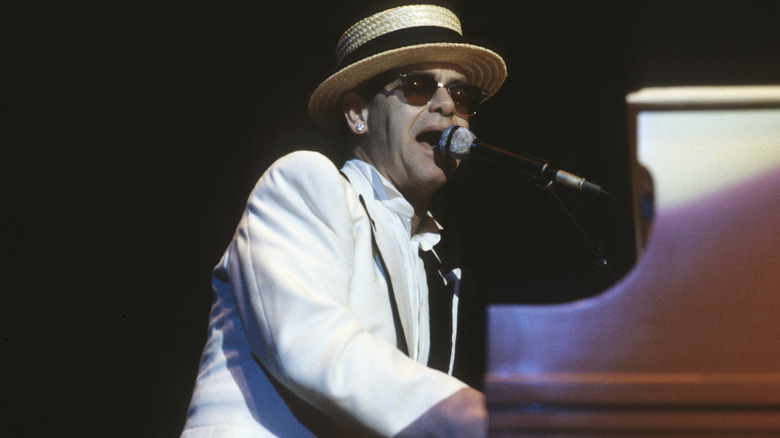
Let's do a little musical comparison. Listen to Sir Elton John perform one of his most famous songs, 1972's "Rocket Man," back when it went to No. 6 on the Billboard Hot 100. Now, listen to that same song performed in 2000. If you're not careful, you might miss a key difference in one of the song's memorable vocal moments. That moment also relates to a voice-changing surgery from 1987, when Elton John completely lost access to his falsetto but saved the rest of his voice and career.
In "Rocket Man," John flips to falsetto on words like "time" from "timeless" in the song's first verse. No matter that we all recognize that bit, it doesn't exist outside of old recordings. Back then and ahead of his 1987 injury, John had done 200 shows over 15 months, a schedule that'd tax even the most well-trained vocalist. He started feeling "spasmodic bouts of pain" in his throat while on tour, as The New York Times wrote, which led doctors to find a "non-malignant lesion" on his throat, as UPI quotes Dr. John Tonkin. "I was booked in to have throat surgery and was worried I would never sing again," John wrote on Facebook. When these nodules got removed, the surgery left John's voice changed forever.
Not only did John lose his ability to sing falsetto, but the entire timbre of his voice also changed. His injury forced him to relearn how to sing properly, right down to fundamental breath control. As he told Billboard in 2004, he became "a singer that plays the piano instead of a piano player that sings." It all worked out, because 10 years after his surgery, he scored the biggest hit of his career with 1997's "Candle in the Wind."
Bret Michaels — Poison

Quite a bit more serious than vocal damage and even career loss, Poison singer Bret Michaels had a brain hemorrhage in 2010 following an emergency appendectomy — just one detail about Bret Michaels you might not know (unless you're a big fan). As the CBC disturbingly quotes him, the hemorrhage was audible — it "sounded like a handgun, like it literally popped." When it happened, he was freaking out and slurring his words, couldn't move his head, and needed to be carted to the emergency room. He told doctors that his two daughters, both in single digits, shouldn't see him in such a condition before he died.
Michaels had suffered a subarachnoid hemorrhage, a type of stroke where a blood vessel bursts at the brain stem and fluid starts to fill the region. It took almost two weeks of intensive, in-hospital care for him to recover. Horrifying as this is, Michaels considers himself lucky. If he hadn't been recovering from his appendectomy at the time, he wouldn't have been home and around family, nor possibly been taken care of so quickly. "It just wasn't my time yet," CBC quotes him. "I really believe that. If I had stayed on the couch for another hour, that probably would've done me in."
While Poison peaked in the late '80s, Michaels hasn't been inactive in the years since, including after his brush with death. He detached himself from Poison to do solo tours where he brings "1,000% energy," as he told USA Today in 2022. Michaels had a more recent diabetes-related incident in 2025 but has otherwise continued trucking on.
Matt Heafy — Trivium
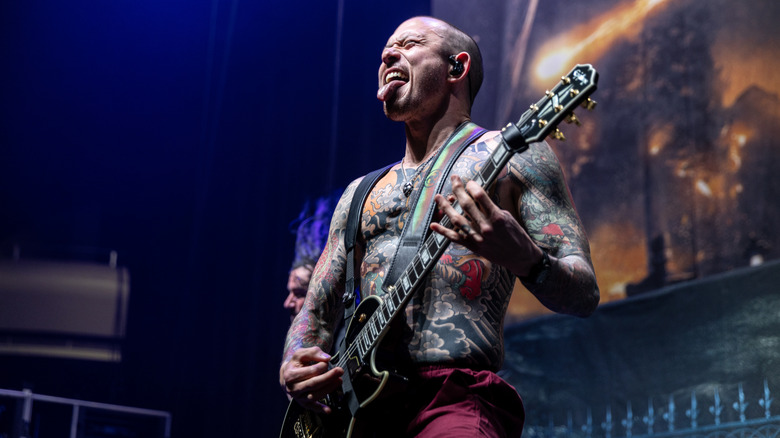
Those who somehow think that harsh (and good) metal vocals are easy to do ought to give it a shot (ever wondered how they scream?). In all likelihood, you'll wind up coughing your guts out or sounding like Kermit the (burping) Frog. But amidst the precise balance between airflow and vocal tension, false vs. true vocal cords, plus the use of throat structures like arytenoid cartilage, it's easy for professionals to make mistakes or never get proper training. Enter Matt Heafy of Trivium, who blends harsh vocals with melodic singing and wrecked his voice so badly in 2014 that the band thought it was finished.
"Blowing one's voice," as Heafy did, is an umbrella term used to describe what is essentially muscle strain, irritation, overuse, etc., in the throat. When Heafy blew his voice in 2014, he'd not only been screaming wrong since his preteen years, but he'd also been straight-up singing wrong, too. He just went on stage and started shredding his voice as well as his guitar. As a result, Trivium had to cancel its shows. This started Heafy's long road to relearning how to do everything voice-related from scratch. In the meantime, Trivium soldiered on but steered 100% clear of harsh vocals with its 2015 album, "Silence in the Snow."
It took until 2024 for Heafy to post on Facebook about recovering the "old voice" that he'd wielded on early Trivium albums. It took one to four hours of practice a day, five to seven days a week, to purge every incorrect habit under the tutelage of voice coach Ron Anderson and of Avenged Sevenfold singer M. Shadows.
Rod Stewart
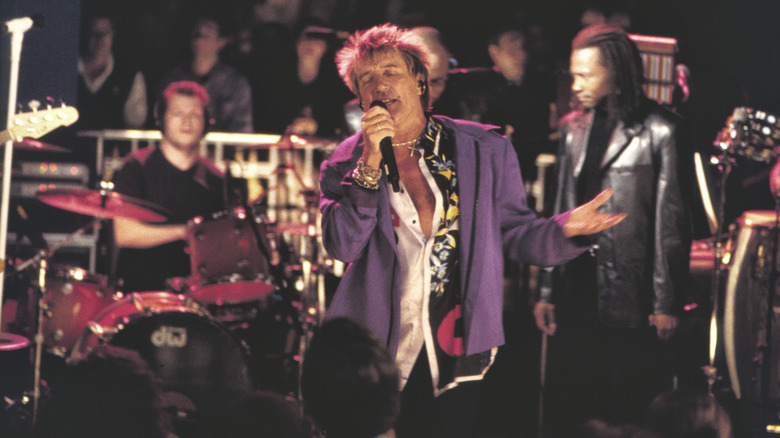
Rod the Mod had a decades-long career extending back to the '60s before he received a terrifying diagnosis of thyroid cancer in 2000 that made his "palms go cold," as Surrey Live quotes. The scene played out much as it's played out for thousands upon thousands of people and families: Stewart was waiting on test results from a routine checkup when his doctor said that they'd found something on his thyroid. The next day he went in for a biopsy, and the results indicated that he had cancer. Malignant, no less.
It only took two days for Stewart to go back to the hospital for surgery. He wanted to keep things hush-hush and even used a fake name when he was in for surgery: Billy Potts. Aside from the cancer itself, there was a risk that Stewart's vocal cords would be slashed. The merest mistake from the surgeon could have ended his career. We all know this didn't happen, though. The surgery was a success, Stewart's brief bout with cancer was over, and he continued on his merry way, amassing over 250 million in record sales over the course of his entire career.
Even though Stewart's biggest decade was the '70s by far ("Maggie May/Reason to Believe," "Tonight's the Night (Gonna Be Alright)," "Da Ya Think I'm Sexy?" went to No. 1 over a seven-year span), Stewart remained active and releasing albums since his surgery. He also, not insubstantially, was diagnosed with prostate cancer in 2017. Per The Guardian, he joked that he's at least never had to get chemotherapy, which has kept his signature hair intact.