

Forget The Charts — Critics Say These Were The 5 Most Successful Solo Careers Of The '70s
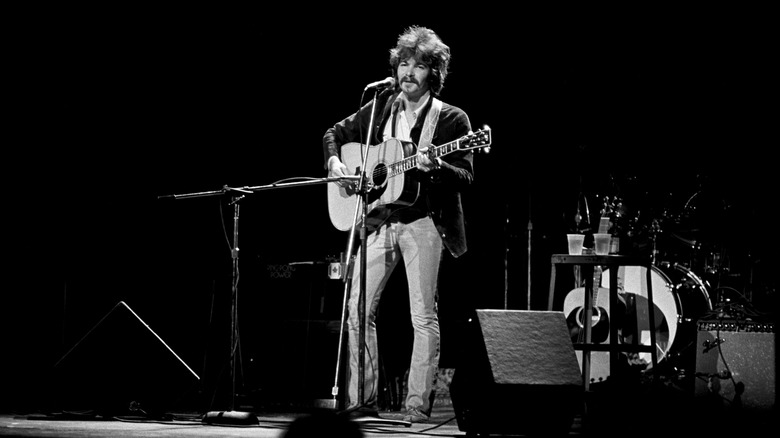
With the 1970s long in our rearview mirror, certain solo artists are obvious standouts, not necessarily because of how they charted back then, but in the way their music is still relevant, how it has remained influential, and the way those musicians innovated songcraft. There are many reasons artists may be critically appreciated, even if they didn't have all the No. 1 hits — not that they can't have that too; some did — but that is not the sole criterion we're looking at as a mark of success as we delve into some of the most critically acclaimed solo artists of the '70s.
The musicians here need no introduction, but we'll highlight their approaches to their craft and how the results helped shape pop culture, because while Captain and Tennille held the No. 1 spot the longest in 1975, those cats had no real sway, not like Neil Young, Joni Mitchell, David Bowie, John Prine, or Marvin Gaye did. What made those legendary solo artists so successful in the '70s was multiple highly regarded albums that earned the admiration of critics, other musicians, and audiences alike, often influencing how we thought about ourselves and the world around us. Today, these artists are still spoken of with reverence. Billboard hits come and go, but staying power and musical influence are the true marks of success.
Marvin Gaye
Even though Marvin Gaye had been with Motown since 1961 and was a successful hitmaker throughout that decade, by the beginning of the '70s, he was ready to stretch his musical capabilities and delve into more personal and meaningful songwriting. Shaken by the ongoing Vietnam War and societal and environmental issues of the day, he crafted his 11th album, "What's Going On," to huge critical and commercial success, and its influence on art as social commentary cannot be overstated. Another thing that made it such a standout was that it was a new kind of record from a Black artist, and Gaye both wrote it and produced it, proving his creative mettle. The songs are purposeful and sound like a perfectly curated tapestry when taken as a whole.
In the '70s, Gaye released several more albums, including what the Rock & Roll Hall of Fame called a "moody masterpiece," 1973's critically acclaimed "Let's Get It On," which delved more into Gaye's sensual side. However, as the BBC noted, "'Let's Get It On' is an iconic, rapturous work, but one very much laced with Gaye's doubt and uncertainty," in part because Gaye had reached the pinnacle of success with "What's Going On," and it was hard to know where to go from there. Variety says that "'What's Going On' changed the sound of R&B forever," and that kind of influence, along with the timelessness of the album, is hard to beat.
Joni Mitchell
In 1971, Joni Mitchell released her seminal fourth album, "Blue," an intimately personal record that earned her much critical acclaim. She was already well known as folk-rock's angel-voiced poet, but in the '70s, and beginning with "Blue," Mitchell began exploring new avenues with her music, making more jazz-leaning records and experimenting with her lyrical content. In 1974, she had her biggest Billboard hit with "Help Me," from her album "Court & Spark." That single went to No. 7, but Mitchell's output was never made for commercial success as much as it was her sincere expression of her craft. Critics noticed, especially in the '70s.
As Pitchfork points out, Mitchell "follow[ed] her muse," and her first 10 albums, the majority spanning the 1970s, were among the finest consecutive releases of any artist ever: "Mitchell was pop's first female auteur, an innovator of singular talent, whose influence was vast, immediate ... and long lasting." Pitchfork writer Jessica Hopper pointed out in 2012 that Mitchell's influence on the modern-day "kiss 'n' tell cottage industry" is still seen in artists like Taylor Swift and St. Vincent.
Mitchell said in 2022 that she thinks that while her albums were critically praised, they didn't get the mainstream attention they should have due to the male-dominated music industry of the '70s, saying, "People thought that it was too intimate ... I think it made people nervous" (via BBC). However, she appreciated that new generations who were influenced by her songwriting are more comfortable confronting their emotions.
John Prine
John Prine could be described as a songwriter's songwriter, the kind of artist those who understand the craft recognize as an authentic talent. His musical origin story underscores that. Interestingly, he was first reported on by Roger Ebert in 1970 — yes, the movie critic, who saw Prine where he regularly played in a little venue in Chicago when he was a 23-year-old postal carrier. He had already written some of his most beloved songs, like "Angel From Montgomery" and "Your Flag Decal Won't Get You Into Heaven Anymore."
Legendary songwriter Kris Kristofferson had heard about Prine too, and in 1971 went to check him out in Chicago at the little club where Prine regularly performed. Kristofferson, who Prine described to Billboard as being "hotter than a two-dollar pistol at the time," knew he'd heard something new and extraordinary in Prine and took him under his wing. Later that year, Prine released his first, self-titled record, followed by three more albums in 1972, 1975, and 1976, and many more beyond the '70s.
Prine was never a mainstream hitmaker, but the San Diego Troubadour's Terry Roland described him in 2020, the year he died, as "a timeless journeyman who reported on the human experience with deceptive simplicity. He made us laugh, cry, think and feel deeply, and gave breath to singular singers like Bette Midler ('Hello in There'), Bonnie Raitt ('Angel From Montgomery'), Johnny Cash ('Paradise'), and George Strait ('I Just Want to Dance With You'), through the power of his words and the unique eccentricities in his mind. He was the embodiment of three chords and the truth."
Neil Young
Neil Young was first known as a member of Buffalo Springfield in the late '60s, but his solo work in the '70s is often considered his sweet spot. Young released "After the Gold Rush," which Classic Album Sundays called "perhaps his first true masterpiece," in 1970, but the album didn't see mainstream success, and Rolling Stone initially panned it. Today, however, it's seen as one of the decade's best, featuring such songs as "Southern Man" and "Only Love Can Break Your Heart." 1972's "Harvest" cemented his reputation as a critically acclaimed solo artist, even though Rolling Stone disliked this record too when it first came out. Meanwhile, Guitar.com called the album "a work of genius" in 2021, which is interesting since that outlet reported that Young once said that how his music is "seen in 30 or 40 years' time" is what he cares about most.
Young released nine solo albums in the '70s, not counting his releases with the band Crazy Horse. Eight of his 11 Billboard hits as a solo artist were from that decade, with "Heart of Gold" hitting the top spot in 1972. His next highest charted song was at 31. As reported in an essay written by Fred Schruers for Young's Rock & Roll Hall of Fame induction, Young was disillusioned with mainstream music after "Harvest," so he said he "headed to the ditch" where there were "more interesting people." From there, Young cultivated a unique body of work that mined the darker places and still came back to rock out with songs like 1977's "Like a Hurricane."
Susan Lacy, Emmy-winning creator and executive producer of "American Masters," sang his praises, saying, "There's no denying Neil Young as music's most uncompromising rock royalty. He's an irreverent poet with a rock and roll heart. His music embodies the arc of American experience, challenges authoritative views, defies industry pigeon-holing and continues to have an impact on musicians and fans worldwide" (via PBS).
David Bowie
David Bowie was a different kind of musician than the others on this list, as his artistry went beyond songcraft to include a heavy emphasis on stage performance and pushing the boundaries of conventional identity. Bowie was prolific in the '70s, releasing 11 studio albums, including "The Rise and Fall of Ziggy Stardust and the Spiders From Mars," "Aladdin Sane," and what became known as his Berlin Trilogy, "Low," "Heroes," and "Lodger."
While the other artists on this list were very embroiled in the time in which they were experiencing life, Bowie was looking ahead and imagining what could be. His fearlessness in the name of experimentation earned him an audience of fans and critics alike who were always curious what he would do next. Time wrote, "The '70s remains Bowie's most visionary era, the time when he established himself as the Nostradamus of modern pop" for the way he seemed to be ahead of coming trends in identity and the way we curate our self-images for the world today via things like social media.
As for his music, it had similar qualities. Robert Hilburn wrote for the Rock & Roll Hall of Fame, "Bowie produced some of the most probing and affecting music of the modern pop era. Writing about the scary monsters in his own life in a society that was re-examining its values, Bowie foreshadowed almost every important trend in pop — from the gender-bending confusion of the glitter era to the soul-searching alienation of '90s rock."