

5 Backup Singers Who Actually Carried These Classic No. 1 Hits
The best musicians are those who know exactly what is best for the song at hand, even if that means standing back and letting someone else's voice shine through for a while. The artists on this list did just that, whether by necessity or pure production instinct, sitting out some of their most iconic musical moments in order to let another singer bring something new. In each of these cases, what that new singer brought was the right stuff, helping send all of these songs to No. 1 on at least one major chart.
Not only does the addition of a renowned backup singer add star power to a song, it also adds a whole new sound that can act as a fun or emotive contrast to the main singer's own. A singer's voice is like a fingerprint, and some unique vocal features just work better for certain lyrics and styles — imagine, for example, if Fleetwood Mac singers Stevie Nicks and Lindsey Buckingham had swapped lead vocal duties so that Nicks sang "Go Your Own Way" and Buckingham led "Dreams." The idea feels alien, demonstrating that the band truly knew who was best suited to what parts. Likewise, the five songs here all feature singers who knew when to farm out vocal moments for maximum impact, leading to their famous backup singers actually carrying some of their biggest hits.
Sting — Money for Nothing
When it comes to a part carrying a song, there's carrying it to completion in an artistic sense, and then there's carrying it into a whole new world of success and legacy. While Sting's feathery falsetto line in the Dire Straits' "Money for Nothing" — sung to the tune of The Police hit "Don't Stand So Close to Me" — can certainly be argued to have accomplished the former, it is without question that it nailed the latter. Yes, Sting's line guides the ethereal, freeform intro, which definitely helps build up anticipation for Mark Knopfler's iconic guitar riff to drop, making it a crucial element of the song. But in a much broader sense, it also gave the song an entire second function as both a generational and corporate anthem.
"Money for Nothing" hit No. 1 in 1985 and helped define that era of rock history. It was a huge hit in its own right and receives consistent radio play to this day, but the decision to use Sting to shout out the newfound Music Television channel was its real stroke of genius. The line "I want my MTV" had been part of the channel's marketing before the song was released, and thanks to its inclusion at the opening to "Money for Nothing," the song was chosen as the very first music video played when MTV Europe launched in '87. The company still uses the line to soundtrack the MTV Entertainment Studios title card as recently as 2026, ensuring the legacy of Sting's backing vocals for generations.
Mick Jagger — You're So Vain
Carly Simon's 1973 No. 1 hit "You're So Vain" is one of those songs that succeeded both on its own merit and thanks to the whirl of circumstance surrounding it. In a vacuum, Simon's ode to post-breakup pettiness is a tightly written and produced piece of songcraft, with a lot of unusual and effective arrangement choices (not least of which being the intro's galloping, arpeggiated bass chords) and infectious melodies, like the "clouds in my coffee" pre-chorus, which could be its own chorus. But what allowed "You're So Vain" to transcend the label of one-and-done pop hit is the song's blatant reference to real-life, personal events — the kind of tabloid-worthy fodder that the public will forever gobble up greedily — and that's where uncredited, but easily detectable once looked for, backup singer Mick Jagger comes in.
After tackling the first chorus alone, Simon enlists Jagger's backing vocals to bring the remaining choruses to the next level, not only by doubling her melody but also by inserting a man-woman duet into a song in which that woman has been calling out her former lover. The implication is that Jagger himself is one possible candidate for "You're So Vain's" mysterious subject. Even if Jagger were not the accused, the inclusion of a male counterpoint immediately makes the song's central feud seem more than just a one-sided complaint. Eventually, Simon told People that the second verse, at least, is actually about Warren Beatty, though the song's two other subjects remain a mystery.
Michael Jackson — Somebody's Watching Me
Ah, Rockwell. Though you won't hear much about the singer these days, or for very long in his own day, frankly, his brief time in the spotlight might have amounted to the perfect musical career. He slipped into the music industry relatively quickly and easily, almost immediately dropped a tremendously successful single before his first album's release (though it only hit No. 2 on the Hot 100, it did land No. 1 on the Hot R&B/Hip-Hop Songs for a solid five weeks), and within about two years had retired from music. The best part: the hit single, "Somebody's Watching Me," with its paranoid lyrics and haunted house music video, became an instant staple of Halloween playlists everywhere, meaning steady royalties for decades.
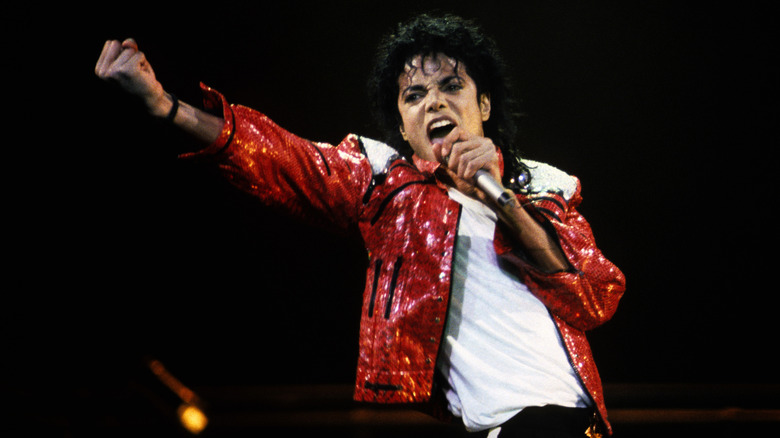
Though "Somebody's Watching Me" is undoubtedly Rockwell's song through and through — he wrote the lyrics and music, as well as arranging and producing almost all of it himself — you would be hard-pressed to find a single soul who didn't cite the memorable chorus hook as the song's highest and most memorable point. And though part went uncredited, it was obvious to all who heard it that Michael Jackson, Rockwell's childhood friend, was the hook's singer. While Jackson's melody is a singable earworm, Rockwell's own vocal parts are just eccentric with an oddly-affected accent, befitting his own really weird personality. In short, Rockwell owes Jackson a lifetime of thanks for taking a song with solid bones and actually breathing it to life.
John Lennon — Fame
In 1975, David Bowie landed his first No. 1 hit in the States with "Fame," a tremendously catchy tune that is equal parts funk and angular oddness — a distinctly Bowie mixture. There's plenty on offer in the song: the snappy central guitar riff, Bowie's scathing indictment of the music industry and celebrity worship, and, of course, the almost constant refrain of "Fame," with Bowie's voice always echoed closely (debatably a beat closer than you'd normally expect) by another. That other voice is John Lennon's, whose falsetto not only fits with Bowie's but gives the song one of its most memorable hooks.
As both Lennon and Bowie have revealed, Lennon's involvement on the track, not only as a backup singer but also as a writer, was all but written in the stars. During his commencement address at Berklee, Bowie called Lennon his "greatest mentor," citing him as a chief creative inspiration. Likewise, Lennon felt that helping Bowie achieve his first chart-topper was poetic, once musing that "He got his first Number One [with "Fame"]. I felt like that was like a karmic thing, you know? With me and Elton [John], I got my first Number One ('Whatever Gets You Thru The Night'), so I passed it on to Bowie and he got his" (via johnlennon.com). In Lennon's mind, after Elton John's backing vocals had helped Lennon take 1974's "Whatever Gets You Thru The Night" to No. 1, it was an apt passing of the torch to help his "mentee" reach the same mountaintop.
Linda Ronstadt and James Taylor — Heart of Gold
Neil Young's 1972 minimalist masterpiece "Heart of Gold" is proof that, with the perfect blend of ingredients, very little can go a very long way. The vast majority of the song is carried by Young's own guitar, harmonica, and vocals, with the sparse backing band mixed into a softer, background role. The song's structure is also simple, comprised solely of repeated verses broken up by harmonica solos and likewise, the arrangement remains mostly the same throughout. That unassuming backdrop is what helps the outro section stand out so much. That, and the addition of legends Linda Ronstadt and James Taylor entering to harmonize with Young.
It came together when Ronstadt and Taylor happened to be in Nashville, where Young was recording. Young got word and made the quick call to bring the two stars in. In addition to contributing to "Old Man," the pair added their distinct voices to the ending of "Heart of Gold," just what the song needed to stick the landing. Taylor's signature buttery soft voice, alongside Ronstadt, who sang wonderfully for someone at the very top of her register, take the central message of "Heart of Gold" to the next level, transforming Young's lone yearning into a common, universal desire.