

5 John Denver Songs That Prove 1974 Was The Best Year Of His Career
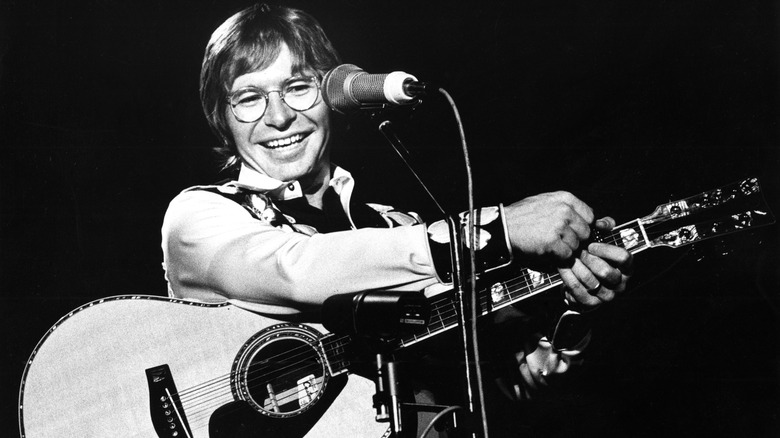
John Denver's career had many high points, but there's no doubt that the catalog he released across 1974 was the best he had to offer in any single year. Denver, whose real name was Henry John Deutschendorf Jr., was an iconic proponent of a new-age Americana lifestyle across his career, which peaked in the '70s but lived on beyond. He blended country and folk music into a style that could grip wide audiences with songs like the iconic "Take Me Home, Country Roads," which appealed to fans of all types and even became the anthem of Oktoberfest in Germany. 1971, the year in which this iconic track was released, was certainly one of Denver's best as a musician, but it wasn't the strongest he had.
A short time later, 1974 balanced chart-topping hits with high-quality deep cuts in what became, without a doubt, the best year of his career. The No. 1 hits "Thank God I'm a Country Boy" and "Annie's Song" are two of Denver's highest-profile tracks of the year, but it's the depth of the rest of these five songs that sets the year apart. In this list, we'll head back to 1974 to remember just how great these songs were.
Thank God I'm a Country Boy
John Denver's 1974 was mostly defined by the full-length work he released in June, the album "Back Home Again." Though it wasn't released as a single until the spring of 1975, "Thank God I'm a Country Boy," originally written by John Sommers, was the fifth track on this standout album. It would eventually become one of Denver's four No. 1 hits.
A definitive country anthem, "Thank God I'm a Country Boy" has since become one of Denver's most iconic tracks aside from the obvious "Take Me Home, Country Roads." Lyrically, it's carefree and fun, with a blissful magic of the simple: "Well, I got me a fine wife, I got me ole fiddle / When the sun's coming up, I got cakes on the griddle / And life ain't nothin' but a funny, funny riddle / Thank God I'm a country boy." It has a classic Appalachian feel, with swirling strings and snapping percussion paired with homey harmonies and Denver's reedy voice.
Annie's Song
"Annie's Song" is another of John Denver's most iconic hits, and it's considered among his best songs. Today it's his second most popular track, with over 300 million streams on Spotify alone. This sweet ballad is representative of the heights of feel-good, easy-listening music that he was capable of. Structurally, "Annie's Song" is quick and simple, with only a chorus, one verse, and a final repetition of the chorus. It's a much slower tune than the former entry, but fans in '74 liked all sides of Denver, with "Annie's Song" spending two weeks at No. 1 during the summer.
The gentle, swaying tune is simple but flowery in its depiction of love. Denver's voice takes on a natural sweetness over the traditional instrumentation, and its lyrics reflect this theme with similar imagery: "You fill up my senses, like a night in a forest / Like the mountains in springtime, like a walk in the rain / Like a storm in the desert, like a sleepy blue ocean." "Annie's Song" is a gorgeous tune, and a joy to hear on each repeated listen.
Back Home Again
This title track and album opener sets the scene as fittingly as possible for the record to come, and it's a perfect example of the themes and songwriting style John Denver was known for in the early '70s. "Back Home Again" renders its moment of homecoming, a timelessly relatable feeling, in rich detail and contemplative memories. Even with all the John Denver on the charts in '74, this song took off nonetheless, reaching the top five on the Billboard Hot 100 by early November.
"Back Home Again" is beautifully laid out, driven by an engaging chorus that's made memorable by its addicting harmonies: "Hey, it's good to be back home again / Sometimes this old farm feels like a long lost friend / Yes, and hey, it's good to be back home again." It's a definitively country story, though it's relatable to anyone, painting scenes of warm fires and valley storms and wide highways. Denver's Americana pen, as genuine as one comes, makes "Back Home Again" one of his standout tracks, and it's further proof that he was at the top of his game in 1974.
Sweet Surrender
At five and a half minutes, "Sweet Surrender" is the longest song featured on this list. It balances a reserved yet pretty tune with a message that represents John Denver's entire musical philosophy, a worldview often parallel with idealism. Of course, it still calls upon much of the expected Denver imagery and themes: forgotten highways, nature and its beauty, and the promises of tomorrow. The soft ballad was respectably successful on the charts, entering at the end of '74 and peaking at No. 13 in early '75.
"Sweet Surrender" again incorporates the harmonies that made Denver's music just so listenable in the early '70s, as the vocals slowly build into a larger-than-life chorus by the song's final repetitions: "Sweet, sweet surrender / Live, live without care / Like a fish in the water / Like a bird in the air." It acts as an appropriate note to reflect on toward the end of the album, leaving "Back Home Again" in a thoughtful, optimistic place. Denver's style is as peaceful as ever, with "Sweet Surrender" leaving a brilliant impression no matter the amount of listens.
This Old Guitar
"This Old Guitar" was never released as a single, but this deep cut from "Back Home Again" is as fitting a final statement for John Denver's 1974 as any. "This Old Guitar" is the closing track of the album, situated right after "Sweet Surrender." The soft acoustic song brings out another essential Denver style of songwriting, structured with three verses and no chorus.
"This Old Guitar" is a pensive reflection on Denver's career and his passion, and it's an extremely pleasant listen in its removal of any ambiguity, with a straightforward message from artist to consumer: "This old guitar gave me my life, my living / All the things you know I love to do ... Most of all, to sing my songs for you / Ooh, I love to sing my songs for you." It's a fitting closing to this excellent album, and "This Old Guitar" brings more personality — that of a thoughtful, real person — to the performer who dominated the charts of 1974. In all styles and types of songs that John Denver excelled at, this year showcased his best at all of them, making it the clear best year of his storied career.