

5 Songs You Didn't Know John Denver Wrote For Other Famous Musicians
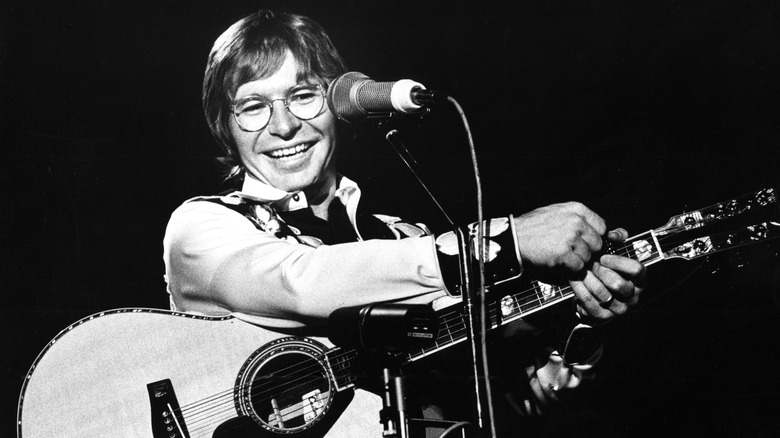
Not only was John Denver a 1970s luminary in his own right, but he also provided the musical fodder with which plenty of other artists in the '60s and '70s found success. As the folk movement of the 1960s gave way to the singer-songwriter era of the 1970s, Denver bridged the gap between those two similar yet ultimately disparate approaches to heartfelt vocalizing with the accompaniment of an acoustic guitar. Those songs prove that Denver was the ultimate idealist of the '70s, combining pop, rock, folk, and country to create some of the decade's most definitive soft and sweet sing-along classics.
Denver wrote so prodigiously and with such enthusiasm that he could afford to share. Some of the best John Denver songs that aren't "Take Me Home, Country Roads" are tunes that the multi-skilled singer, songwriter, and guitarist wrote for other people, including the classic '60s act Peter, Paul and Mary and the legendary Frank Sinatra. As a result, these notable John Denver songs ended up being far more famous as covers.
For Baby – The Sandpipers
In the late 1960s, the Sandpipers were briefly a novel, soft pop phenomenon. With light instrumental backing, the mostly male group used extensive vocal harmonies and some occasional female vocalizing to interpret well-known songs and standards. Associated with the 1960s folk scene, the Sandpipers are best known for their novel variations of "Guantanamera" and "Louie, Louie," and for helping John Denver earn an early hit as a songwriter with "For Baby."
Also known as "For Baby (For Bobbie)," "For Baby" is a musically delicate but lyrically aggressive song from Denver in which a character proclaims his love and promises all the things he'll do to prove those feelings, and how the wind, leaves, and birds will acknowledge them. Denver's performance has a spot on his 1972 album "Rocky Mountain High," while the Sandpipers first got the public acquainted with the song. "For Baby" appeared on their 1967 self-titled LP and was a No. 31 hit on the easy listening chart.
Leaving on a Jet Plane – Peter, Paul and Mary
Peter, Paul and Mary were among the biggest pop stars of the 1960s folk scene, and they found fame by interpreting the work of some of the era's greatest songwriters. "Blowin' in the Wind," Bob Dylan's classic, never hit No. 1, but Peter, Paul and Mary's version is the definitive take, and they took it to No. 2 on the charts. Another haunting, heartbreaking, and harmony-loaded single from Peter, Paul and Mary, and one that did manage to top the charts, is 1969's "Leaving on a Jet Plane," written three years prior by John Denver.
Capturing the emotional ache of bidding a loved one farewell before a journey and a long time apart, "Leaving on a Jet Plane" was originally titled "Babe, I Hate to Go," after a chorus line, and it showed up on the independently released "John Denver Sings," and then again on the 1969 major label "Rhymes & Reasons" but under its better-known name. Mary Travers of Peter, Paul and Mary was so taken with the Denver song that she suggested her group sing it for "Album 1700," and the recording topped the Hot 100 for a week in December 1969.
Follow Me – Mary Travers
After Peter, Paul and Mary officially broke up in 1970, breakout star Mary Travers quickly pivoted to a solo career. When recording her first songs outside of the group for which she'd been a vital part for nearly a decade, she sought out the songwriter who'd given Peter, Paul and Mary its most successful single: John Denver, whose tune "Follow Me" got Travers onto the charts.
The 1971 LP "Mary" is mostly a collection of the powerfully and passionately piped singer's spins on the tender and sensitive compositions of acclaimed early '70s songwriters. Along with tunes by Elton John and Bernie Taupin, Paul Simon, and poet Rod McKuen, Travers recorded three songs originally composed by Denver. Only one single taken from the "Mary" album made it onto the Hot 100, and it was a Denver tune, "Follow Me." A vulnerable plea from one romantic partner to another, "Follow Me" depicts a person asking for understanding and devotion, and offering the same in return. Travers' only solo entry ever on the pop chart, "Follow Me" peaked at No. 56 in 1971.
My Sweet Lady – Cliff DeYoung
American record buyers' appetite for John Denver material reached insatiable levels in the mid-1970s, such that made-for-TV movies could generate hits from other people covering the singer-songwriter's work. This was the case for 1973's "Sunshine," which employed the use of seven Denver songs, including hits like "Sunshine On My Shoulders" and "Take Me Home, Country Roads," as well as more obscure gems like "My Sweet Lady," all written or co-written by the folk-rock icon.
A romantic melodrama based on the life story of Jacquelyn Helton, who died of bone cancer not long after welcoming a baby and getting married, "Sunshine" starred rock musician and Broadway performer Cliff DeYoung as the musician husband. It spawned a TV series and a sequel TV movie, and it made DeYoung's impassioned, in-character performance of "My Sweet Lady" a hit. Once recorded for Denver's 1971 album "Poems, Prayers & Promises," it was released as a single to promote a 1977 hits compilation and peaked at No. 32. DeYoung's "My Sweet Lady" was far more popular, climbing to No. 17 on the pop chart in 1974, and No. 7 on the adult contemporary list.
Like a Sad Song – Frank Sinatra
Frank Sinatra was one of the biggest singing sensations of the 1940s, when he made his name crooning what's alternately been called traditional pop or jazz. However, by the 1970s, Sinatra wasn't the prolific hit-maker he once was, being more of a legacy artist whose music, both old and new, could garner some airtime on radio stations specializing in easy listening. That genre is a wide tent that includes anything soothing, soft, and pleasantly inoffensive, adjectives that could also describe the '70s output of John Denver. And so, in 1976, those two stars' career trajectories crossed paths.
The mega-star of the present collaborated with the mega-star of the past, resulting in both enjoying a hit with "Like a Sad Song." A Denver original, it appeared on the musician's 1976 LP "Spirit" and reached the pop Top 40. Around the same time, Sinatra recorded a smooth cover backed with strings, and Reprise released it as a standalone single. It made it up to No. 31 on the easy listening chart, and was one of the final hits of Sinatra's legendary career.