

The 5 Best Drum Solos In Rock History
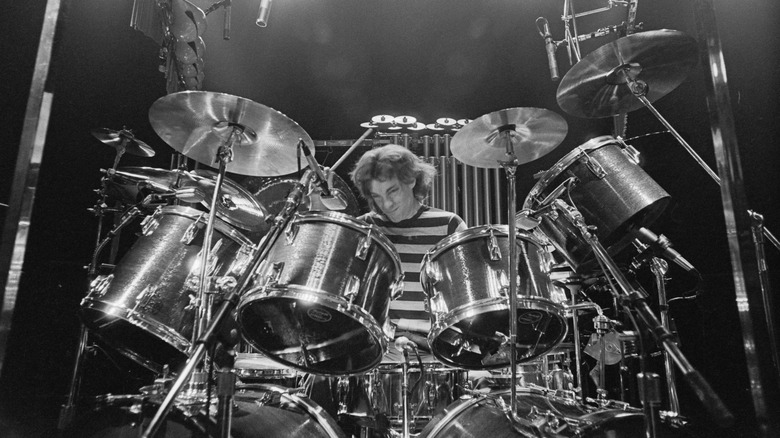
Removing the drums from a band is like removing the spine from a body — it just can't move. And while every genre of music has had god-tier drummers (Buddy Rich, anyone?), rock gives drummers a unique chance to blend power, energy, pocket, technical chops, and flash. The entire history of rock has granted us some amazing drum solos from profound drummers.
When selecting the best of these solos, it's tricky choosing only five across seven-plus decades of rock going back to the 1950s (with a lineage going back to the '20s). Technical and creative standards have risen quite a bit since the days of Johnny B. Goode. We've got to choose drum solos of such a high caliber of skill and inventiveness that they not only shone in their day, but continue to impress now. Some classic rock drum solos give us chills, like Ringo Starr's drum solo on "The End," but that's because it was his only drum solo across the Beatles' entire run, not that it was mind-blowing in and of itself. Also, bear in mind that a drum "solo" doesn't need to mean that all other instruments stop, in the same way that a song continues while a guitar solos, although this might be the case.
In the end, we're drawn to classic rock's peak because of its emphasis on superlative musicianship. This means drum solos from some of history's greatest drummers, like Neil Peart and John Bonham, as well as appearances from the likes of Bill Ward and Keith Moon.
YYZ — Neil Peart
We all knew that a Neil Peart solo had to be on this list, right? The Rush drummer comes up again and again in every list of greatest drummers ever, and rightfully so. Endlessly inventive, driven by his innate rhythmic ear as much as technical learnedness, characterized by insane limb independence (the rest of us can stick with patting our heads while rubbing our bellies), Peart didn't just blow audiences away with his percussive performances before he died in 2020; he was also Rush's lyricist. Nowhere better do we hear his profound talent at play than on one of Rush fans' favorite tracks, "YYZ." The studio-recorded version from 1981's "Moving Pictures" is impressive enough, but his drum solo from the song's live version on 1981's "Exit ... Stage Left" is one of the greatest solos, ever.
The "Exit ... Stage Left" version of "YYZ" contains a three-minute-plus-long drum solo of interlocking grooves, fills, some of Peart's unparalleled limb independence we mentioned (especially the kick drums), woven into a single percussive wave of absolute virtuosity that propels the song onward. The solo even contains distinctly composed sections where the drums act melodically, as though Peart is a one-man orchestra.
This drum solo has gotten scrutinized and cited countless times over the years, serving as both a tool of analysis and inspiration for generations of drummers. Thankfully, Rush's new touring drummer, Anika Nilles, won't have to reproduce such insanity behind her kit, no matter that she's already won over the band's most loyal fans. Peart, however, remains irreplaceable.
Moby Dick — John Bonham
Like Neil Peart, Led Zeppelin's John Bonham is another drummer who you'd 100% expect to have a solo on this list. Considered one of the greatest rock drummers to ever live, and placed at the top of many such lists, Bonham is a drummer about whom it'll sound like we're exaggerating if we praise his abilities, but about whom we're really just speaking the truth. If a track like "The Ocean" convinces you that Bonham is a superb drummer, then the drum solo from "Moby Dick" from 1969's Led Zeppelin II" will convince you that he was a world-class percussionist of shocking skill.
The original drum solo on "Moby Dick" takes up basically the last three minutes of the song. It moves through several passages, incorporates an amazingly intricate interplay of drum types and what's come to be known as "Bonham Triplets" that give the illusion that Bonham is playing in some odd time signature (the song is in standard 4/4 time). Such talent is rendered tragic because of Bonham's sudden death, which basically ended Zeppelin.
But if there's one artifact that portrays Bonham's skill not only as shocking, but practically terrifying, it's his nearly 17-minute-long version of this drum solo played at Earl's Court, London, in 1977. Bonham dedicated this performance to his son, who was in the audience. All the other members of Zeppelin, plus no doubt the audience, could do little but watch Bonham go on and on, relentless and with seemingly infinite stamina, permutating through fill after fill, roll after roll, and sequence after sequence. This performance is possibly the one, single greatest drum solo in the entire history of rock.
Won't Get Fooled Again — Keith Moon
The Who's Keith Moon wasn't just an infamous drummer who earned a bad reputation in the music world for equipment-destroying antics like stuffing his kick drum with fireworks (until he was remembered fondly, that is). He was also a brilliant drummer. His micro-sized drum solo on "Won't Get Fooled Again" from 1971's "Who's Next," which we could define as a kind of prolonged drum fill that leads into the song's outro, isn't the longest, flashiest, or most technically demanding of the solos in this article. But it's so punchy, instinctively spot-on, and energetic — like Moon himself — that it stands as one of the best in rock history. And yes, for those who are wondering, this solo comes before Roger Daltrey's "Yeah!" that's blessed so many beloved "CSI: Miami" David Caruso one-liner and sunglasses-donning memes. Bonus points all around.
Moon's solo comes in at a place in "Won't Get Fooled Again" that might seem odd on the surface, but fits perfectly. Landing around the seven-minute, 30-second mark of an eight-minute, 30-second song, "Won't Get Fooled Again" has been building and building over its entire length and builds towards one final, penultimate release — and it totally nails it thanks to Moon. Tom-heavy, interspersed with snare hits and a single cymbal crash, the solo lasts a mere 15 seconds or so, but hits harder because of it. In fact, it sounds like Moon is about to go off for several minutes or so, but that's exactly when the song's main theme kicks in one final time. It's ironic that such a masterclass in restraint and precision came from a drummer believed to be so out of control.
Rat Salad — Bill Ward
Bill Ward doesn't get enough credit or attention for his role in Black Sabbath. Crisp and brutal, groovy and technical in equal proportions, big Sabbath hits like "War Pigs" from 1970's "Paranoid" show precisely how stank-face inducing and thoughtful his playing was. But it's a tiny track from the same album that really let Ward cut loose, easily overlooked and tucked between chunkier songs: "Rat Salad." It's an instrumental-only, riff-heavy, funky track that showcases Sabbath's connection to '70s psychedelia as much as it does Ward's jazz roots.
Coming in at about one-minute, 15-seconds when the other instruments drop out, Ward melts your face with an intricate, improvised combination of syncopated, stuttered, swing-like tom strikes (long hit, short hit combinations), snare rolls, triplets (three hits to a beat), and more that sound suited to big band music more than "heavy metal" (a term that was still evolving at the time). Typically, Ward would construct his parts around Sabbath's other players, filling gaps and following their lead to know what to play.
As Ward told Modern Drummer in 2020, "I play orchestration; I play back to what comes at me. I build structures around things. And I make allowances for the bass to sweep over me and for Tony [Iommi] to break through." Ward was still doing the same thing on "Rat Salad," building off the rhythm of Iommi's main riff, but running with the rhythm and evolving it into its final form: a standout, completely disgusting solo that ranks amongst the best that rock ever offered.
In-A-Gadda-Da-Vida - Ron Bushy
Ron Bushy's drum solo from Iron Butterfly's 1968 magnum opus, "In-A-Gadda-Da-Vida," is our dark horse candidate and easily the least known of our choices. Lasting for about three minutes of the song's 17-minute length, it comes in at about six minutes, 30 seconds, and gets a reprise around the 13-minute mark before receding into the background to allow some guitar and organ shenanigans the chance to shine. If you only ever heard the extremely truncated, three-minute-long radio edit of "In-A-Gadda-Da-Vida," you'd never hear any of this.
Bushy's solo is a tribal, pounding, extremely in-pocket groove. The kick drum on each beat powers the solo forward as Bushy dances atop it in a measured, even semi-restrained way. His solo takes the hand of the listener, rather than smashes them in the face, and ushers them into the song's next segment. Just to illustrate how well received Bushy's work was on "In-A-Gadda-Da-Vida," Rolling Stone quotes Ringo Starr once telling Bushy at dinner that he nicked "a part of your drum solo in 'In-A-Gadda-Da-Vida'" for his only Beatles' drum solo in "The End."
Believe it or not, though, and in true mythical fashion, the most jaw-dropping version of Bushy's solo came from Iron Butterfly's final performance in 2012, featuring all four original band members, Bushy included. Before his heart-wrenching death some nine years later in 2021, Bushy delivered a gonzo, pounding, relentless, and oozingly cool rendition of his drum solo, full of rhythmic change-ups and just as much explosive energy as he had in his youth, if not more. This was a fine and fitting way for one of rock's greatest drum solos to go out.