

5 Classic Albums That Define Soft Rock
It's a sound once reviled by rock purists, but now, boomers, millennials, and Gen Z have embraced it unironically. Call it easy listening, yacht rock, or pop rock — soft rock has been the soundtrack to so many summers since first emerging in the mid-'60s. Though it wasn't as mind-blowing as prog or as headbanging as hard rock (both of which arrived on the scene at the same time), many found this mix of pop, folk, and rock as refreshing as a piña colada on a hot July day. After all, there was a dark side of the 1960s, and after those turbulent times, a touch of "easy listening" took the edge off.
Soft rock blossomed in the 1970s and into the '80s, with many artists releasing albums and songs that defined the genre. And the impact wasn't limited to those decades. In the streaming era, new fans are discovering the smooth sounds of soft rock, so even flop songs are earning respect from younger generations. These young listeners are also discovering the foundational albums of this genre, full of summer breezes, hazy dreams, and more.
Summer Breeze — Seals & Crofts
If there is a definitive, quintessential soft rock song, it's Seals & Crofts' "Summer Breeze." Jim Seals and Dash Crofts had been involved in the rock scene before forming their eponymous duo, playing together in bands like Dan Beard and the Crew Cats and the Champs. "We've been in the hard rock scene for a long, long time, and we never mind hearing it and being around it," Croft said in 1971 (via Variety). "But playing it gets to be pretty tough physically after a while. ... It's such a nice relief to just sit and play pretty stuff for a change."
"We were tired of loud music," said Croft (via Texas Monthly). "We were tired of rock and roll." So, they began Seal & Croft, releasing a handful of albums to little fanfare. But in 1972, they had their big breakthrough when the title track to their fourth album, "Summer Breeze," became a hit, reaching No. 6 on the Billboard Hot 100. With its distinct opening and mesmerizing vocal harmonies, the song became the soothing reprieve that audiences were looking for.
The "Summer Breeze" album reached No. 7 on the Billboard 200, eventually going double-Platinum. The follow-up, 1973's "Diamond Girl," reached new commercial heights — the LP went to No. 4 on the album charts, and the title track peaked at No. 6 on the Hot 100. Though they broke up in 1980, Seals & Croft's "Summer Breeze" has remained a seminal album for the soft rock genre, influencing acts for years to come.
Tapestry — Carole King
Carole King ascended to a level of music royalty with her second album, "Tapestry." Released in 1971, her sophomore release included the chart-topping "It's Too Late" and "I Feel the Earth Move," Top 20 hits "So Far Away" and "Smackwater Jack," and her version of "You Got a Friend" (which her friend, James Taylor, turned into a No. 1 hit). The LP earned King the album, song, and record of the year at the 1972 Grammy Awards, but even if it didn't win its accolades, it would still be considered a landmark soft rock album.
"Tapestry" was a turning point for King's life. At age 28, she split from her husband and songwriting partner, Gerry Goffin, to relocate to Los Angeles with her daughters. She had co-written hits for so many others — "A Natural Woman" for Aretha Franklin, "Pleasant Valley Sunday" for the Monkees, and "Up on the Roof" for the Drifters. But as Taylor told The Guardian, "Tapestry" was when King started "writing by herself, about herself — that is to say, from her own life."
"It came out of her so strong, so fierce and fresh," Taylor said. "So clearly in her own voice. And yet, so immediately accessible, so familiar: you knew these songs already." With "Tapestry," King showed how there could be artistry to soft rock. The album continues to influence music stars, with Lucinda Williams, Margo Price, Natalie Merchant, Stephin Merritt, Lucy Dacus, and Bethany Cosentino all singing its praises.
Aja — Steely Dan
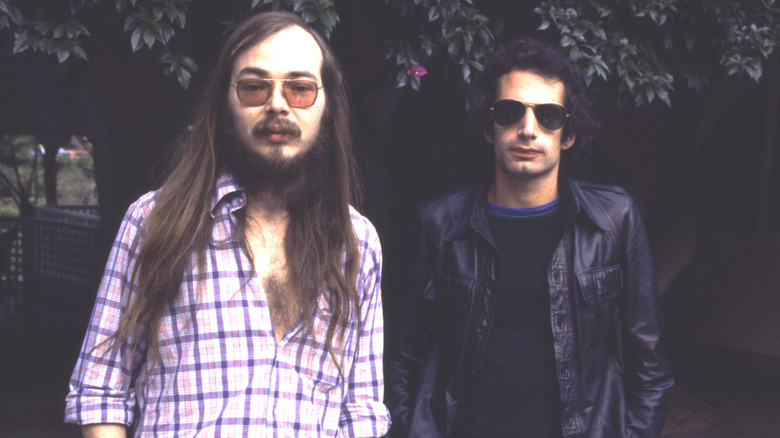
On September 23, 1977, a jazz-adjacent, studio-only duo (named after a marital aid from a William Burroughs novel) released their sixth album. Unbeknownst to Walter Becker and Donald Fagen, the two souls behind Steely Dan, their "Aja" LP would become a soft rock masterpiece. More than five decades later, it still resonates with fans, both young and old. And how could they know? When first reviewing it, Rolling Stone argued that the album would add fuel to the fire that Steely Dan's music was "soulless," overtly "sophisticated," "calculated," and "antithetical to what rock should be."
Yet, "Aja" proved that audiences wanted that expertly produced, refined sound. The album went to No. 3 on the Billboard albums chart, while "Peg" and "Deacon Blues" were both Top 20 hits on the Hot 100. Yes, there is an undeniable polish to the album: Big-box department stores reportedly would use "Aja" when demoing their high-end stereo systems, and the LP won the Grammy for best engineered recording (non-classical) in 1978. But "Aja" is also incredibly charming. From the opening notes of "Black Cow" to Michael McDonald's backing vocals on "Peg," it's a remarkable work of smooth precision. Steely Dan's "Aja" has continued to earn fans, including Rolling Stone, which, in 2021, named it the 63rd greatest album of all time.
Private Eyes — Hall & Oates
There wasn't one but two names that embodied soft rock in the 1980s: Daryl Hall and John Oates, better known as Hall & Oates. With their 1981 album, "Private Eyes," Hall & Oates took the "easy listening" grooves out of the '70s and into the new decade. The release spawned two massive hits, "I Can't Go For That (No Can Do)" and "Private Eyes," both of which went to No. 1 on the Billboard Hot 100.
"Private Eyes" was actually Hall & Oates' 10th (!) studio album. Though they're a band so strongly associated with the 1980s, Hall & Oates actually formed a decade earlier. The duo released a string of so-so albums — "Whole Oats," "Abandoned Luncheonette," and "War Babies" — before scoring their first hit, "Sara Smile," in 1975. They went to No. 1 for the first time in 1976 with "Rich Girl," a song that mixes the Philadelphia soul and the pop of the day to make a charming soft-rock hit. Over the next six years, Hall & Oates would be hot and cold with success, releasing albums that didn't chart and songs ("Kiss on my List") that'd go to No. 1. "Private Eyes" established them as legit stars, with a perfectly balanced sound of soft rock, new wave, and blue-eyed soul.
Rumours — Fleetwood Mac
At this point, what hasn't been said about Fleetwood Mac's "Rumours"? The band's eleventh album (and second with Lindsey Buckingham and Stevie Nicks) is their most famous and most successful. It went to No. 1 in the U.S. and U.K., won album of the year at the 1978 Grammys, and sold over 40 million copies, becoming the sixth-best-selling album of all time. And considering that the story behind Fleetwood Mac's "Rumours" is pretty wild, it's almost shocking that this soft rock masterpiece got made in the first place.
Nicks and Buckingham's relationship had fallen apart. Christine McVie and John McVie had divorced, and she wrote "You Make Loving Fun" about her new boyfriend, the band's lighting designer. Mick Fleetwood's marriage to model Jenny Boyd was disintegrating (his affair with Stevie Nicks didn't help). "We refused to let our feelings derail our commitment to the music, no matter how complicated or intertwined they became," wrote Mick Fleetwood in his 2014 memoir, "Play On: Now, Then, and Fleetwood Mac." "It was hard to do, but no matter what, we played through the hurt."
The hurt created what Rolling Stone called "gleaming, melodic public art" and one of the top 10 best albums of all time. "Rumours" was a finely crafted mix of pop and rock. The album gave the band their sole No. 1 song on the Billboard Hot 100, "Dreams," while "Don't Stop" and "Go Your Own Way" were Top 40 hits. And in the five decades since its release, it continues to resonate with fans, with "Dreams" becoming a viral sensation on TikTok.