

5 Nearly Perfect Bruce Springsteen Songs That Belong On Every Classic Rock Fan's Playlist
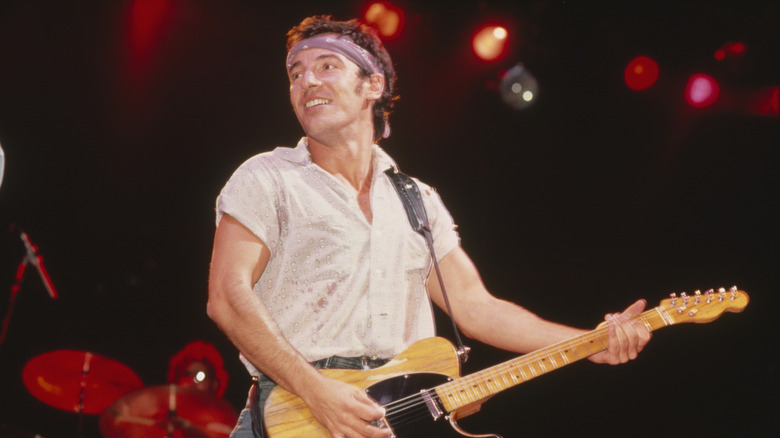
Look, can you really call yourself a classic rock fan if you don't have at least a few Bruce Springsteen tracks on your main playlist? The Boss — who has a bit of a tense relationship with his iconic nickname — is one of the foremost poets of the genre, crafting driving rock and woeful ballads that speak to his complicated love for his country and its people. With a career in the music industry that goes all the way back to 1964, there are a lot of Springsteen songs to choose from when assembling your playlist, but a few stand out as practically perfect and deeply stirring examples of everything that he's about.
What is that ethos, exactly? It's not the sort of rah-rah patriotism that other artists may be accused of perpetuating. Instead, it's a more mature look at people across the U.S., many of whom struggle with overwhelming pressures in Springsteen's work, while still expressing joy and hope. The unnamed narrators of "Thunder Road" and "Born to Run" are energetic and even joyful when making their case to get out of Dodge, but they are proposing escape from something that brings them great anxiety. In other songs, despair overwhelms the narrative and speaks to the difficulty many listeners have felt and continue to feel as they make their way through hardscrabble circumstances. Ultimately, there's something for everyone in the vast yet deeply considered landscape of Springsteen's work, but you surely can't go wrong starting with these foundational songs.
Thunder Road
You might expect Bruce Springsteen's 1975 album, "Born to Run," to open with its title track. But, as much as people remember the excited, almost frantic bombast of that song, the album more rightfully kicks off with "Thunder Road." Even if it's Springsteen's least-popular hit, this is a tune that deserves your attention as it narrates the beginning of a journey with an unknown ending, waiting for the unnamed narrator and Mary at the terminus of that road.
You can read the whole album as a loosely connected story that draws both on deeply personal narratives and the looming sense of unease and hope many felt in '70s America. "I'd loosely imagined the 'Born to Run' album as a series of vignettes taking place during one long summer day and night," Springsteen wrote in his memoir, also titled "Born to Run." With "Thunder Road," he says, "You are introduced to the album's central characters and its main proposition: do you want to take a chance?"
Given the lyrical complexity of "Thunder Road," it's no surprise to learn that Springsteen was a perfectionist here, constantly rewriting and re-recording the album's tracks. He even once threw a master of "Born to Run" into a hotel swimming pool, dissatisfied with the nascent "Born to Run" album, though he was then on tour to support the still-unreleased work. But, despite all the early anxiety (including fears that record label Columbia would drop him), the meticulously crafted album became a hit and its opener of "Thunder Road" legendary.
Backstreets
If "Thunder Road" showcases a burst of idealistic energy, "Backstreets" shows us the flip side. Yet, the true nature of the relationship at the heart of the song isn't quite clear. Many interpret it as another romance that's gone sour or faded away, but that might not be the only kind of connection Bruce Springsteen's talking about. He's described the whole of the album as being about friendship, and anyone who's been through a confusing, hurtful friend breakup knows that a dissolution like that can be excruciating.
This is a song that's beautifully confusing and sad, with poetically dense lyrics. Whatever it means to you, it also means a lot to Springsteen, who's clearly moved to a deep emotional place during live performances of the song. As promoter Tony Pallagrosi told Asbury Park Press of Springsteen's transcendent experiences performing "Backstreets" live: "We would be offstage, and I would be in the wings, and I would watch him every time he played that song, and there was something deep and dark, someplace that he would go, whenever he played that song."
"Backstreets" is a heady mix of something familiar and strange. We've all lost friendships and perhaps been confused by the dissolution of something that once seemed so special. But there's something else in the song here — something ineffable that anyone who's listened has been trying to pin down. And if they're really keyed into Springsteen's work, they've eventually stopped trying to categorize it at all.
Born to Run
Yes, "Born to Run" is one of those Bruce Springsteen songs that you might think is a bit overplayed, but there's a good reason it's on every single playlist ever. It's just really freaking good. First, the bombast of the track is exhilarating even as it underlies the sort of desperation people may feel as they search for a way out of their all-American backdrop. "Oh, baby this town rips the bones from your back," Springsteen warns amidst the joyful cacophony. And it's a kind of carefully engineered overwhelm that, as he's said, was inspired by Phil Spector's wall of sound mixing method.
For all the poetry and music, Springsteen speaks directly to the anxieties of the 1970s. After all, this was a time when Americans felt battered and disillusioned in the wake of wars, economic insecurity, and sweeping cultural changes. The declaration that "baby, we were born to run" isn't manic youthful idealism but a bald statement of truth from someone who's been paying attention to the grind of life in their town and wants to leave it all behind. There's no small measure of desperation as the narrator pleads, singing, "Wendy let me in, I wanna be your friend / I want to guard your dreams and visions." The lyrics show a true maturation of Springsteen's creative outlook, balancing precariously between hope and anguish. "This was the album where I left behind my adolescent definitions of love and freedom; from here on in, it was going to be a lot more complicated," he wrote in his memoir, "Born to Run."
The Promised Land
In the wake of "Born to Run," Bruce Springsteen found himself in limbo. A previously signed contract demanded that producer Mike Appel oversee more Springsteen albums, despite the rocker's desire to move on. In the meantime, Springsteen was effectively barred from recording. When the dispute with Appel was settled with a contract buyout in May 1977, Springsteen and the E Street Band leapt into recording the very next day. The result, "Darkness on the Edge of Town," was a direct response to "Born to Run," offering up a wider scope and a more pared-down sound. Springsteen has said that this shift was also an expression of his desire to turn more toward folk and blues, with influences as varied as Woody Guthrie, the Animals, and even Chuck Berry.
One of the album's key singles, "The Promised Land," is far from a tired repeat of the themes in "Born to Run." This track is an even more mature work, with a narrator who's gone beyond being a starry-eyed young adult and is now talking of the grind of daily work and life. Yet, he still aspires for something better, though this is a hard-won dream that has him proclaiming that, in spite of it all, "I believe in a promised land." What that promised land means, exactly, isn't for Springsteen to tell you here. However, he's since spoken more broadly of going beyond one's downtrodden circumstances or tendency toward petty anxieties to achieve what you might call transcendence. Or, perhaps, listening to the joy and aching of "The Promised Land," you might call that ultimate goal truth.
The River
Bruce Springsteen's work isn't all about hard-bitten joy and hope. As his career has progressed, he's been increasingly likely to sing about the harsh realities of life. And few songs explore that in such agonizing beauty as "The River," released on the 1980 album of the same name that features a dizzying 20 tracks. Originally, it was set to be half that, but Springsteen retracted the initial submission to the record company because, as he told Backstreets, "[I]t wasn't big enough. It wasn't sprawling enough. It didn't include enough."
Springsteen later confirmed that the devastating song is inspired in part by the real-life story of his sister, Virginia (also called Ginny), and brother-in-law, Mickey. Though your initial impressions of the tale may be grim — Ginny became pregnant while still in high school — the two remained happily married through economic difficulty and had three children together. Clearly, the growing agony of scarce work and a crumbling relationship in "The River" is more Springsteen's invention.
Even if it's quasi-fiction, though, the song is arresting in its despair. As Springsteen sings it, "The River" is the exhausted expression of a man trapped in his circumstances who speaks of his last-minute, no-frills wedding as if it were a funeral. "And the judge put it all to rest," he sighs. Later, he elaborates that "Now those memories come back to haunt me / They haunt me like a curse / Is a dream a lie if it don't come true? / Or is it something worse?"