

The No. 1 Song On August 9, 1985 Sounds Even More Cathartic Today
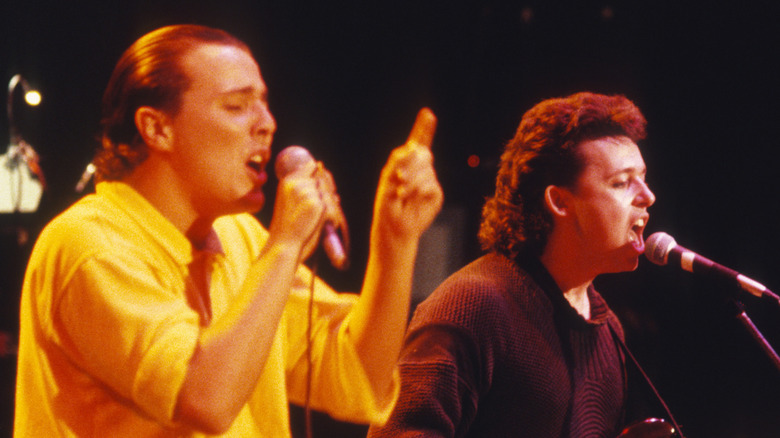
Millions of Americans must have been looking for psychological release around August 9, 1985, because they took the encouraging and cathartic "Shout" by Tears for Fears to No. 1 on the Billboard Hot 100 earlier that month. The Moody, lush, ominous, and future-forward song is a captivating combo of rock guitar, synthesizers, and the vocal blending of main members Roland Orzabal and Curt Smith. Indeed, Tears for Fears broke out in a big way with their second LP, "Songs from the Big Chair." It contained songs from the '80s that nail the meaning of life and define rock history, and of course, lots of big hits. After "Everybody Wants to Rule the World" reached the top of the chart, "Shout" followed suit and stayed there for even longer, ultimately wrapping up a three-week run at No. 1 by the end of August 1985.
While Tears for Fears didn't play Live Aid in 1985, they were busy elsewhere trying to effect change through their music. Here's the story of how "Shout" exposed music fans to a psychological movement widely espoused in the 1970s. In order to resolve what was bothering them, Tears for Fears advocated that everyone simply needed to "shout, shout, let it all out."
Shout is about the systematic elimination of pain
After some moderate success with their first studio album, "The Hurting," Tears for Fears prepared the follow-up, "Songs from the Big Chair." It took the band a long eight months to complete the project, and they estimate that about half of that was spent just on making sure "Head Over Heels" and "Shout" sounded the way they wanted. Initially, writing the latter seemed like it would be an arduous task, too. After working out the imposing and spooky chorus, imploring listeners to "shout," singer-songwriter Roland Orzabal couldn't think of anything to say in the verses. So, producer Chris Hughes sent him out of the studio with the directive to come up with an idea in one hour's time. Based on a few notes played by keyboardist Ian Stanley, he was off and running.
As for the lyrical content, Orzabal pulled from the material that led to many songs on "The Hurting": Primal scream therapy, developed by psychologist Dr. Arthur Janov and popularized through the 1970 bestseller "The Primal Scream." He encouraged patients to release and manage deep-seated trauma and emotional pain by yelling it all away. Similarly, in the smash hit "Shout," Tears for Fears explored the idea of cathartic, healing shouting.