

Neil Peart's Top 5 Drum Solos Of All Time
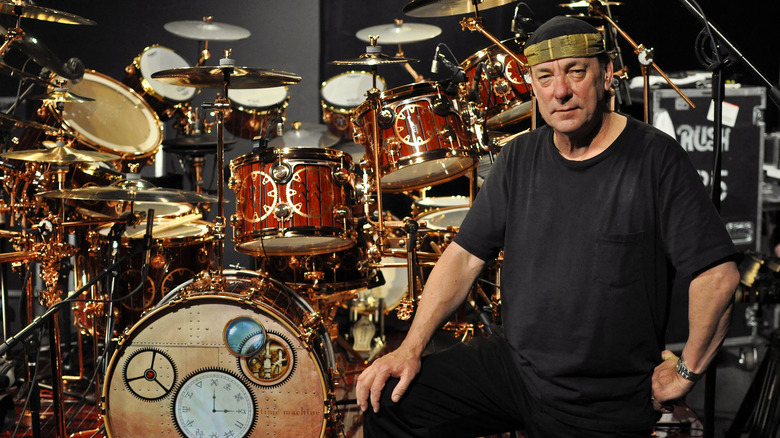
Any fan of classic rock ought to know Neil Peart. For those who somehow don't, everything we have to say about him will sound overblown, rhapsodic, and downright worshipful — and with good reason. Drummer and lyricist for the one-of-a-kind Rush, a band characterized by youthful verve as much as intellectual composition, Peart was the rhythmic and poetic soul of the band and one of the greatest drummers in recorded human history. His entire body of work demonstrates his craft, especially his best drum solos.
Listening to Peart will change what you think "drumming" really is. Boundlessly inventive, precise, and groovy all at once, he treated his drum kit like a standalone orchestra, full of its own melodies and stories, even as he perfectly serviced Rush's songs. His best drum solos reflect this talent, right up to his death in 2020 at the age of 67, and serve as masterclasses for all subsequent drummers. Besides this main criterion, we're opening our choices for his best solos to both studio and live versions of songs, including one-off performances that have been thankfully captured on film. We're also open to all eras of Rush, although Peart himself said in an interview (via Drumeo/YouTube) that the band's musical identity didn't really cohere until "Tom Sawyer" from 1981's "Moving Pictures." This album kicked off the band's most financially successful period and also Peart's most accomplished drumming, overall.
Even though the solo from "Tom Sawyer" is an obvious choice, some of our choices are lesser known. We're talking true lightning-in-a-bottle performances that showcase a master of his craft.
Der Trommler
Just go ahead and watch Neil Peart's "Der Trommler" drum solo from Rush's 30th Anniversary Tour in 2004 in Frankfurt, Germany. This one video could substitute for this entire article, starting with the mere sight of Peart's enormous kit. That kit encircles him like a fortress — each tom, cymbal, and pad (which play notes, not percussive sounds) a player in his orchestra — as he shifts positions on his kit mid-solo and the raised platform underneath him spins. Even if you know nothing about drums, it's nuts to behold. Most importantly, this solo is fully comprehensible to non-musicians as much as it's stank face-inducingly groovy.
Like a lot of other Peart solos, his 2004 Frankfurt solo is composed in movements. For a good chunk of the solo, he builds varying accents and rhythmic patterns on top of a constant kick drum, which propels the whole piece forward even as he tinkers atop like a mad god ordering the cosmos, true to his nickname, "The Professor." And indeed, as Drumeo quotes Peart in reference to a collaborative lyric-writing partner: "I live in a much more ordered universe and impose that structure and rhythm and parallel construction on it." Peart's 2004 Frankfurt solo demonstrates this statement to a T, and showcases his tidal ferocity as much as it does his clinical attention to detail.
Finally, if anyone's ever had trouble patting their head and rubbing their belly at the same time, keep this in mind while watching this drum solo. Peart's hand independence seems beyond human capacity. All his solos live on Olympus, but this one might sit on its throne.
YYZ (from Exit ... Stage Left)
This time, we've got one of the best drum solos in rock history from Rush's 1981's "Exit ... Stage Left," the same year that the band released their career-defining "Moving Pictures." We're, of course, talking about the prolonged solo from fan favorite "YYZ." In the studio version, Neil Peart plays a funky little drum fill following a funky little Geddy Lee bass lick. But in the live version, Peart's fill expands into a three-minute-long escapade that leaves the crowd erupting into a euphoric frenzy. No matter how many times we hear it, this solo still gives us chills.
As usual for Peart, you'd have no idea where his "YYZ" solo is going even though it makes complete sense when it lands. Starting out as a series of snare rolls reminiscent of paradiddle drum exercises (alternative right-hand, left-hand strike patterns), Peart slips a rhythmically independent kick drum into the mix, then closed cymbals and open crashes before shifting rhythmic gears and introducing a tom run that rings like the melody of a Revolutionary War bugle. This is partially what drummers mean when they say that Peart's playing is very "musical," as Dream Theater drummer Mike Portnoy says on Drumeo.
Peart approached his drum kit in the way a composer approaches blank sheet music, as we alluded to earlier. There's a whole piece to write and perform using each part of the drum kit like a minion with a musical specialty. And even though Peart's live version of "YYZ" from "Exit ... Stage Left" is a solo that plays without bass and guitar, it still hearkens back to the entire song and ends in service of it.
2011 Letterman Solo
So, how often do you see a drummer — not a band, just a drummer — play by himself as a guest on a TV show, especially to cap it? It used to happen with the likes of drumming legends Buddy Rich and Gene Krupa back in the day (sometimes together doing a drum battle), though that goes back to the '60s. But Neil Peart was so good and so recognized that he became one of those rare drummers who actually gets attention outside of his band, as evidenced by his 2011 drum solo on the "Late Show with David Letterman." Wild enough, this solo aired on the 30th anniversary of "Moving Pictures," which contained the aforementioned "YYZ" and its own top-tier solo. This most recent of our Peart drum forays showcases how he'd evolved even since those early '80s glory days.
Peart's 2011 Letterman solo isn't connected to any specific Rush song, much like his 2004 Frankfurt solo. It's a standalone, whole musical composition that fuses electronic elements with organic drum kit components, is highly melodic, has this spooky jungle part, a big band bit, the whole spinning platform thing that lets the audience know when the piece is entering a different section, and so forth. On the surface, you could mistake the solo as largely improvised, but we'd bet, given Peart's craftsman-like approach to his work, that it's all planned out to a T (with some wiggle room here and there). That doesn't detract from the solo's magic and excellence, however. After all, who wrote and performed it? We're just grateful it was recorded, like all of our other choices.
La Villa Strangiato
Our wild card choice for this article that beats out several other possibilities, Neil Peart's drum solo from "La Villa Strangiato" off 1978's "Hemisphere" isn't one of his Peart-only compositions, but intertwines with his bandmates and the song on a whole. Running from about six minutes, 10 seconds to seven minutes, 10 seconds, Peart weaves a series of micro-solos through Geddy Lee's and Alex Lifeson's bass and guitar, respectively, where his drumming takes front and center, recedes into the mix, returns to the front, etc.
Peart's "La Villa Strangiato" drum solo won't make your jaw drop in the way that "Der Trommler" or his 2011 Letterman percussive extravaganzas will, but it'll show you that Peart's drumming formed within the context of virtuosic bandmates. As he's quoted in the Drumeo video, Rush liked to "play individually and as a band at the same time." This balance of interdependence and freedom gave Peart the breathing room to develop into his fullest creative self and also have the chance to push to the forefront. It's the interplay of Lee, Lifeson, and Peart that not only made Rush, the band, but Peart, the individual. "La Villa Strangiato's" sequential, bit-by-bit drum solo is a demonstration of this Peart-Rush interplay and a benchmark for how Peart would develop from there.
Even only listening to the drum solo itself, outside of context, you've got a piece of work that tightly syncs with the rhythm of Lee and Lifeson's bass and guitar, has loads of tom fills, what sounds like little triangle taps, and could easily break out into one of these long, Peart-only solos from later shows. Here is a master at work who's also working with everyone.
Tom Sawyer
Fret not, Rush fans, we weren't going to leave "Tom Sawyer" off our list — not because it's Rush's most famous song that even casual listeners know and love, but because it's largely Neil Peart's drumming that's made it that way. Couched within a track that masterfully plays its instruments off each other, we've got a 10-second-long drum solo that is possibly the ultimate testament to Peart's skill, comparing its brevity to its impact. Memorable, followable, as physically and mentally demanding as it is emotionally urgent, and way more technically challenging than it may sound, this is the go-to for music lovers and musicians alike. It's possibly the most well-known, most air-drummed solo in the history of rock.
Peart's drum solo in "Tom Sawyer" flows from the song itself, which has been building and building precisely to this point over its entire length. Peart kicks into double-time leading into the solo, takes the baton from Alex Lifeson's guitarwork, overlaps with his and Geddy Lee's rhythm, and then cuts loose. Peart not only reportedly considered it a good night if he could pull "Tom Sawyer" off to his satisfaction, but always circled back to "Tom Sawyer" in conversation as one of the most difficult songs in Rush's repertoire. And to be able to not only pull it off night after night, fusing minor variations in tempo and feeling with core limb independence, but to have written the drum part to begin with? Let's just give up pretending that Peart's playing on "Tom Sawyer" is anything but the apex of rock drumming, its solo included. It's inspired countless people to pick up drumsticks, same as it's inspired existing drummers to up their game.