

5 Rock 'N' Roll Happy Accidents That Sound Even Cooler Today
Rock 'n' roll was born to be rough-hewn and messy, which is why mistakes sometimes fit into rock songs perfectly. Sometimes, they even bring something new and raw to a song and make it better in the process. Especially now, when audiences are savvy to that telltale showbiz veneer and often seek out bands made from real humans with real talent, hearing a mistake left on a final recording can be downright refreshing. In the case of the songs we've pulled together here, these accidents were actually secret ingredients that helped the track blow up into the smash hits they were destined to be.
Especially in the early days of classic rock, songs were recorded using more live takes and less post-processing, meaning accidents were an eventual guarantee. The real wisdom of the bands on this list and their producers was often in knowing when to keep the accidents instead of replacing them with a fresh, sanitized take. Because of that forethought, we got amazing moments in rock history like Roger Daltrey's stutter on "My Generation," Merry Clayton's voice crack on "Gimme Shelter," the genre-spawning distortion on the Kinks' "You Really Got Me," and more. Here are those and other songs whose creators left accidents on the final recording and ended up really happy they did.
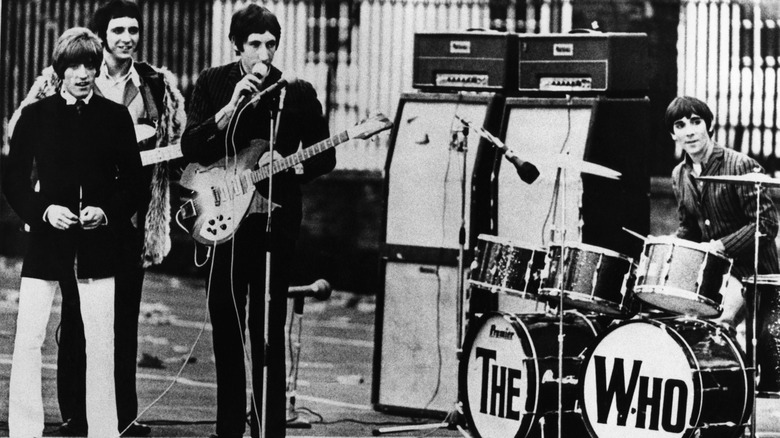
My Generation — The Who
The Who's bombastic anthem "My Generation," released in 1965, sounds cooler today in general, largely thanks to its role as a spirited rallying cry applicable to one frustrated young generation after the next. A big part of that spiritedness comes courtesy of Roger Daltrey's dynamic-yet-disaffected vocals, a perfectly proto-punk blend that encapsulates the angst and attitude of youth in revolt.
Easily the most unique and immediately notable facet of Daltrey's performance is the famous stutter he displays on the song — although infamous might be the better term, as the stutter did cause the BBC to ban the song from the radio for a time, fearing it would offend other people with stutters. Though the story behind the stutter has been debated over the years, one common thread from those recounting it, like producer Shel Talmy and Daltrey himself, is that it came about relatively unplanned and was smartly kept in the final cut.
As Daltrey told Uncut, "[The stutter] was always suggested with the 'f-f-fade' but the rest of it was improvised." Talmy described it as "one of those happy accidents" (via This Day in Music) that either he, the band, manager Kit Lambert, or some combination thereof had the foresight to keep. Daltrey stutters on roughly half the lines in the final song, and if only the "f-f-fade" was planned ahead of time, that is a relative ton of improv comprising one major happy accident on the part of The Who.
Louie Louie — The Kingsmen
When it comes to happy accidents, the Kingsmen's cover of Richard Berry's "Louie Louie" is the type of song that makes it hard to know where to begin. From before the song was even recorded, it seemed doomed to a certain level of chaos. The band recorded "Louie Louie" at a studio that was ill-equipped for rock bands, and, as guitarist Mike Mitchell told Louder, "What we thought was a rehearsal run-through turned out to be the only take of the song!" Consequently, the take used on the album is littered with mistakes, though all of them helped contribute to the song's enduring mystique and rebellious aura.
One noticeable flub comes after the guitar solo, when singer Jack Ely starts singing the next verse early, only to catch himself and stop while drummer Lynn Easton fills the awkward space with a drum lick. Another gaffe comes from Easton himself, who, thanks to some inaudible drumming mishap, loudly drops an F-bomb at 0:54. Ironically, the FBI investigated "Louie Louie" for alleged profanity and corrupting youth, but not because of that F-bomb (which they somehow never discovered). Instead, it was Ely's indecipherable lyrics that whipped up the moral panic that brought in the feds.
As Louder reported, Ely's voice was rough from a previous night's gig, which in combination with his braces and the awkward placement of the studio mic, made the words he sang incomprehensible. In that vagueness, listeners imagined all sorts of lewd lyrics, prompting the FBI investigation and ultimately, a huge spike in notoriety.
In-A-Gadda-Da-Vida — Iron Butterfly
If you're familiar with Iron Butterfly, it's probably as the '60s one-hit wonders behind "In-A-Gadda-Da-Vida," one of those songs that acts as an un-missing link between late psychedelic rock and early hard rock. Much of the song is indicative of the California hippie sound à la the Doors, like its unleashed organ and vague lyrics that exist solely in service to the groove. Its distorted, minor-key guitar riff takes center stage, however, and gives the song its place in the evolution of hard rock. Unlike the other songs described here, the happy accident in "In-A-Gadda-Da-Vida" wasn't an instrumental or vocal surprise during recording, but rather a simple case of drunkenly slurred speech.
As drummer Ron Bushy revealed to It's Psychedelic Baby, the song's name was supposed to be "In the Garden of Eden," but singer-songwriter Doug Ingle was less than clear in relaying that fact. "Doug had been drinking a whole gallon of Red Mountain wine," Bushy said. "I asked him what he had done ... It was hard to understand him because he was so drunk ... so I wrote it down on a napkin exactly how it sounded phonetically to me ... 'In-A-Gadda-Da-Vida.'"
The lyrics to "In-A-Gadda-Da-Vida" are generally forgettable, with a chorus consisting of "Oh, won't you come with me / And a-take my hand? / Oh, won't you come with me / And a-walk this land?" but the mispronunciation of the titular(-ish) garden makes them memorable. It's possible that Ingle's inebriated garble to Bushy is the reason the song took off the way it did.
Gimme Shelter — The Rolling Stones
Among all the famous unplanned moments left on rock 'n' roll tracks, Merry Clayton's vocal crack on the Rolling Stones' "Gimme Shelter" has probably garnered the most renown in proportion to its length. The entire accident consisted of just three voice cracks, each only a moment in length, starting at about 2:57 on the album recording. Nonetheless, the darkness and almost terror that the moments brought to the song suited its similarly grim subject matter, and helped propel it to the ranks of the Rolling Stones' best songs ever.
The story of Clayton's inclusion on "Gimme Shelter" famously begins with a late-night phone call from Rolling Stones producer Jack Nitzsche and ends with one of the most legendary takes in backing vocal history. As Clayton and Mick Jagger agreed in the documentary "20 Feet From Stardom," Clayton only performed "a couple" of takes in total. For the last, Clayton resolved to "blow them out of this room," which she did partially by singing an octave higher and partially by straining her voice so hard it broke. The breaks lend tremendous weight to the lyrics of "Gimme Shelter," which fits their severity far better than a clean, accident-free take ever could have. Happily for Clayton, she is one backup singer who finally got her long-deserved moment in the spotlight.
You Really Got Me — The Kinks
The happy accident behind "You Really Got Me" by the Kinks actually took place before the song was even recorded, but it still affects the entire finished product and even a great deal of rock music recorded since. The song has been cited as foundational to the evolution of hard rock, heavy metal, and punk, mainly due to the scratchy distortion effect on Dave Davies' guitar, which turned his power chords into something formidable and new — the modular piece that a huge percentage of all rock since has been built upon. The thing is, Davies had no intention of defining genres. Instead, he was just a frustrated kid (he would've been 16 or 17 at the time of recording) foolishly lashing out at an inanimate object.
Davies explained the incident to The Guardian, revealing, "I was very depressed and fooling around with a razor blade ... I had a little green amplifier, an Elpico, that was sounding crap. I thought, 'I'll teach it' — and slashed the speaker cone. It changed the sound of my guitar." The intent was simply to vent anger, but the result was an amp that distorted everything that came through it in a uniquely gnarly way. "It just happened, you know? It was really spontaneous," Davies told Guitar World. The impulsive destruction of a piece of equipment is as rock 'n' roll as it gets, which is fitting, given that it helped steer the course of rock for decades to come.