

The Most Iconic Guitar Riff From Every Year Of The '70s
Rock music reached maturity in the 1970s, and with astounding regularity, the bands and solo artists of the day released one head-banging anthem after another — so much so that every year of the decade can claim a world-famous, music-changing riff. Underneath the wide umbrella that is 1970s rock sits a variety of different but related sub-genres, including arena rock, hard rock, heavy metal, new wave, blues rock, and progressive rock. But they all got popular with a tried-and-true, crowd-pleasing formula: Songs built around brain-melting, stadium-filling, speaker-blasting, totally awesome guitar riffs.
Of the countless classic rock songs of the 1970s, only a few can boast a riff that's instantly recognizable by millions and by name. Why? Those are the ones that rocked the hardest, and they're forever linked to a specific point in rock history's timeline. From that timeless opening of "Stairway to Heaven" to the pounding heartbeat of "Barracuda," these are the biggest and most important riffs of every year of the decade.
1970: Layla – Derek and the Dominos
The title track on Derek and the Dominos' sole studio album, 1970's "Layla and Other Assorted Love Songs," "Layla" is really about guitarist Eric Clapton's then-unreciprocated love for Pattie Boyd, then-wife of his friend George Harrison. The lyrics speak to that, but they don't convey the gamut of emotions — guilt, frustration, anger — as much as the musician's guitar can. The song begins with a bewildering, blistering display of fretboard work and technique as Clapton delivers a searing, evocative riff. It's such an effective segment that Clapton repeats it often throughout "Layla," embedding it into classic rock history.
1971: Stairway to Heaven – Led Zeppelin
One of the best-known multi-part epics in rock history, "Stairway to Heaven" appeared on Led Zeppelin's untitled fourth album, commonly known as "Led Zeppelin IV." Coming at the top of the eight-minute saga, Jimmy Page's gentle and rustic yet leading acoustic riff sets the tone for the soft, folky first part before "Stairway" rocks out and goes electric. But that one opening riff is still the most famous (and easy to play at home) part of what's probably the most famous rock song ever.
1972: Smoke on the Water – Deep Purple
From the 1972 album "Machine Head," the introductory and then pervasive electric riff that powers Deep Purple's heavy "Smoke on the Water" is such a notoriously easy guitar line to pluck out that it's one of the first things that many beginning guitarists learn to play. But when Deep Purple's Ritchie Blackmore added some depth and effects, it's as booming, ominous, and foreboding as gathering smoke on water. Deep Purple is where blues met metal, and the "Smoke on the Water" riff is a proof of concept.
1973: Money – Pink Floyd
A riff so showy that it breaks through a cacophony of bass, organ, and cash register sound effects, and which also functions as a solo, David Gilmour's work on "Money" is a highlight of the perennially popular 1973 Pink Floyd opus "The Dark Side of the Moon." The confident, bluesy riff pushes through and then circles back over itself before repeating, making it sound like Gilmour is playing two guitars at the same time. The shimmering, vibrating guitar work makes an already hypnotic song all the more so.
1974: Sweet Home Alabama – Lynyrd Skynyrd
Leading off its second album, "Second Helping," "Sweet Home Alabama" is Lynyrd Skynyrd's declaration of Southern pride in the face of insults from Canadian rock star Neil Young. One of the songs that can explain the story of Lynyrd Skynyrd, "Sweet Home Alabama" runs on a riff that's the very definition of Southern rock, with a blend of country and folk. The way it's expertly picked out note by note makes it more interesting and languid as the song progresses.
1975: Walk This Way – Aerosmith
Aerosmith was heavily influenced by the blues, and Joe Perry infuses that inspiration into the spirited riff used in "Walk This Way," found on Aerosmith's 1975 LP "Toys in the Attic." Herky-jerky and requiring the guitarist to hit notes all over the fretboard, "Walk This Way" plays like an old blues riff played as fast, loud, and often as possible, and sometimes sounds like a record scratching. More importantly, it serves the song, which is full of quickly delivered lyrical nonsense.
1976: (Don't Fear) The Reaper – Blue Öyster Cult
Blue Öyster Cult heeded the call for more cowbell with the "Agents of Fortune" standout "(Don't Fear) The Reaper," a 1976 song that defines rock history. Immortalized in a "Saturday Night Live" skit for its insistent use of percussion, Blue Öyster Cult's dark jam also packs an ear-worm of a picked guitar riff. It starts off the song on its long, strange journey into death, and it recurs throughout "(Don't Fear) The Reaper," both magnetic and off-putting as its notes cyclically rise and fall.
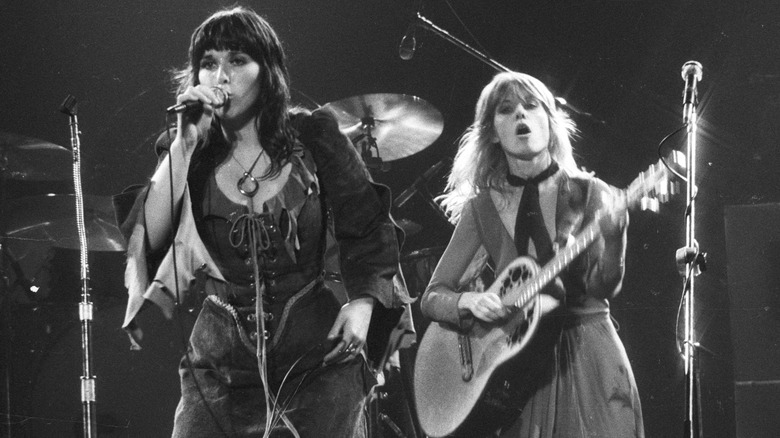
1977: Barracuda – Heart
Heart doesn't waste any time getting things rolling on 1977's "Little Queen." The band's second album starts off heavy and loud with "Barracuda," an arena rock staple from Heart's first era. The entire song feels as if it springs forth from guitarist Nancy Wilson's bold and powerful riff. First, that buzzy, low-end line chugs along at a rapid clip, then stops to shimmer and show off, only to start back up again with the rest of Heart following along, trying to churn along. As a result, Heart gave us a song from 1977 that sounds even cooler today.
1978: Runnin' with the Devil – Van Halen
In 1978, the future of hard rock arrived, and its name was Van Halen. Led by the supremely skilled and gifted guitarist Eddie Van Halen, the band's self-titled debut album showed off the namesake's shredding abilities, and perhaps most effectively on the LP opener "Runnin' with the Devil." With a dramatic introduction of what sounds like traffic and some deeply low bass notes, Eddie Van Halen comes rushing in with a distinctive clean and almost classical guitar sound. His riff carries so much melody and joy, and it influenced a decade of the hard rock that followed in its wake.
1979: Rock Lobster – the B-52s
Infused equally with the sounds of punk, post-punk, and new wave, the B-52s helped open up rock to strange and inventive new places with their 1979 debut LP re-recording of the earlier, self-released party song "Rock Lobster." Keith Strickland played the guitar with a frenetic urgency on the song, unlike the polished guitar heroes of earlier in the '70s. "Rock Lobster" is subsequently rough and raw, with a riff that never quite resolves.