

5 History-Making Guitarists Every Classic Rock Fan Should Already Know
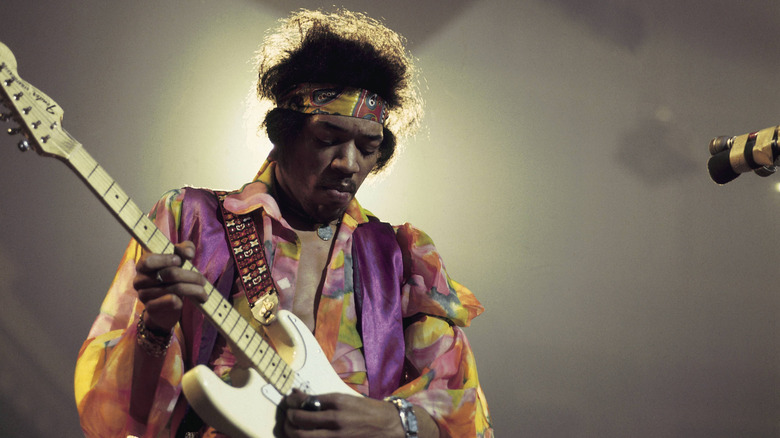
It may seem that the guitar is so central to rock that it's taken for granted. But, every once in a while, there comes a musician who's so good and so daring that it fundamentally changes the way people approach rock and roll. To truly understand the history of the genre and of classic rock in particular, you've got to learn about some of the key guitarists who shaped everything else that came after. Each one established themselves as unique talents within the music world while also inspiring many who came after them.
Some go way back, even before the genre really got its start in the 1950s, and all those musicians started cementing their place in history with iconic onstage moments and the like. If you could travel back in time to the late '30s, for instance, you might hear some very interesting guitar licks put down by one Sister Rosetta Tharpe, a highly popular gospel artist who bent the boundaries of her musical lane so much that she inspired generations of rockers afterward. Without her, chances are that we wouldn't have Little Richard or Chuck Berry, and perhaps not even those who were inspired by them, like the Beatles and the Beach Boys. And even with rock in full swing, some musicians like the endlessly experimental Eddie Van Halen were so innovative that they couldn't help but stand out in the growing crowd, easily landing them in the ranks of history-making guitarists.
Sister Rosetta Tharpe
In the history of rock and roll, one guitarist comes up over and over: Sister Rosetta Tharpe, who some deem "the godmother of rock 'n' roll." Though billed as a gospel performer, listen to her guitar playing and you'll hear blues and jazz mixed with Tharpe's own uniquely energetic style. No wonder she's cited as inspiration for a tremendous swathe of rockers, including Bob Dylan, Keith Richards, and Little Richard (who performed with her in 1945). Chuck Berry even reportedly said that "My whole career has been one long Sister Rosetta Tharpe impersonation" (via the National Women's History Museum).
Tharpe's mother, Katie Bell Nubin, was active in the Church of God in Christ, which was unique in that women had prominent roles in church services. After moving to Chicago in 1921, a 6-year-old Tharpe began performing with a traveling group of musicians. Early on, Tharpe recognized the tension between her edgy musical interests and her Christian faith. She continued performing in this style, though it garnered the disapproval of many around her, including her own mother. By the late 1930s, she was wildly popular, to the point where around 25,000 people attended her third wedding at Griffith Stadium in Washington, D.C. The '50s saw a downturn in her fortunes, though she continued performing until her death in 1973.
Besides her skill with the guitar, Tharpe also had charisma and daring that pushed the boundaries of what was then considered possible for a Black woman singing gospel. Her charm and stage presence, which sometimes proved alarming for more conservative types, clearly left a mark on her audiences.
Jimi Hendrix
You've already heard that Jimi Hendrix was one of the best guitar players ever, but what made him so jaw-droppingly different? There was his technical skill, for one, boosted even further by his stunning ability to improvise, willingness to experiment with the audio distortion, effortless stage presence, and the spiritual way he connected with his music. All lent authentic power to his playing that simply could not be replicated. In 1966, Linda Keith, then dating Keith Richards, was so awed by Hendrix that she wanted to help him land a record contract. To accomplish this, she borrowed one of Richards' guitars (neglecting to ask him first) and lent it to Hendrix to use at a key gig where the Rolling Stones' manager would be in attendance.
Said manager passed on signing Hendrix, but Chas Chandler, bassist for the Animals, got involved. Chandler, starting his own career as manager, signed Hendrix in September 1966 and encouraged his move to London and subsequent rise, including the 1967 release of "Purple Haze," an early introduction to Hendrix's daring, compelling style. He became more recognized in the U.S. following his June 1967 appearance at the Monterey Pop Festival, which saw him perform one of the wildest on-stage moments in rock history when he set his guitar on fire and flung the carbonized bits to the audience. However, after an intense final year, his tragic death in September 1970 cut his career short and left many agonizing over the incredible guitar work left unplayed.
Jimmy Page
Though Jimmy Page is known for his iconic '70s-era stage costumes, that's hardly his whole story. Page was a key founder of Led Zeppelin, which came together in summer 1968. Prior to that, he was a kid with "a voracious appetite for all things guitar," as he told Rolling Stone, who eventually became a London session musician. Though Led Zeppelin broke up in 1980 after the death of drummer John Bonham, Page has remained largely in charge of the group's legacy. That's in keeping with his involvement in the whole process of making music, which often saw him developing, performing, and producing work at the same time.
When asked about his iconic guitar riffs, Page has often said that the best ones have a hypnotic effect. Given Page's long-discussed interest in mysticism and the occult, that hypnotic aspect is all the more interesting. As he told Rolling Stone, "Riffs come out of the ether, out of nowhere. Will you tell me where that is? Because no one knows. One minute I'm playing one thing. The next minute, I've got that."
For an example of Page's excellence, take the lead-in to "Stairway to Heaven," which is masterful fingerpicking with a complex, melodic line. It may sound deceptively simple ... until you try to play it yourself, of course. Still, Page's favorite riff may be the one he plays in "Kashmir," which featured an orchestra scored by Led Zeppelin bassist and keyboard player John Paul Jones.
Eddie Van Halen
Eddie Van Halen could be a bit demure when discussing his contributions to rock 'n' roll. Speaking to reporter Steve Baltin for Forbes in 2009, Van Halen said he spent hours playing. "[G]od's not gonna give you nothing if you don't practice or play," he said. In fact, Van Halen never learned to read music, though he did take piano lessons as a young child and won piano competitions after the family moved to California. Later, tracks like "Cathedral" and "Little Guitars" from "Diver Down" hint at those lessons. He was also routinely inspired by the blues — and Jimmy Page, whom Van Halen thought was the ultimate rock guitarist.
Eddie Van Halen was also a brilliant tinkerer. Look at "Eruption," the track on the band's 1978 self-titled debut that's basically just him riffing, featuring his signature finger tapping technique. True, Van Halen didn't invent finger tapping — in short, actively using both hands to play the guitar — but he did perfect the technique to virtuosic levels. Van Halen could also get down blindingly rapid runs of notes, though, technically, there are a couple of mistakes on "Eruption" that he insisted remain to preserve the energy of the moment.
Eddie Van Halen was also a gear nerd who built his famous "Frankenstrat" out of disparate parts and deployed custom amplifier modifications and pedals to create a fuzzy, saturated "brown sound" precisely to his liking. All told, there was simply no one like him. Eddie Van Halen explored all genres, boldly tried and combined new techniques, and often did so with a sense of joy and curiosity that was all his own.
B.B. King
Is B.B. King directly a rocker? Well, no, but the list of rock stars inspired by King's masterful blues guitar is as long as your arm, and then some. So, who did King inspire? Who did he not inspire? Members of the Rolling Stones toured with him in 1969, a young Jimi Hendrix listened to King's work, and Eric Clapton wrote in his autobiography that King was "without a doubt the most important artist the blues has ever produced." Carlos Santana, another widely renowned master of the rock guitar, praised King after his 2015 death (via Time): "His one of a kind sound was an inspiration to an entire generation of musicians, including myself."
Born in Mississippi in 1925, he initially worked as a street corner busker before landing gigs and recording contracts. King eventually racked up an astounding number of accolades, including 15 Grammys, a spot in the Rock & Roll Hall of Fame, and the Presidential Medal of Freedom. He even named his guitar like he was a fantasy hero with a legendary sword — only he was wielding the power of the blues and his own indelible musicianship, with its beautifully fluid, soulful melodies. To be fair, Lucille was a really good guitar, especially in King's hands. The legend goes that, in 1949, King was performing at a dance hall where a fight broke out and the subsequent tussle led to a fire. While escaping the building, King risked his life to grab his guitar. Upon learning that it started over a woman named Lucille, King landed on the name.