

5 Songs From The '80s That Wouldn't Be The Same Without Their Legendary Drum Solos
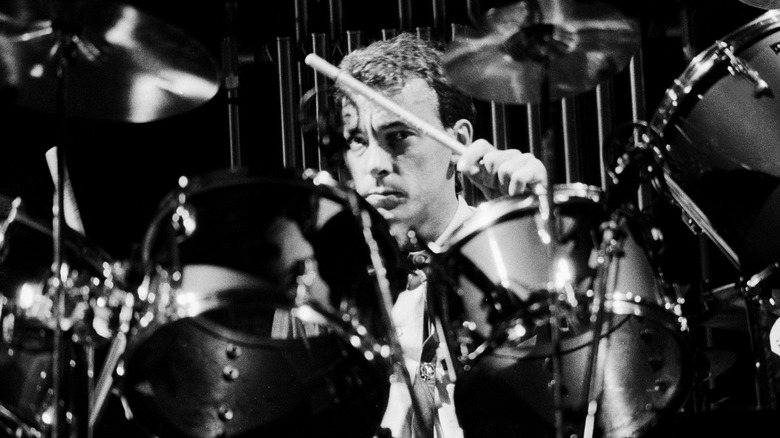
Popular music was in a very different place in the 1980s than it had been in the '70s. Even as hair product use expanded, song complexity shrunk, or at least changed focus as styles like new wave redefined what complexity looked like. This includes percussion, and just as the best drum solos of the '70s defined that time, the '80s came equipped with songs that just wouldn't be the same without their own drum solos.
Admittedly, the drum solo pickings in the '80s are more sparse than they were the previous decade or so. Rather than more baroque instrumentation, the '80s came equipped with a lot of big toms, sweeping feelings, and calculated strikes. Think of an obvious choice for a standout drum solo from the decade — such as Phil Collins' legendary solo from "In the Air Tonight" — and you'll see each of those three elements on display. This isn't the only way an indispensable drum solo from the decade could unfold, as we'll see, but it does speak to the broader trends of the times.
Bearing those trends in mind, we've got some solos from massive pop-rock outfits, Collins included. We've also got a couple of solos that hearken back to earlier classic rock times, but still suit the decade.
In the Air Tonight — Phil Collins
There's no way that Phil Collins' drum solo from 1981's "In the Air Tonight" wasn't going to make our list. This heavily air-drum-inducing, descending tom sequence is one of the most recognizable drum solos in the history of rock. No matter that it's a mere musical blip that lasts less than five seconds, Collins' drum solo for "In the Air Tonight" is exquisitely crafted and well-placed within the whole song.
The entire track builds to that point, all ambience and restrained emotion, and then: boom, the feelings come out — much like those described in the song's lyrics. Without this drum solo, "In the Air Tonight" might not crumble, but it would be far less memorable, hard-hitting (so to speak), and most certainly wouldn't have reached its now-legendary heights. The song has grown in popularity over time, only reaching No. 19 on the Billboard Hot 100 when it came out (unlike his seven No. 1 hits), but becoming his most-streamed song on Spotify.
Collins has always kept things close to his chest, but eventually talked about the inspiration for "In the Air Tonight" on "The Tonight Show Starring Jimmy Fallon" in 2016. He revealed that the song comes from frustration during his divorce, rather than the weird urban legend that Collins witnessed a murder ("I was there and I saw what you did / I saw it with my own two eyes"). The song's deeply personal meaning just might be why its drum solo hit extra hard.
Tom Sawyer — Neil Peart (Rush)
The crack Canadian trio Rush built their brainy prog rock around the rhythmic backbone of the one and only Neil Peart, a history-making drummer whose name every classic rock fan ought to know. His genius was on full display on "Tom Sawyer," which features one of Peart's five best drum solos of all time, one that's so distinctive that it's proven indispensable to the song, Rush's entire repertoire, and rock history on a whole.
Peart's solo on "Tom Sawyer" flows directly from how Rush had evolved come the early '80s. The prog rock of the '70s was out of fashion, and with it much of the popular tolerance for long and involved musical pieces. At the same time, Rush wound up compressing their individual talents into a more packageable version with 1981's "Moving Pictures," an album that showcased how Peart, Geddy Lee, and Alex Lifeson played off each other. This is what people are hearing in Peart's solo, which follows Lifeson's own guitar solo, synchronizes with the entire band, and hits in three distinct sections: flowing tom fill, double-kick bonanza, and cymbal-kick interplay. It's a masterclass of precision, control, power, creativity, and most of all, the experience that came with time.
Peart's roughly 10-second-long solo demanded all of his substantial talent every time he played it, much like the entirety of "Tom Sawyer." This is why the song is so much more than a neat '80s tune, but an elite-tier rite-of-passage song for drummers, especially its drum solo.
Hot for Teacher — Alex Van Halen (Van Halen)
"Hot for Teacher" isn't just a stand-out, goofball track by one of the most iconic arena rock bands of the '80s, then at the height of their powers with the LP "1984." It's a musical mystery wrapped in an enigma wrapped in turbo-blasted, Gatling-gun kick drums that has baffled drummers since the song was released. It just sounds like you shouldn't be able to physically play it, especially not at 256 BPM. Alex Van Halen takes the lead at the beginning of the song with the solo, which sounds like a motor revving up, and his brother Eddie comes in about 30 seconds later with the fretboard tappy taps. Then, both of them segue into the rest of the song's gallop.
The seemingly impossible drum solo came together through a combination of talent and technology. It sounds like a hot rod because the kick drums are electronic, and Alex switched up the toms with electronic-sounding pads that were in fashion at the time. This makes the drum solo for "Hot for Teacher" about as '80s as you can get in tone and production, on top of coming from David Lee Roth-era Van Halen.
Alex's drum solo lasts about 30 seconds before Eddie joins in, and then the two play about 15 seconds before the song kicks into its main riff. That section lasts until about a minute into the song, when the momentum dies and a clean electric section reminiscent of ZZ Top's "La Grange" comes in, before the main riff starts again. In other words, you could cut the whole, pell-mell drum intro entirely. But if you did, "Hot for Teacher" would lose the chaotic feeling it's going for.
Separate Ways — Steve Smith (Journey)
Big feelings, big hooks, and big arenas: That's Journey, who almost always managed to thread the needle between sincerity and schmaltz. This was especially the case following the colossal success of 1981's "Escape" ("Don't Stop Believin'," "Open Arms"), when they had to build new songs for a new album to maintain their momentum. That's when "Separate Ways (Worlds Apart)" hit the airwaves with 1983's "Frontiers," a song that Journey drummer Steve Smith on Drumeo says was built from the ground up for booming, rousing live performances. That's why his drum solo fits the song so, so perfectly. His playing throughout the track sustains the song's drama and drives it home.
Smith's drum solo on "Separate Ways" is actually rooted in restraint. He's sparse with emotional valves, pulling back on the forward motion of his playing, then landing masterfully planned hits. None of it is excessive, and so every hit counts. Those hits center on toms, which are a little secret shortcut to deeper emotion, as they have a clear pitch that hovers in the human vocal range.
This is the emotion that comes out when Smith delivers his drum solo at about the four-minute mark on the album version, and three minutes, thirty seconds on the edited version. The solo sings a supporting voice that echoes "Separate Ways'" melodies and rhythm throughout.
YYZ — Neil Peart (Rush)
Neil Peart's drum work on Rush's "YYZ" isn't just one of the best from the '80s; it's one of the best drum solos in rock history. The song's extended solo from Rush's 1981 live album, "Exit ... Stage Left," really drives the point home, but the original studio recording does the job just fine. Coming in about midway through "YYZ," the drum solo punctuates "YYZ" like the perfect condiment for a burger. The burger might be excellent without it, but it takes your meal to 11 out of 10.
Like much of Peart's work, the drum solo for "YYZ" has been the subject of lots of praise, study, and scrutiny. The name of the song refers to the airport code for Toronto Pearson International Airport. The music, which is completely instrumental, is supposed to reflect the hustle and bustle, crossed lanes, hurried legs, and general commotion of a busy travel hub. Keep this in mind when listening to "YYZ," especially Geddy Lee's bass solo as it leads in Peart's drum solo, and the whole track will make perfect sense.
Peart's drum solo isn't just a piece of technical wizardry, or merely bombastic and head-spinning; it sounds exactly like what it feels like to be rushing around at an airport. This element of creativity and abstract thoughtfulness is what truly defines this drum solo and "YYZ" as a whole. Plus, Peart even got the general idea for the song's rhythm from Morse Code, which felt like a 10/8 time signature to him. Now that's what we call an irreplaceable musical insight.