

5 Dolly Parton Songs That Became Bigger Than Country Music
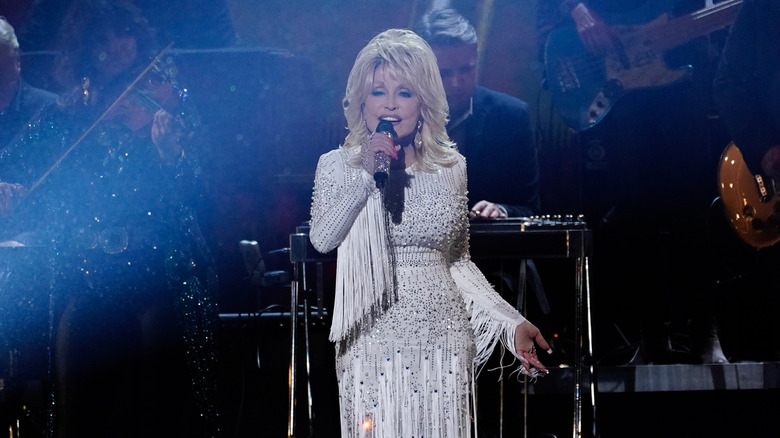
Dolly Parton has been called the queen of country music — but that's a crowded throne, with her near-peers Loretta Lynn, Wanda Jackson, Reba McEntire, and a handful of other luminaries also claiming the crown. Where Parton really excels as an icon is her ability to find success and fame beyond her silo, bursting out of the country-music niche just as she so often threatens to overwhelm her shapewear.
Dolly Parton has been a tycoon, a pop singer, a movie star, a songwriter, a sex symbol, and any number of other roles during her long and spectacular time in the public eye. It's made her rich, but more than that, it's made her one of the most beloved public figures in the modern United States and across the world. Through timeless hits such as "I Will Always Love You" and "9 to 5," the mountain songbird from East Tennessee has become one of the most recognizable voices of modern music, dominating country charts even as she's never let genres box her in.
I Will Always Love You
Dolly Parton wrote "Jolene" and "I Will Always Love You" in a single astronomically productive afternoon (long before the Pomodoro Technique became trendy), possibly setting a record for royalties earned per minute of work. Parton's gentle, mournful rendition of "I Will Always Love You" is one of music's classic heartbreakers, an intimate farewell delivered with the caution of someone holding her breaking heart to try to keep it from shattering.
And then came Whitney Houston, one of the all-time powerhouse belters, who covered the song for the soundtrack of her otherwise forgettable film "The Bodyguard." If Dolly was a songbird, Whitney was a jet engine (we mean that as a compliment), and the controlled power of Houston's rendition propelled the single way past the film, winning record of the year at the 1994 Grammys.
Parton and Houston praised each other's work, with Parton publicly admiring Houston's version and shooting down speculation of jealousy. And after all, as the songwriter, Parton cashed in on the success of Houston's version, bringing her millions of dollars — an excellent reason to share Houston's pleasure in the cover's success.
Islands in the Stream
"Islands in the Stream," a duet with fellow American treasure Kenny Rogers, was one of Dolly Parton's biggest crossover hits, peaking at No. 1 on both the Hot 100 and the country charts. This tune is so indelibly connected with Parton and Rogers' distinctive voices (and the audible fun they have singing together) that it's a bit of a shock to peek at the alternative history in which this Bee Gees-penned song was recorded by their first choice, Marvin Gaye.
Whatever you think of the Bee Gees' distinctive antipodean falsettos, the hypersuccessful band had their fingers on what the listening public wanted for a number of years, both as performers and as songwriters. When Gaye was having a renaissance in the early '80s, the Gibbs wrote "Islands in the Stream" with him (and royalties) in mind, but the deal never landed. Rogers got the next crack at it; when he balked a bit, Barry Gibb suggested he try to rope Parton in. The rest is disco-soul-country-pop-crossover-smash-duet history.
Jolene
"Jolene," the other juggernaut jam from Dolly Parton's legendary songwriting afternoon, may be the singer's best-known song, at least in the version she herself recorded. The song is as close to perfect as a human creation can be: simple but memorable, heartfelt, and unusual in its treatment of a woman confronting the "Other Woman." No wonder audiences have worshipped it for decades.
"Jolene" has also found an ardent following among other musicians, who cover this song almost as a rite of passage. Its relative simplicity means it's both easy to handle and has a lot of room for artists to put their own spin on it, and its recognizability means people will be drawn to hear even the thousandth take on this apparently immortal song. Miley Cyrus did it as a sexy alto, the way she shines best. The White Stripes did it as an unhinged, queer-coded cri du coeur. It's been gothified, filtered through new wave, and translated into Persian. Two things have remained clear: some men will get real stupid over a redhead, and Parton is a peerless songwriter with the checks to prove it.
9 to 5
For all her sweet demeanor, Dolly Parton drives a hard bargain. A case in point: when she was scouted to appear in the female-led workplace comedy "9 to 5," she agreed on one condition: that she could write the theme song. And for a lady who hasn't spent much time watching the clock at a bleak office job, she certainly captured the vibe, with both the film and the song "9 to 5" becoming hits, eventually leading to a stage musical.
"9 to 5" speaks more to women's experiences, like much of Parton's music, but it's certainly an experience many men can also relate to. Parton's relentless upbeatness in the face of the keep-on-keepin'-on drudgery of the workaday world makes the song a minor worker's anthem, especially with its acknowledgment that most of the value workers create goes to their alleged superiors. Multi-hyphenate Parton got a little bit of work as a foley artist on the track, by the way: That syncopated "typewriter" rhythm that underpins the song is made with her artificial nails.
Here You Come Again
Crossover songs — and crossover artists — aren't a real rarity. Music lovers tend to love music from multiple genres, and the lines between them are seldom so clearly drawn that the right song can't blow up in more than one lane. That said, it's still a major career milestone when an artist with a "home" in one genre or style breaks out of their lane to find success on new charts and with new audiences, and that's what Parton did with 1977's "Here You Come Again."
"Here You Come Again" plays to Parton's strengths while being closer to a pop ballad than a traditionally twangy country jam. She shows off the range and expressive power of her voice and alludes to physical intimacy without becoming graphic: We know what lyrics like "Just leave it up to you and in a little while / You're messin' up my mind and fillin' up my senses" probably mean. Audiences new and old loved her new direction, lofting her first platinum album of the same name into the Billboard 200's Top 20.