

The Top 5 One-Hit Wonders Of The '70s As Decided By The Charts
The 1970s is probably the most stylistically diverse and explosively creative decade that mainstream music will ever experience. But all that free-forming and experimentation also led to a golden age for the one-hit wonder. In the '70s, a slew of singers and groups climbed the charts but enjoyed their fame ever so briefly, as they were unable to turn one smash hit into a lasting career.
While a one-hit wonder is often considered to be an artist with only one Top 40 hit, a narrower definition only includes acts that landed on the Billboard Hot 100 once, regardless of placement. The '70s offered plenty of those, so to cull the field even more, we've selected artists who never placed another high-charting single on any major Billboard chart, such as the R&B, country, or adult contemporary lists. These are the true one-hit wonders: those who scored only one actual hit in any genre. Each of these songs made it into the Top 5 and sold at least 500,000 physical copies, but success was fleeting. Here are five songs that fascinated the masses for a little while and earned their performers — from bluegrass artists Eric Weissberg and Steve Mandell to future "American Werewolf in London" star David Naughton — the status of biggest one-hit wonders of the '70s, according to Billboard chart data.
Dueling Banjos – Eric Weissberg and Steve Mandell
The 1972 film adaption of James Dickey's novel "Deliverance" concerned a group of friends who get lost on a rural canoe trip and endure a series of horrific events. One of the few light-hearted and crowd-pleasing moments in the movie was a musical interlude based on a 1950s instrumental by Arthur Smith in which a vacationer with a guitar, played by Ronny Cox, engages in a musical fight with a banjo-playing Appalachian (Billy Redden).
The lively call-and-response work, officially titled "Dueling Banjos," was actually performed for "Deliverance" by bluegrass veterans and session players Eric Weissberg and Steve Mandell. While the movie was widely released in the U.S. in the summer of 1972, it took until early 1973 for the song to make a commercial impact and hit the Hot 100. It spent an entire month at No. 2 while also going to No. 1 on the adult contemporary chart. But authentic, instrumental bluegrass wasn't exactly taking over pop culture in the 1970s, so "Dueling Banjos" was ultimately a fluke. Weissberg and Mandell attempted to capitalize on the attention and formed a band called Deliverance. They're best known for another bluegrass novelty: a cover of the Coasters' early '60s hit "Yakety Yak," which barely made it onto the country chart in 1975.
In the Summertime – Mungo Jerry
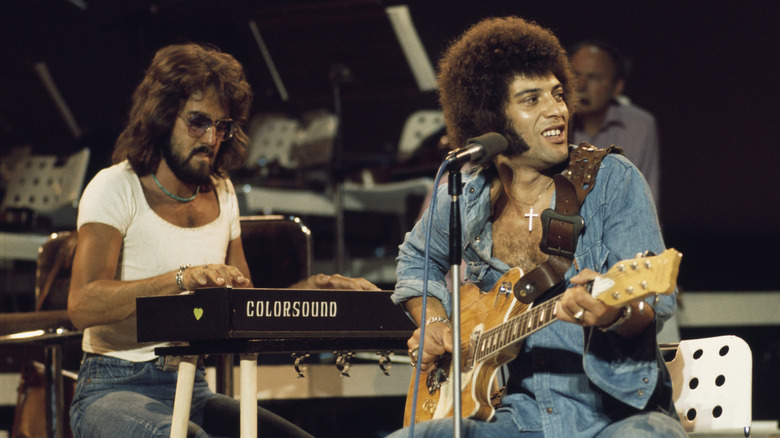
One of the biggest hits of 1970, "In the Summertime" by Mungo Jerry, is among the most joyful smash hits ever, while also coming across as rough around the edges and charmingly old-fashioned. There's a lot of blues in the song, but it's more reminiscent of early 20th century musical forms played by skiffle groups and jug bands, which played a mashup of folk, jazz, and country on primitive or improvised instruments. That's all very classic Americana, but Mungo Jerry was a modern group made up of young people from the U.K. Completing the song's celebratory approach, the lyrics of "In the Summertime," as warbled by frontman Ray Dorset, touch on the positives of the warmer months of the year.
"In the Summertime" danced up to No. 3 in 1970 — and in the summertime, no less. While that single was irresistible and relatable, Mungo Jerry's antiquated music was probably too weird and too far out of the mainstream of '70s rock to ever allow its practitioners to achieve lasting fame. By 1972, Mungo Jerry was an outlet for Dorset, who later transitioned to an unsuccessful solo career. Even after re-embracing the "Mungo Jerry" moniker, he played smaller venues, sometimes with a band and sometimes alone with pre-taped support musicians.
The Lord's Prayer – Sister Janet Mead
In what is both a fascinating religious relic and a pop culture obscurity, a practicing nun in the Roman Catholic Church scored a Top 5 hit in 1974 with a rock 'n' roll rendering of "The Lord's Prayer." Also known as "Our Father" for its first line, the prayer is directed to the God of Christianity, and it gives praise, offers thanks, and calls for a unification of heaven and Earth. It's a central part of the Catholic Mass, and it's the lyric sheet for Sister Janet Mead's "The Lord's Prayer," her only Hot 100 hit, which found a peak position of No. 4 in the spring of 1974.
This wasn't a mere recitation or a church-ready hymn — Mead sang classically and sweetly over a fuzzy, buzzy wall of psychedelic electric guitar noise. The bold and modern rendition was an outgrowth of a rock music service that Mead had staged in Adelaide, Australia. Her goal was to expose young people to her faith, and she did just that, globally selling more than 2 million copies of the record. Despite the record's success, Mead had little interest in musical stardom. She never appeared on a chart again and gave all the funds that "The Lord's Prayer" generated to charitable causes. She remained a nun until her death in 2022.
Makin' It – David Naughton
A TV sitcom cribbing the plot of the dramatic dance movie "Saturday Night Fever" might seem like an odd footnote in the messed up history of disco, but that's the basis for "Makin' It." The show hit the air in early 1979 and starred David Naughton — known to TV viewers as the singing, dancing, mugging pitchman in Dr Pepper's ongoing "I'm a Pepper" ad campaign — as fame-seeking disco regular Billy Manucci. That idea is reflected in the aspirational, upbeat, and disco-styled "Makin' It" theme song, as performed by Naughton himself.
"Makin' It" was decidedly unpopular, canceled after just nine episodes. It had disappeared from the airwaves by May 1979, when a full-length version of the sitcom's theme song peaked at No. 5 on the Hot 100. Naughton was primarily an actor, not a singer, so he pursued that career instead and never returned to the music charts. After making it with "Makin' It," he continued to show up in Dr Pepper ads, and in the 1980s he starred in "An American Werewolf in London" and the sitcom "My Sister Sam."
Do You Wanna Make Love – Peter McCann
While the No. 1 hits prove that 1977 was the decade's best year for soft rock, it's a No. 5 hit by Peter McCann, "Do You Wanna Make Love," that shows just how deeply popular well-produced, smooth, and slow romantic jams for serious adults were in the latter part of the decade. Still, in an age where the pop chart (and the adult contemporary one, too) was ruled by sensitivity-espousing, mustached singer-songwriters focusing on the emotional side of human carnality, McCann somehow landed only one Hot 100 hit, never to return.
McCann was inspired to write "Do You Wanna Make Love" after feeling uncomfortable about the state of the dating scene. Responding to what he saw as heartless and transactional interactions, he aimed to be more romantic with his come-on. He had the foundation of the song in place in a few hours, and ABC/Dunhill Music oversaw the release of the final version. McCann's earnest approach worked: "Do You Wanna Make Love" was on the Hot 100 about two weeks after it hit record stores. After better-known singer Jennifer Warnes simultaneously released a cover of McCann's next single, "Right Time of the Night," ABC/Dunhill stopped promoting its signee. He jumped to CBS Records for one final album, "One on One," but it sold so poorly that McCann stopped recording and became a full-time songwriter.