

The 5 Longest Guitar Solos In Rock History
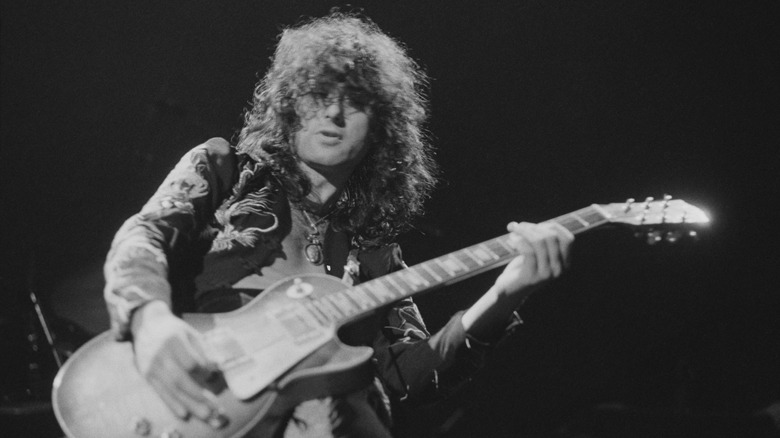
Rock music is defined by the guitar, and so naturally, solos often represent the peak of the genre's experience — on albums and especially live. Rock history is packed with killer guitar solos, many of which are famed for their length. Songs like Lynyrd Skynyrd's "Free Bird" and Peter Frampton's "Do You Feel Like We Do" have proven the guitar solo's ability to not only better a song but also become its main attraction. Even tracks not known for their solos specifically can find new life in concerts when guitarists transform them into extended sagas that often become their show's centerpiece.
We do mean extended, too. Some guitarists are skilled enough and command enough attention from audiences that they can co-opt a 20- to even 40-minute segment of a concert for a single solo. Here, we've collected five of the longest in rock history, with some ground rules to keep it fair and accessible. First, we're limiting things to well-known artists, which tend to leave enough live recordings to actually hear the solos we're referencing. In addition, no repeated artists (otherwise the Allman Brothers might take over the list) and no solos that weren't committed to albums, meaning no world-record attempts or other gimmicks. The works here are in service to the music and live experience. And no matter their prodigious size, at the end of the day, they're still just examples of great guitarists making rock music even greater.
Let There Be Rock (live versions) — Angus Young
When you think of the phrase "rock guitar," there's a good chance that Angus Young and his late brother Malcolm are some of the first names that come to mind. In the catalogue of most iconic guitar songs in history, AC/DC is arguably represented more than any other band. Riffs from "Back in Black" and "Thunderstruck" have been considered essential learning for generations of rock guitarists, and for more intermediate musicians, the same can be said of Angus' solos. Over the course of AC/DC's long, long career, Angus laid down a metric ton (they are Australian) of iconic solos. But in their live shows, it's the "Let There Be Rock" solo that stands out for how long he's been performing it through the years and for how long he performs it each night.
Since the song's release on the album of the same name in '77, Angus has turned the song's already blistering solo into an extended ritual, night after night. By now, the expanded "Let There Be Rock" lead is a staple that repeat AC/DC concertgoers have come to anticipate, and it never fails to deliver. As Airbourne's Joel O'Keeffe described it on Classic Rock: "There's a lot of similarities each night, but it's a fresh solo, and each night he blows himself away again. ... So for me the greatest Angus Young solo happens every night when he plays 'Let There Be Rock.'" Versions like the "Live At River Plate" are typical of the performance's length, clocking in at almost 18 minutes, a full 14 minutes of which are all solo.
Machine Gun (Isle of Wight version) — Jimi Hendrix
Jimi Hendrix is synonymous with virtually all things guitar, and extended solos are no exception. His epic "Voodoo Child (Slight Return)" is one of the most famed guitar pieces of all time, and it's mostly solo, as is its much longer cousin, "Voodoo Chile." Yet those were tracked with his band, the Jimi Hendrix Experience. To truly experience Hendrix's longest and most solo-driven efforts, we have to look to his following group, Band of Gypsys. Though he only recorded one six-track album with the band during his lifetime, it boasts as much solo guitar as any two of its peers combined. The longest and most legendary of the bunch is "Machine Gun," already over 12 minutes on the album, but other live takes like the Isle of Wight version extend to over 22 minutes.
For accuracy's sake, we'll note that Hendrix gives drummer Buddy Miles about three of those minutes for his own improvisation in the Isle of Wight version. Yet that still leaves about 19 minutes, which are almost all wall-to-wall Hendrix's guitar. The album take of "Machine Gun" (still recorded live) has been hailed by more than a few critics as Hendrix at his peak, and other live versions do not sully its legacy. The Isle of Wight version still features the same pioneering playing techniques meant to emulate the sound of machine gun fire, bombs, and pained wails. It's an unusually powerful protest song, and the added length only helps to further fuel its innate angst and fire.
The Diamond Sea (live versions) — Thurston Moore and Lee Ranaldo
Classic rock has long been considered the era of the guitar greats, with such players as Jimi Hendrix, Eric Clapton, David Gilmour, and the like. The '90s have only recently started to come under the classic rock umbrella, meaning there are a few guitarists from the decade still waiting to enter the conversation. Two of the best examples are Thurston Moore and Lee Ranaldo of Sonic Youth, whose wildly experimental playing was foundational for the field of noise rock and highly influential to experimental and alternative rock in general. One of their best demonstrations of their prowess is "The Diamond Sea," which also happens to clock in at over 19 minutes on album (25 minutes for the "alternate ending" cut) and even longer live.
Rolling Stone once ranked the "Diamond Sea" solo as one of the 50 best of all time, calling it "a free-form, 20-minute tempest that went somewhere different every night." "Tempest" is an apt description, as the dueling guitars alternate between dark depths of eerie quiet and crashing, high waves of sound. No two minutes of the "Diamond Sea" solo are alike, and between certain sections, Moore's and Ranaldo's guitars don't even sound like the same instruments. The pair genuinely understood noise — how to produce it, how to control it, and when to eschew it in favor of more melodic riffs. In the same way that Hendrix channeled the noises of war for his "Machine Gun" solo, Moore and Ranaldo channeled the noise of chaos for "The Diamond Sea."
Mountain Jam (Ludlow Garage version) — Duane Allman and Dickey Betts
Seeing the Allman Brothers in any discussion of long guitar solos is almost a given, but that's only because the band made a career out of letting guitarists Duane Allman and Dickey Betts run free and happily recording the consistently stellar results. They were known for being a jam band whose songs could run on at length, especially live, but their song "Mountain Jam," from their hit double album "Eat a Peach," takes the cake. Split into two parts on the album, the combined length of "Mountain Jam" is around 34 minutes, making it one of the longest songs in classic rock history. The version on their "Live at Ludlow Garage" album is even longer, reaching a truly incredible 44 minutes exactly.
On top of its already exceptional length, the "Ludlow Garage" version of "Mountain Jam" is unburdened by the vocal sections that other extended solos are forced to build around. Instead, the song is entirely instrumental, and aside from the middle sections that let the drums, bass, and keyboard take their flights of fancy, the whole song is Allman and Betts soloing to their hearts' content. Unlike the highly contrasting quiet-loud dynamics of solos like "The Diamond Sea," the playing on "Mountain Jam" is relatively uniform across the board. Instead, Allman and Betts use expert little tricks to keep things fresh and fun, like small changes to guitar tone between sections and the continual shifting of rhythms and registers. "Mountain Jam" is one of those solos meant only for the most committed of fans.
Dazed and Confused (live versions) — Jimmy Page
Perhaps the most famed evolution of a live solo in rock history comes from Led Zeppelin's cover of Jake Holmes' "Dazed and Confused," which began as a relatively modest six-minute acid rock jam on Zepp's first album. By the mid-'70s, it had ballooned into an over-40-minute odyssey with distinct sections, including Jimmy Page's famous bowed guitar playing. Though Zepp's live recordings are notoriously rare for a band of their import, a handful of "Dazed and Confused" live performances exist online, and none are longer than those from their multi-day stint at the Los Angeles Forum in 1975. On their closing night, the song ran for over 45 minutes, with almost every minute dedicated to Page's soloing.
Page smartly structured the extensive solo into distinct sections with their own styles. Different band members left and rejoined him in different places, which helped keep the staleness at bay. Even during the several sections in which Page is the only member audibly playing, he continually varies his style, sometimes playing recognizable riffs, sometimes shredding at his limit, and sometimes descending into echoing, atmospheric soundscapes.
Zepp would retire "Dazed and Confused" from their live sets only two months later during their legendary show at Earls Court, and it's not hard to guess why. In its place, the band could fit an entire other set of material. "Dazed and Confused" might have become the one guitar solo in rock history so long it had to be put to bed forever.