

The Best Classic Rock Hits Inspired By Foreign Languages
Rock 'n' roll is an American phenomenon, and it initially spread English-language songs around the world. But by the 1960s and 1970s, musicians were pulling tunes from other languages and turning them into classic rock hits. In the early decades of rock, artists got material or their songs from their own lives and relied on non-performing songwriters, and as the genre matured, all parties involved dabbled in remaking pieces largely unknown to American and British audiences, because they originated with non-English-speaking countries and cultures. Rewarded for their skills of searching and adaptation, major rock stars scored major hits with their tunes inspired by songs from other languages.
Some of these initially non-English songs stand out, because they were successful and read as rock songs despite their non-American and non-rock 'n' roll pedigree. English-comfortable songwriters flawlessly turned these older songs into contemporary and contemporary-sounding hits. Acts of the '60s and '70s, such as Terry Jacks, the Grass Roots, Sonny & Cher, and Elvis Presley, all delivered classic rock-era hits based on songs originally written and performed in languages besides English.
Terry Jacks – Seasons in the Sun
Boldly opening with some wobbly, spaced-out electric guitar notes, 1974's "Seasons in the Sun" at first sounds like a holdover from the late-1960s psychedelic era. But then the lyrics kick in, and Terry Jacks segues into delivering a poignant folk-rock ballad told from the point of view of a dying man spending his final moments looking back on a life well lived and saying goodbye to some of the important figures who shaped it. It's all achingly bittersweet, a feeling dominant in its source material: a decade-old French song.
In 1961, French musician Jacques Brel wrote "Le Moribond," also known as "The Dying Man." Pop poet and successful recording artist Rod McKuen drafted an English translation in the mid-1960s, and folk group the Kingston Trio recorded that adaptation in 1964. About a decade later, Jacks was working as a session contributor for the Beach Boys, and he turned them on to the song, since retitled "Seasons in the Sun." They opted to not let the public hear their stab, prompting Jacks to make his own version. Jacks' single of "Seasons in the Sun" ultimately spent three weeks at No. 1 in 1974.
The Grass Roots – Let's Live for Today
Their songs were seeped in emotion and inflected with soul, and the Grass Roots sent 14 of them into the Top 40 in the late 1960s and early 1970s. They're best remembered today for how one of their guitarists was Creed Bratton, famous for playing a demented version of himself on the American remake of the British sitcom "The Office," as well as for "Let's Live for Today," a remake of an English-language take on a just-released Italian song.
The British Invasion included more than just pop-rock bands from the U.K. who dominated the U.S. charts for the better part of the 1960s. The Rokes were a British act who found their biggest audience in Italy. One massive hit there for the group was "Piangi Con Me," which works out to "Cry with Me" in English. Member Shel Shapiro helped write the tune, which the Rokes then adapted into English as "Let's Live for Today."
But that wasn't a hit in the U.K. or the U.S. until the Grass Roots got a hold of it. Making it melodramatic and affecting, the song about embracing life and living in the right now captured the hearts and attention of American music fans, who sent it to No. 8 on the Hot 100 in the summer of 1967.
Sonny & Cher – What Now My Love
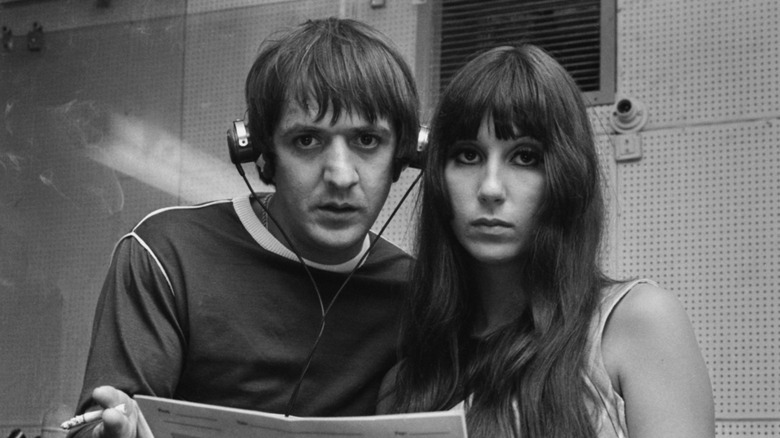
The relationship between Sonny Bono and future superstar Cher is a bandmate romance that shaped rock history. Breaking out as a personally involved, counterculture-adjacent singing duo in 1965, Sonny & Cher reached the Top 40 10 times by 1972 with songs like the No. 1 "I Got You Babe" and "What Now My Love."
"Et Maintenant," or "And Now" in English, debuted in 1961 from French and French-language performer and composer Gilbert Bécaud and lyricist Pierre Delanoë. It sold well and then went into high demand in English-speaking countries. With a lyrical translation by songwriter Carl Sigman, "Et Maintenant" became "What Now My Love," and the heart-wrenching ballad became a Top 5 hit in the U.K. for Shirley Bassey but missed the U.S. charts. Herb Alpert and the Tijuana Brass made it the title track of an easy listening LP in 1966, the same year that Sonny & Cher delivered a more youth-oriented and rock-forward version.
The song became something of a standard in the 1960s, with Lou Rawls, Petula Clark, Jane Morgan, Connie Francis, and other '60s acts we completely forgot about also recording and performing prominent covers during the decade. But the Sonny & Cher one rocked the most and did the best on the American pop charts. In early 1966, "What Now My Love" became a No. 14 smash.
Elvis Presley – Surrender
Elvis Presley had his biggest year ever in 1960, scoring three No. 1 singles. He repeated a proven formula in 1961 to more success. After the cover of a 1926 song "Are You Lonesome Tonight?" and the translated-from-Italian "It's Now or Never" both hit the top of the pop charts, Presley struck out with an English-language reworking of another decades' old song of Italian origin.
In 1911, prominent Neapolitan composers Ernesto and B.G. de Curtis presented "Torna a Sorrento," or "Come Back to Sorrento," a pleading and passionate love ballad. Fifty years on, Mort Shuman and Doc Pomus wrote brand-new English lyrics and renamed the song "Surrender," maintaining the original's palpable drama and romantic passion. Presley's version sounds much like a traditional Italian pop song, while studio musicians add a simple but propulsive drumbeat, other percussion, and light brass to make for a dizzy and dizzying love song. But that's also in part due to Presley's ambitious performance, which moves from rock into a croon and reaches some nearly operatic high notes.
At under two minutes, "Surrender" is one of the shortest songs to ever top the charts. But it did, for two weeks, in the spring of 1961.