

5 Bruce Springsteen Songs That We'd Unfortunately Rather Forget

Listen, they can't all be bangers, right? If a career like Bruce Springsteen's spans over 50 years, 21 studio albums, and about 400 songs (estimates vary), it's really, really unlikely that all of them are going to be on par with "I'm On Fire" or "Born to Run." The arguments may vary, but the Boss has some stinkers in his catalogue, too.
There's tons of reasons why we wouldn't want to hear a Springsteen song again, just like any artist. It could be limp, lame lyrics, or tame, tepid music. Maybe the radio has oversaturated the airwaves with it, and we just can't tolerate hearing it anymore, much like any overplayed hit from Springsteen's biggest decade, the '80s. Albums like "Born in the U.S.A." were enormous hits and prove that 1984 was the best year of Springsteen's career, but what about albums like 1987's "Tunnel of Love" or 1992's "Human Touch"? Nobody talks about these works for a reason. There could be some x-factor, too, that makes a track hard to swallow — maybe the attitude, timbre of the instruments, overall mix, anything. We're open to all possibilities for this article.
None of this is meant to poo-poo on a legend. But, there's also no reason to not be honest about an artist's work and have a little fun in the process. So let's take a gander at some sub-par outings from a man who's sold 90 million albums, earned 20 Grammys out of 51 nominations, and is worth three-quarters of a billion dollars (per Celebrity Net Worth). We're sure he won't mind.
Queen of the Supermarket
Bruce. Bruce. Hey, Bruce. What's going on with this song, man? "Queen of the Supermarket"? All this song is going to do is make cashiers not want to bag your groceries for fear that you'll make them your muse. It's not romantic. It's just obsessively weird and more than a bit on-the-nose.
"Queen of the Supermarket" is the queen of cliché lyrics from a cliché album title, 2009's "Working on a Dream" (that won a Grammy, because of course). Lazy lines include "a wonderful world where all you desire," "everything you've longed for is at your fingertips," "the cool promise of ecstasy," people being "blissfully unaware," "guidance from the gods above," and praying, "for the strength to tell the one I love." This grab bag of stock phrases is counterbalanced by occasional, semi-interesting imagery, like, "her company cap covers her hair." But then there's the final conclusion to the song's story of unrequited grocery store love, when the cashier/love interest smiles at the protagonist and, "blows this whole f***ing place apart." What in the world is that supposed to mean?
In the end, "Queen of the Supermarket" is a potentially sound premise bungled in the execution. The core idea of using a single individual in a single place and time to tell a universal story about love is great. Focusing on an overlooked, under-appreciated person is fantastic. But the song's lyrics, which come across as overblown, undercooked, and a bit creepy, are awful. And we haven't even mentioned the music, have we? That's because we can't even remember it. Come on, Bruce, everybody's got a hungry heart. You gotta' find yours again.
Let's Be Friends (Skin to Skin)
Oh no, it's a song that starts with, "I been watching you a long time." Is this about the grocery store lady? No, it's from 2002's "The Rising," which predates "Queen of the Supermarket" and won the 2003 Grammy for "Best Rock Album," which proves that the Grammys are a completely worthless endeavor that no one should heed, ever, ever. But at least the song has dated, vaguely '80s hip-hop percussion that in no way makes it better. And then there's the title: "Let's Be Friends (Skin to Skin)." Sigh.
Rather than being aggressively bad, "Let's Be Friends (Skin to Skin)" is painfully blah. Just like the supermarket song, its lyrics are achingly derivative and completely lack the verve of Springsteen's mid-70s through mid-'80s peak work. Lines include the chorus couplet, "Don't know when this chance might come again / Good times got a way of coming to an end" and the verse couplet, "There's a lot of walls need tearing down / Together we could take them down one by one." Which high schooler's notebook is this from, again?
We all know that magnificent music can elevate lyrics that seem drab on paper, but definitely not in the case of "Let's Be Friends (Skin to Skin)." There's a chintzy background synth tapping out eighth notes (twice a beat, regularly), gospel singers whose soul comes across as oddly placed for a less-than-rousing song, two saxophone solos that each sound like the saxophonist fell asleep mid-solo, and some obligatory "do, do do doo do do do doo" nonsense syllables to fill up space. This is Springsteen at his most mojo-less.
Reno
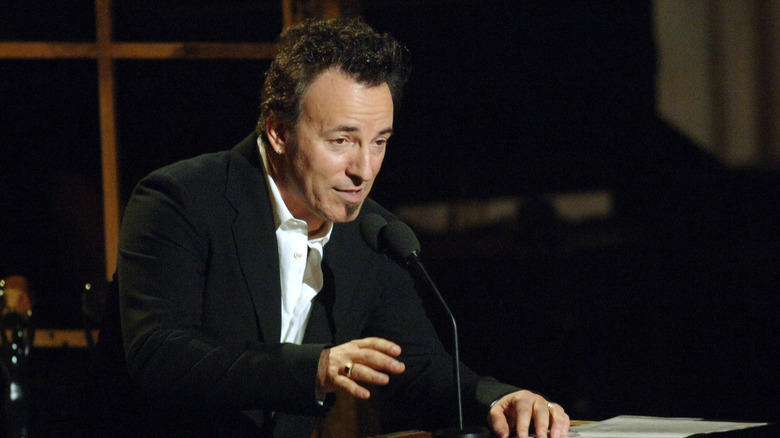
Our previous choices might have been underwhelming and dull, but "Reno" from 2005's "Devils & Dust" is legitimately embarrassing and, at worst, distasteful. The short of it is: "Reno" describes an encounter with a sex worker. That's not the problem — it's the detailed, visual snapshots combined with a total lack of artistry. Some of the lyrics sound like they were pulled from an adult video, the whole thing is sung in a mumble that sounds like Springsteen forgot to open his mouth, and the music is some throwaway acoustic picking-strumming affair.
If we're being charitable, there's probably some rationale behind "Reno," like wanting to show the bare-bones, unvarnished truth of such transactions. The song's last lines are, "It wasn't the best I ever had. Not even close," which at least frames the song in a way that portrays its intent. But let's be honest: Did any fan want to hear this from the Boss? Was there not a more nuanced way of getting the song's point across? Other songs across the decade have been more lurid, but it's the combination of all factors that makes "Reno" unbearable: Springsteen's first-person perspective, his mumble, the blow-for-blow descriptions (so to speak), the diecast music, etc. This isn't sympathetic working-class fare, it's strangely indulgent strip-mining. Surely there were better memories from Reno, right, Boss?
57 Channels (And Nothin' On)
"57 Channels (And Nothing' On)" is another blah song bungled in the execution. The main premise, that TVs are full of garbage, is just too obvious. Some folks might think it's pithy to extend the song's premise to 57,000 dumb YouTube videos to point out that things haven't changed since 1992's "Human Touch." But in that case, we're left with the same issue: And then what? Springsteen's lyrical solution is to buy a .44 Magnum and literally shoot his TV, which lands the song's protagonist in trouble with the law. Not a good plan.
As we said before, music can counterbalance other, poorer song elements. But this isn't the case with "57 Channels (And Nothing' On)." The song is a brief, pared-back, bass-and-drums-focused affair. There's no real variation over its length, no interesting complexities, no lushness to the instrumentation — nothing. In fact, the mix sounds built to allow Springsteen's voice and lyrics to come to the forefront, which doesn't help the song. Those lyrics include, "Well, now, home entertainment was my baby's wish / So I hopped into town for a satellite dish / I tied it to the top of my Japanese car," which tells the story of a person's preoccupation with the boob tube. The story is told in snippets of imagery, like a lot of Springsteen's work, and just reiterates the song's title again and again in the chorus.
You might think we're being a little hard on old Brucy here, but it's Springsteen who set the bar with his best works, like 1982's dark folk "Nebraska" and its title track's melancholy meaning. In the end, "57 Channels (And Nothing' On)" resembles its own premise: lots and lots of words, but little to say.
Born in the U.S.A.
Didn't see this choice coming, huh? Yep, we've had enough of this most non-patriotic song that somehow still fools listeners into thinking it's a patriotic anthem. But don't get us wrong: "Born in the U.S.A." is a magnificent song when it comes to its core message about veterans being discarded after war. That's fantastic, as is Bruce Springsteen's intention with this 1984 song from the album of the same name — Springsteen's biggest album by far in terms of sales (over 22 million) and hits (five No. 10 hits). It's the music, people. This song is annoying and way, way, way too overplayed.
Here's what you can do. Go ahead and listen to "Born in the U.S.A." and focus only on the snare drum. This thing clangs away incessantly on the 2 and 4 over the song's entire length. There's no variation, no change-ups, no tempo or rhythmic changes whatsoever. Now, go listen only to the main synth refrain, which warbles equally incessantly over the song's entire length. Now, go listen only to the word "born." Springsteen hits that one note in the same manner and the same rasp in clustered groups precisely 15 times each time he sings this song, which probably means he's sung "born" approximately 855,932 times over his entire career. The guy's got to be tired of it. We're tired of it after only one listen. This is why we don't want to hear "Born in the U.S.A." again. If it wasn't grossly overplayed, it'll still be achingly tedious to listen to.