

5 Debut Albums That Changed Rock History, Ranked
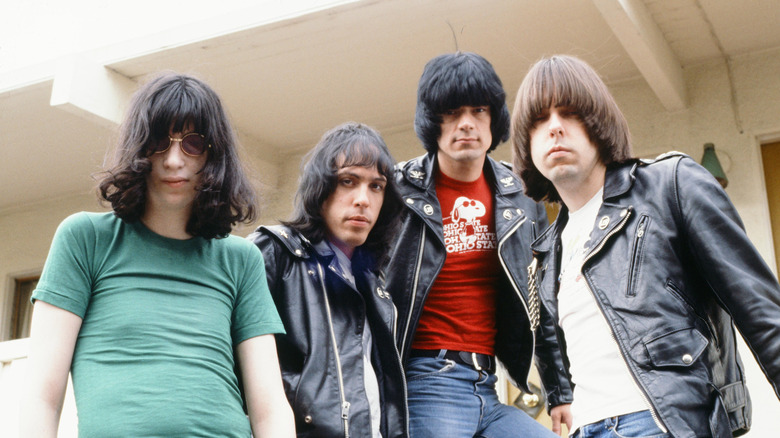
Sometimes a new band comes along and makes such a profound statement with a single album that it changes rock music forever. For this article, we have ranked five classic debut albums in terms of their momentous impact on the rock genre.
Whether they were seismic from the moment they hit record stores or whether they gradually built up a following and later acclaim for being especially forward-thinking and innovative, each of these albums opened up new avenues in rock music. From sub-genre-creating debuts by Black Sabbath and the Ramones — which have been imitated continuously in the decades since they were first released — to one album from a guitar master that sounded like nothing listeners had ever heard before, these records had an energizing effect on rock. Will we see another album come down the line and have the same effect on rock music as these did? For the love of the genre, let's hope so.
5. Is This It – the Strokes
"I just wanted to be one of The Strokes" sings Arctic Monkeys frontman Alex Turner on "Star Treatment," the opener of the British band's 2018 album "Tranquility Base Hotel & Casino." And he wasn't the only one to be influenced by the New York quintet, whose 2001 album, "Is This It," changed the sound of indie rock for the rest of the decade. In fact, it launched thousands of bands across the globe who wanted to imitate the Strokes' singular brand of effortless cool.
The Strokes' sound was characterized by edgy, minimalist instrumentation and frontman Julian Casablancas' idiosyncratic vocal style that veers between sleepily despondent whispers and gravelly crooning. "Is This It" was praised upon its release as a solid album that reconfigured New York punk with a new pop sensibility ideal for the 21st century. Though the record has no skips, arguably the band's approach was at its most successful on "Last Nite," the incredibly danceable lead single that sees Casablancas and the band at their most exuberant.
Though the track was a favorite on indie radio across the globe and eventually achieved several platinum accreditations, it utterly failed to chart on the Billboard Hot 100, though it did hit No. 5 on the Alternative Airplay chart. Frankly, it's one of the greatest rock songs of the 2000s.
4. Are You Experienced – the Jimi Hendrix Experience
Jimi Hendrix had spent years performing with other artists, including Little Richard and Curtis Knight, but without achieving fame in his own right. That all changed when he relocated to London in 1966, where, under the guidance of manager Chas Chandler, he built a huge following with his trio, the Jimi Hendrix Experience. With "Are You Experienced," the group's 1967 debut, Hendrix had the best year of his career while also changing rock music forever.
There had been great guitarists before Hendrix — from Les Paul and Chuck Berry to Link Wray and Dick Dale — but none had made such imaginative use of the electrified instrument, with Hendrix responsible for pioneering a bevy of distortion techniques that smashed the bounds of what guitarists had been capable of producing to that point. With his use of British Marshall amps and recently-developed fuzz pedals, Hendrix helped turn fuzz and sustain into the building blocks of psychedelic rock. Jeff Beck, Eric Clapton, and generations of the world's greatest ever guitarists have taken cues from the classics on "Are You Experienced," such as Hendrix's debut single "Hey Joe" and the mind-bending "Purple Haze." It remains a rite of passage for guitarists everywhere.
3. The Velvet Underground & Nico – The Velvet Underground & Nico
From the delicate ballad of the opening track "Sunday Morning" to the disturbingly chaotic noise jam that closes out the final track "European Son," "The Velvet Underground & Nico" is never less than surprising and compelling. In its experimentalism, it represents a major source of inspiration for alternative artists from David Bowie to Death Grips, and though the Velvet Underground's debut would flop initially and they would continue releasing albums throughout the '60s, ultimately none would prove to be as timeless as this.
Velvet Underground frontman Lou Reed may have been at the vanguard of 1960s experimentalism, but he brought with him two strands of experience that were somewhat conventional. One was from the world of literature, with the songwriter having studied under the acclaimed poet Delmore Schwartz at Syracuse University as a student. And the other was from the cynical business end of pop music, with Reed being employed to churn out countless songs for quick release under a barrage of different artist names as a staff songwriter for Pickwick Records.
These experiences served as an incredibly useful apprenticeship for his work with the Welsh avant-garde composer and Velvet Underground bandmate John Cale, with whom he shared an interest in the droning and discordant sounds that made their debut so unique. Also featuring the tribal drumming of Maureen Tucker and the twisty guitar work of Sterling Morrison, the Velvets were paired by their producer Andy Warhol with the German chanteuse Nico, whose monotone style added further otherworldiness to their sound and created a debut album that changed rock history.
2. Black Sabbath – Black Sabbath
The late, great Black Sabbath frontman Ozzy Osbourne once joked that he would like to find out who came up with the term "heavy metal" so he could strangle them. For him, the music he created existed in the broad, monolithic tradition of rock 'n' roll, and nothing more.
It is strange, then, that his band's debut album has been held up as the record that pretty much set the blueprint for heavy metal, alongside the Beatles' "White Album" track, "Helter Skelter." Released in 1970, the dirge effect achieved by Sabbath guitarist Tony Iommi's downtuning his instrument — the result of a finger injury — sounded harder and more hellish than anything that rock fans had heard before. Opening track "Black Sabbath" revolves around a three-chord riff that could be a motif in the soundtrack of a horror film, while Osbourne's searing vocals tell the story of a demonic presence appearing at the foot of the narrator's bed, before they are seemingly dragged to hell.
Other tracks on the record, including "The Wizard" and "N.I.B." — which was played during Osbourne's farewell show in 2025 — rank among key foundations in the heavy metal genre. Sabbath would go on to create arguably better work — the follow-up album "Paranoid" is held by many fans as the best thing in their discography — but the debut is where everything changed.
1. The Ramones – the Ramones
By the mid-1970s, the New York music scene was beginning to coalesce around a generation of exciting new artists playing out of dive clubs such as CBGBs. Patti Smith, Television, and Blondie all made a huge impact creating interesting, edgy music that nevertheless had some degree of pop focus. But nothing could compare to the arrival of punk in the U.S., heralded by the debut album by the Ramones.
Fast-paced, aggressive, but ultimately danceable and catchy, the 1976 record is packed tight with 14 songs that together last less than half an hour. For many rock fans, the record was an antidote to many of the bloated and self-indulgent tendencies that characterized much of the wider genre in the mid-1970s, and the resulting punk explosion in the U.S. and U.K. was heralded by its supporters as a new year zero for guitar-led music. Punk would soon expand in all directions and mutate into post-punk, new wave, and countless other forms before the close of the decade, but for purists, "The Ramones" is still the first point of inspiration and the only record you need to hear to divine what punk is all about.