

5 Rock Bands With The Longest Careers In Music History
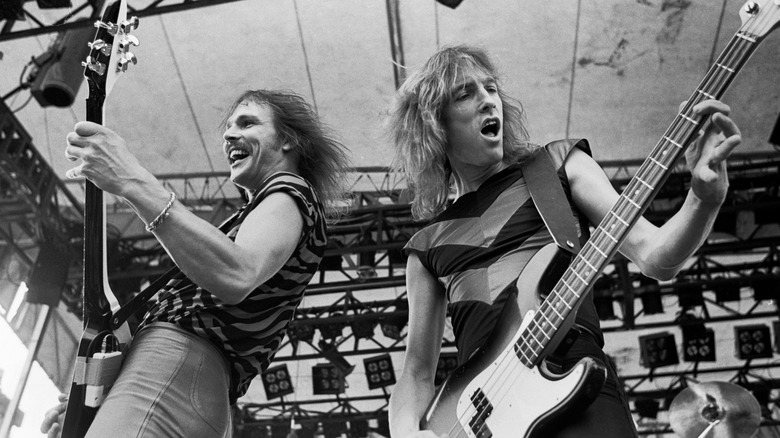
Owing to artistic burnout, the musician's desire to try something new, or the ever-changing tastes of the public, it doesn't seem like most rock bands last for much more than a few years. Sure, the most successful groups of the '60s, '70s, and '80s will put aside their band breakups for a lucrative reunion tour, but they rarely come back at full force. Only a scant few major, globally known bands in the lengthy history of rock 'n' roll were in it for the long haul. They got together as teenagers or very young adults, and weathered successful band member replacements and stayed together as an active concern, regularly recording and touring without ever splitting up.
Just as many members of the rank-and-file workforce used to just stay with one company for their entire employment history, these are the bands that would similarly qualify for the proverbial gold watch upon retirement. Except they don't really retire. The Beach Boys, the Rolling Stones, Scorpions, Golden Earring, and Chicago have been rocking audiences for around six decades each — the longest runs in music history.
The Beach Boys
The biggest American band of the 1960s outlasted all of their contemporaries. As of 2026, and with dates booked into the next year, the Beach Boys still play to large audiences. The band, formed in 1961, initially consisted of Hawthorne, California, siblings Dennis, Carl, and Brian Wilson, family cousin Mike Love, and friend Al Jardine. In 1962, they coalesced into a pop-rock band with airtight harmonies and issued a single that got them a deal with Capitol Records and established a musical theme for the next few years: "Surfin'." Also playing up Southern California surf culture was a change in name to the Beach Boys from the Pendletones (because the musicians wore Pendleton shirts). Soon thereafter, the Beach Boys got massive, a time so detrimental to the mental health of Brian Wilson that at the close of 1964, he opted out of playing live to concentrate on studio work. That's where he honed and reinvented the Beach Boys sound, taking them to majestic and progressive new places with 1966's "Pet Sounds" LP.
After making a series of critically appreciated moody and introspective albums in the '70s, the Beach Boys re-embraced pop and went to No. 1 in 1988 with the tropical "Kokomo." Of the foundational lineup, all of the Wilsons have died and Jardine has retired, leaving Love as the leader of the Beach Boys, which otherwise consists of hired professionals. That's still an uninterrupted band history of 65 years.
The Rolling Stones
The Rolling Stones proudly wear the nickname "The Greatest Rock 'n' Roll Band in the World," and they've got the history and resumé to support it. With eight No. 1 singles in the U.K. and in the U.S., including eternal '60s classics like "(I Can't Get No) Satisfaction" and "Paint It, Black," and '70s albums such as "Exile on Main St." and "Sticky Fingers" that rank among the most praised ever, the Rolling Stones have been defining and redefining rock music for decades. They've played well over 2,000 concerts, with quintessential rock frontman Mick Jagger and influential guitarist Keith Richards still thrilling crowds.
That duo comprises the unchanging core of the Stones. In 1960, childhood friends Jagger and Richards reunited in a blues group, Little Boy Blue & the Blue Boys, before joining guitarist Brian Jones in his startup rock band, the Rollin' Stones, later changed to Rolling Stones. They played their initial show at London's Marquee Club in July 1962 — 64 years ago.
Scorpions
Strongly associated with '80s hard rock and heavy metal hits characterized by screeching guitars and ominous vocals, Scorpions had been playing and recording together for a long time before international attention and record sales arrived. Guitarist and lead singer Rudolf Schenker put together the first iteration of Scorpions in 1965 alongside Lothar Heimberg on bass and Wolfgang Dziony on drums. Those two musicians ultimately left and Schenker organized a new lineup. Moving to guitar and bandleader responsibilities, Schenker ceded lead vocalist duties to new member Klaus Meine, the voice on every well-known Scorpions song in the '80s and '90s, including "Rock You Like a Hurricane," "No One Like You," and "Wind of Change."
As of 2026, Scorpions are still a touring and recording entity, with Meine fronting the band for 40 years. They've only got one founding musician left, but Schenker has kept Scorpions going for 61 years and counting.
Golden Earring
While they were still attending school in their Netherlands hometown of The Hague in 1961, George Kooymans and Rinus Gerritsen put together a rock band called the Tornadoes. After learning that an American band that captured what '60s surf rock was all about already had that name, the growing group became the Golden Earrings, simplified to Golden Earring by 1970, and thereupon became one of the leading acts of the Dutch rock scene.
Golden Earring's 1973 album "Moontan," their ninth full-length studio effort, is the first one that resonated in the United States. In America, "Moontan" sold more than half a million copies, primarily on the strength of the lead-off single and hard-charging, classic rock radio staple and singalong favorite "Radar Love." That peaked at No. 13 in the U.S., while follow-up "Candy's Going Bad" made it up to No. 91. Almost a decade later, Golden Earring re-emerged in the U.S., and the hypnotic "Twilight Zone" became the band's only Top 10 hit stateside in 1982.
The band regularly released studio and live albums throughout the '80s, '90s, and beyond. Only after original guitarist Kooymans retired from music when he was diagnosed with ALS in 2021 did Golden Earring breakup. Not counting the goodbye/reunion show staged in early 2026 after Kooymans' death, Golden Earring endured for 60 years.
Chicago
Long before they were the over-produced, synth-powered juggernaut name brand of 1980s soft rock, with smooth hits like "Hard Habit to Break," "You're the Inspiration," and "Look Away," Chicago was a sprawling and freewheeling collective that aimed to combine hallmarks of jazz and R&B — particularly a lively horn section — with energetic late '60s hard rock. In 1966, Chicago resident, DePaul University student, and woodwind player Walter Parazaider recruited Terry Kath, Danny Seraphine, and Lee Loughnane from his band, the Missing Links. Transfer student James Pankow joined in, and they poached pianist Robert Lamm and bassist Peter Cetera from other local bands. By early 1967, the group was called the Big Thing, and they were playing bars and clubs in the Chicago area. Parazaider's old friend and CBS Records producer Jimmy Guercio came on to help the band make it, moving everyone to Los Angeles and renaming the project the Chicago Transit Authority.
After one album with that title, which spawned the hit "Questions 67 and 68," the musicians decided to call themselves just Chicago. No rock band scored more Billboard hits in the '70s than Chicago did, and through various additions and exits, the band has recorded more than 30 albums and was still scoring hits on the adult contemporary chart as recently as 2019. Since its genesis in 1966, Chicago has been at it for 60 years.