

5 Disco Hits That Were Way Bigger Outside The US
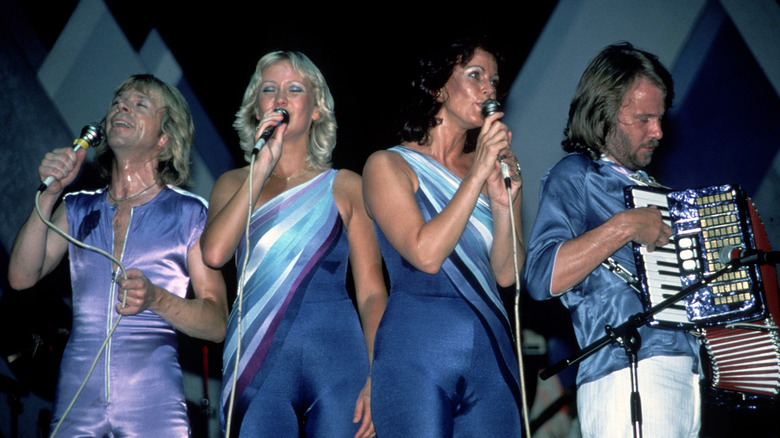
For a moment in the late 1970s, disco took over mainstream culture. Insidiously or delightfully catchy, dance music with a fast beat and loaded up with strings, horns, and jittery percussion got millions of people across the U.S. and Europe to put on their best pair of tight-fitting bell-bottoms, feather their hair, and cut loose on the dance floor of their local discotheque or just jam out to the hottest hits of the day on their home stereos.
A canon of disco standards emerged from roughly 1975 to 1980, but those lists of universal hits aren't the same elsewhere. Some disco songs that were only minor hits in American record stores fared far better internationally.
Americans who survived the all-encompassing disco craze and fondly remember the music might only faintly recall certain singles by acts like Leif Garrett, Donna Summer, Patrick Hernandez, ABBA, and Teach-In. Disco lovers in other countries may recall them as inescapable and some of the biggest hits ever.
I Was Made for Dancin' – Leif Garrett
In the late 1970s, the world was a friendly and supportive place for a charismatic teen idol with a pleasant singing voice. In that pop culture scene was Leif Garrett, a teen-magazine favorite actor and singer who had a decent career as a singles-focused pop and disco vocalist.
Today he's an iconic musician who's surprisingly poor, but after reaching the airwaves with hit covers of old gems like "Surfin' USA," "Runaround Sue," and "Put Your Head on My Shoulder," Garrett entered the Top 10 for the first and only time in 1978 with the then-contemporary disco bop "I Was Made for Dancin'."
Dramatic and rapid-fire, Garrett sang the innocent love song that captured the disco zeitgeist. "I Was Made for Dancin'" was Garrett's biggest U.K. hit. It peaked at No. 4 and spent 10 weeks on the British pop chart in early 1979.
I Feel Love – Donna Summer
A disco song from the '70s that still inspires a dancing mood today, Donna Summer's "I Feel Love" is an ambitious, enveloping, and enchanting dance music masterpiece. Layered, spacey, and aiming for full sensory overload, it's an epic built equally on synthesizers and grooves by Summer and collaborators Giorgio Moroder and Pete Bellotte.
Not nearly as successful with American mainstream pop audiences as Summer's later '70s No. 1 dance-floor-filling smashes like "Hot Stuff," "Bad Girls," and "MacArthur Park," "I Feel Love" was maybe a bit too weird for Top 40 radio saturation. It took three months to peak at No. 6 in November 1977.
In Europe, pop fans had no issues at all with Summer and "I Feel Love," warmly and emphatically embracing the electrifying disco classic. The track climbed up the pop charts in Austria, Belgium, the Netherlands, and the U.K., where it spent four weeks at the top. It remains one of the country's 100 best-selling singles.
Born to Be Alive – Patrick Hernandez
Spain-born, France-raised singer Patrick Hernandez left his pop band Paris Palace Hotel to go solo as a disco artist, and he quickly had a massive hit with the irresistible "Born to Be Alive." In the waning days of 1970s-style disco, the bass and horn section heavy "Born to Be Alive" reached a respectable No. 16 on the Hot 100 in the U.S. in 1979, Hernandez's only showing on the American pop chart. A glorious appreciation for life you can only get by dance-floor ecstasy, "Born to Be Alive" showed off the cathartic release that disco could provide.
The United States was one of the few major music markets of the era in which "Born to Be Alive" didn't make it to No. 1 on a national pop chart. Hernandez ruled the lists in Austria, Denmark, Mexico, New Zealand, Portugal, Sweden, Norway, and West Germany for a spell with the disco anthem. In his home nation of France, "Born to Be Alive" was especially massive, taking over the No. 1 spot for 15 weeks.
Voulez-Vous – ABBA
Never mind their stateside multiplatinum greatest hits album "Gold and the two "Mamma Mia!" movies built around their songs became box office blockbusters — back in the 1970s, when they were a prolific group, ABBA was only marginally popular in the United States. Based in Sweden, ABBA broke out in 1974 with the greatest song in Eurovision history, "Waterloo." The foursome hit No. 1 in the U.S. once with "Dancing Queen" in 1976.
ABBA wasn't exclusively a disco band; they dabbled in pop, rock, and balladry, but their dance music did particularly well in Europe. One such disco smash: 1979's frenetic, propulsive, and brass-driven "Voulez-Vous." The song, with a sensual title translated from French that means "do you want?", is even set in a nightclub. "Voulez-Vous" went No. 1 in Belgium and the Top 10 in many countries including the U.K., Ireland, the Netherlands, and Switzerland. But Americans did not want "Voulez-Vous" much at all. It completely flopped in the United States, spending just three weeks on the Hot 100 and peaking at a paltry No. 80.
Ding-a-dong – Teach-In
One year after ABBA became widely known for winning Eurovision, another act had global success with their own frothy, frivolous pop. In 1975, Teach-In captured a Eurovision victory for the Netherlands with "Ding-a-dong." Written and performed in English, "Ding-a-dong" is an innocuous, goofy tune that encourages listeners to use the power of music to feel nice inside. But the song has all the studio touches and instrumentation that transformed simple dance-pop songs into club-ready disco monsters in the '70s.
In Teach-In's nation of origin, "Ding-a-dong" only got as high as No. 3 on the Dutch singles chart, but it sold very well throughout Europe, arriving in the Top 10 in Belgium, West Germany, and Ireland, and going to No. 1 in Switzerland and in Norway (for eight weeks). Across the ocean, "Ding-a-dong" only slightly registered with Americans in the early days of disco. It could only muster a No. 22 placement on Billboard's adult contemporary chart.