

Born 57 Years Ago Today In Dorset, This Farm-Raised Rocker Made British Music History
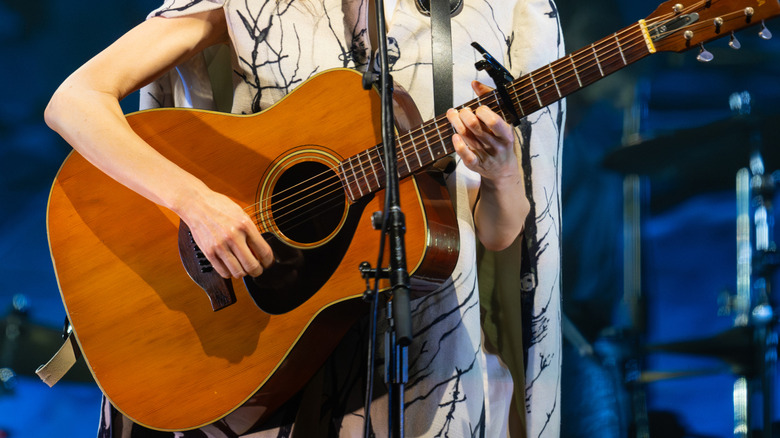
Truly great music takes just as much technical skill as it does imagination, and it's safe to say the world got tremendously more vivacious when alt rock poet Polly Jean Harvey was born 57 years ago today. Beautiful and unapologetically intelligent, her whimsical yet sophisticated brand of music defies being pinned down to just one genre.
One of the most criminally overlooked artists of the '90s shoegaze rock movement, Harvey's feminine-forward lyrics never shied away from the darker and stranger parts of life. Her debut 1992 album, "Dry," married punk and blues in tracks like "Sheela-Na-Gig," turning to haunting, string-based ballads in songs such as "Plants and Rags." Her album, "Rid of Me," helped to establish 1993 as the decade's best year for women in rock, turning the trope of women's soft desires into an aggressive and unapologetic force. 2000's "Stories from the City, Stories from the Sea" maintained its roots in rock, but took a much more gentle approach, indulging in trip-hop melodies with "A Place Called Home" and featuring Radiohead's Thom Yorke on "The Mess We're In."
She also made history after winning the Mercury Prize, a recognition of achievement awarded to top musicians in the U.K. and Ireland, in both 2001 and 2011, exemplifying her much-deserved national value as an artist. Harvey has also published two poetry books – 2015's "The Hollow of the Hand" and 2022's "Orlam," mastering many mediums over the course of her decades-long career. If there's ever been a feeling too complicated to put into words, you can bet that Harvey has at least one track that resonates.
PJ Harvey's rural upbringing and artistic spirit sparked her dark curiosity
Born on October 9, 1969, PJ Harvey was raised by her hippie parents on a non-working sheep farm in Dorset, England, where her father mostly made a living as a quarryman. The rural countryside was the perfect place to learn both the guitar and saxophone, and she returned there for an interview with NME in 1993, recalling the gory details of working with livestock at a young age, and pointing to how it inspired some of the more visceral lyrics in songs such as 1993's "Legs."
Her capacity for creativity was abundant from the beginning, even earning her a place at the prestigious Central Saint Martins Art school in the early '90s — but with her musical talents being realized, Harvey swapped her ambitions in sculpture for a record deal. Her more eccentric taste in art certainly shines through the symbolism she evokes in her songs — some of her saddest lyrics were inspired by the works of visual artists such as Andres Serrano. Experimental art and its political ambitions made themselves staples in her work, showcasing how music's commercial success is based on resonance above all else.
Songs such as her 1995 track "Long Snake Moan" use abrasive guitar riffs and growling vocals to establish images of drowning, desire, and black magic. If her work could be summed up in one word, it would have to be free — free to express yourself, free to love, free to hurt, and free to live. The world feels a little more free whenever one of Harvey's songs is playing, and that's certainly worth celebrating.