

The Best Drum Setup For Beginners
We may receive a commission on purchases made from links.
So you want to bang on the drum all day, huh? Fun as it may sound, and loud as it will sound, getting into playing the drums requires a lot of time and commitment — more than learning your first open C-major chord on a new acoustic guitar for beginners, if we're being honest. You need a whole kit, space in your house, the correct accessories, tolerant loved ones, and loads more. Thankfully, we're here to help.
Beginners who want to get into drums might envision things rather simply: Buy a box of drums, take it home, open it, and start bashing away. But no. Drums come in two types: acoustic and electronic, with the former being the big, clanging, time-honored snare, kick, toms, cymbals, etc., that everyone knows. Electronic drums often look like little pads and can be routed through headphones, silently, and played with various effects and sounds. After determining which of these is better for you, you've got to figure out what kind of kit you need, which boils down to the number and type of drums, which affects the placement of the drums around you. Eventually, you'll have to figure out minor details like how high you want your stool, what type of sticks feel best for you, if you want gloves to avoid sweat slippage, what height and angle you want your cymbals, what tightness you want your snare, and so forth.
But within all such complexities, there are simple rules of thumb and purchase options that will help novices. You won't be playing a famous classic rock drum solo that gives you chills in a week or anything, but you'll at least be keeping time.
Acoustic kits
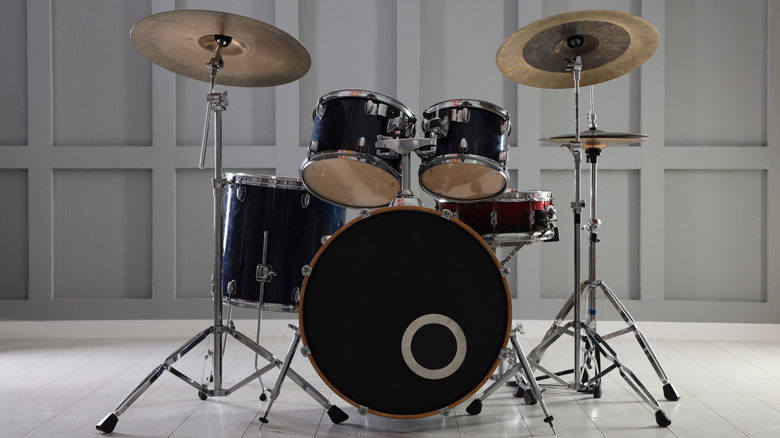
Acoustic drums are the only way to go if you want to develop real technique, which boils down to the moment-to-moment feel of your sticks hitting the drums. How the sticks bounce off different surfaces and quiver in your grip, how the strength and location of your strikes produces different dynamics and timbres, the decay of the drums' reverberations in the air around you, etc. — you can't reproduce this experience with an electronic kit.
The downside to an acoustic kit is the noise. We mentioned tolerant loved ones, but what about ornery neighbors? Unless you're a veteran drummer playing with brushes, an acoustic drum is going to produce anywhere from 90 to 120 decibels of sound — that's the equivalent of a motorcycle engine and jet engine, respectively. Even in a standalone house surrounded by a yard, folks down the block will hear you practice (unless you're in a soundproof room, which we'll get to).
For those willing to go this route, options await. Novices should buy entire kits, not individual components like kick pedals — you can customize later. Sweetwater is a big online seller, and preferable to Amazon if you want a balance between high-enough quality and low-enough price. Low-enough, bear in mind, is still more expensive than a cheap Fender for beginner electric guitarists. Affordable acoustic kits can go below $500, though a nice, entry-level Pearl Roadshow or Ludwig Accent kit — our recommendations — can go up to $800. A five-piece kit is enough to start (with caveats, which we'll get to): kick, snare, floor tom (deeper-pitched), two rack toms (higher-pitched), cymbal, and hi-hat. That's five physical components, not five individual things to hit.
Electronic kits
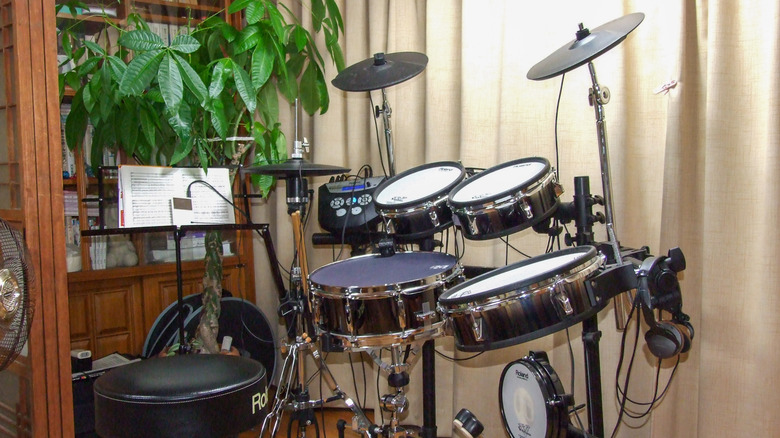
Electronic kits are basically the opposite of acoustic kits when it comes to drawbacks and strengths. It's not that they feel nothing like acoustic drums, but rather that they demonstrate precisely how paramount "feel" is to drums, period. Electronic drums are often flattened pads with mesh covers, which leaves a lot more open space in the kit. The heads are also often smaller in diameter than acoustic drums, and your sticks bounce much differently. But, electronic kits are vastly quieter — basically an apartment dweller's only option. More expensive kits use shelled or half-shelled drums (half the depth), which simulate the feel and sound of acoustic drums more accurately.
The true strength of electronic drums dwells in the name: They're electronic. Electronic drums are half musical instrument, half software interface. You set them up, physically, like an acoustic kit, and then configure their software, which might use a module (a main controller) attached to the kit plus an interface on a laptop or phone. The latter is especially true if your kit comes with sound effects and samples, because, like a keyboard, an electronic kit can sound like anything. As inspiration, Rush drummer Neil Peart wielded an electronic kit for marimba-like tones in his legendary "Der Trommler" performance from 2004, one of his best drum solos.
Options for electronic kits are vast, as are all related hardware. But, it's best if you buy an electronic kit that mimics the layout of an acoustic kit so you can transfer your skills: five-piece with a kick, snare, floor tom, rack toms, cymbal, and hi-hat. The Roland V-Drums TD-02KV is a good, all-in-one option for $650 with 16 different kit presets.
Notes on kit size and placement
Even though we recommended five-piece drum kits for beginners, novice drummers should still know about other options and how those options affect the entire learning process, top to bottom. Enter three-piece kits, which are either, a) compact kits for kids, or b) regular kits for adults arranged differently than five-piece kits but containing the same or similar number of things to hit (kick, snare, toms, etc.).
Kit size boils down to which parts connect to other parts. On a five-piece kit, both rack toms (higher-pitched toms) sit on top of the kick drum, making one, fused object. On a three-piece kit, the snare, tom, and hi-hat might be attached to a pole that sits to one side, while the kick drum stands alone. This doesn't just affect the timbre of the drum when you hit it, but it also changes where the drums are physically located in front of you. Since beginners rely on muscle memory, differences in the physical location of your drums change everything about how you learn. A novice simply can't go from one type of kit to another and play the same. The same rule applies to either acoustic or electronic kits.
But before you think a three-piece kit is cheaper than a five-piece, they can actually be more expensive due to construction costs; acoustic three-pieces bottom out at $600 on Sweetwater. There's also seven-piece kits, nine-piece kits, etc., to consider, either acoustic or electronic. All such choices affect drum placement. In the end, this means you might need to go in person to a store to sit down in front of a kit and see how it feels, no matter our recommendation. After all, feel is paramount.
Accessories, sticks, and more
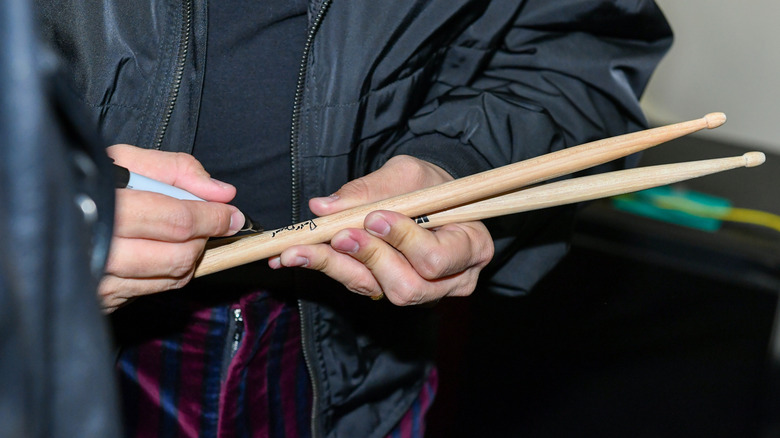
Your drum setup won't work without the smallest, most easily overlooked details. This starts with sticks, which affect the sound and feel of your strikes. The typical drumstick comes in different thicknesses (higher numbers mean thinner sticks), lengths (often 15 to 17.5 inches), materials (maple, oak, aluminum, etc.), and tip types (acorn, nylon, round, and more). While you can play with anything, a thickness of five and length of 15 inches is good. Nylon tips work best across a variety of kits. Also, no sticks are super expensive. Vic Firth 5A American Classic Hickory sticks are a good all-around choice that go for $15 a pair.
Then there's the stool, aka the throne, which might not come with your kit and is 100% essential for any setup. Your throne is like the trunk of a tree that supports all of your bodily movements while playing. A good overall stool with an adjustable height, like a Tama HT750BC Ergo Rider Hydraulic, goes for about $330. Even a cheaper, but not terrible, stool like the Gibraltar 9608E Drum Throne goes for about $125. The difference boils down to how stable the stool feels and how comfortable the cushion is for long periods of sitting.
Then there's accessories for electronic drums. When you buy an electronic drum kit, you'll no doubt feel the urge to tinker with it from the get-go. Multipads (big electronic squares you hit with your sticks) are a fun way to add different sounds and samples to the proceedings, while different modules will expand your customization options. These aren't necessary from day one, but newcomers might want to have such considerations in mind when choosing an electronic drum kit.
Space and sound considerations
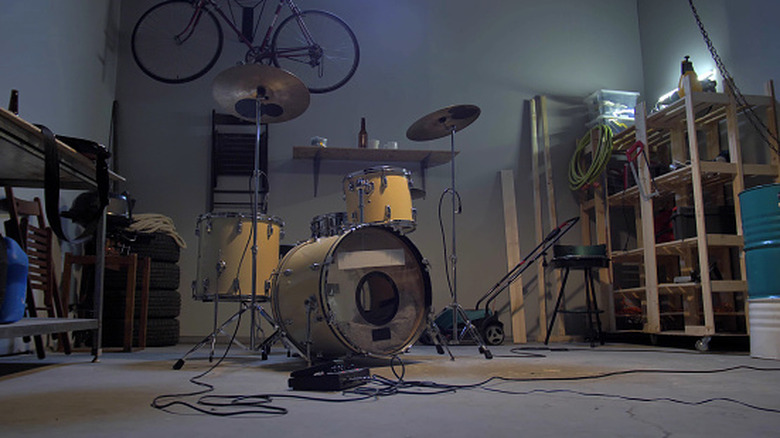
Lastly, there are some general considerations that we ought to mention but could only touch on earlier. Chief amongst these is physical space. The short of it is: Drum kits are way too much of a hassle to setup and take down every time you practice. Unlike a space-saving vinyl record setup, you'll need to leave your kit out unless you start toting it to gigs. Even sparse-looking electronic kits take up way more space than you realize, which means you'll need a dedicated practice area somewhere in your garage, second bedroom, spare half of the kitchen, shed out back, whatever. There's no "best" recommendation here, only a proviso to work with what you have.
Relatedly, and if you're ambitious and have the budget, you could try to soundproof your play space to some degree. This is a potentially massive DIY project that requires soundproof pads, which can run up to $150 for a mere eight square feet. This is probably out of scope for most beginners, leaving you with an electronic kit as your only choice (unless you're using a dedicated practice space somewhere and transporting your drums there each time you play). Nonetheless, the option remains.
Finally, if you live above someone, remember that sound travels down, too. Even if you have an electronic kit, you'll probably need some kind of mat on the floor under you when you play, as your feet will pound and rumble around. You can resort to Amazon for this, as basic soundproof mats will at least put some layer between you and the floor. The $30 to $50 range is reasonable.