

The 5 Best Duets To Ever Come Out Of Yacht Rock
While smooth, slick, and sophisticated R&B and jazz-inflected soft rock arrangements are its backbone, yacht rock relies most of all on emotive, soaring vocals. Since this genre, like most radio-friendly pop music of the late '70s and early '80s, tended to take up relationships and matters of the heart, it's little wonder that it's produced truly gorgeous and unforgettable duets. Sometimes, a ship sails faster with two sails, and sometimes a song needs two singers to propel it.
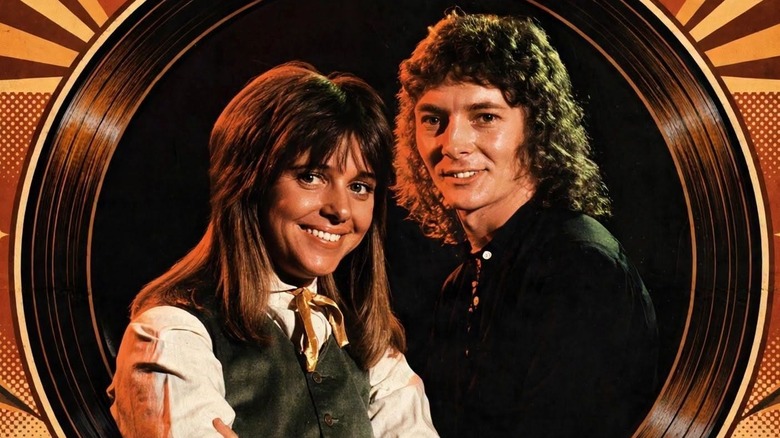
In the best yacht rock duets, the chemistry between the singers and the way that their voices complement each other take center stage. That's what made singer Chris Norman and Suzi Quatro's "Stumblin' In" a groovy hit in 1979 and keeps it a timeless classic. Both Michael McDonald and Kenny Loggins released versions of "What Fool Believes" (the former with the Doobie Brothers). However, the song truly comes alive with the two swapping verses on Loggins' live album "Outside: From the Redwoods." McDonald, an omnipresent figure in the genre, also joined forces with the legendary Patti LaBelle on the shimmering breakup ballad, "On My Own."
Featuring some of the most beautiful voices in yacht rock history, these duets lay everything bare. They tug our heartstrings, hug us, and make us sigh or cry; they pour us another glass. The music that these singers made together became greater than the sum of its parts. You can hear that each pairing, each song was a cresting wave in a creative tide that continues to carry us away.
Whenever I Call You 'Friend' — Kenny Loggins and Stevie Nicks
Off "Nightwatch," one of the classic albums that define yacht rock, "Whenever I Call You 'Friend'" proved that Kenny Loggins could captain his own ship. He'd seen some mid '70s chart success as part of a duo with Jim Messina, but going solo meant entering uncharted waters. "I didn't realize at the time how difficult it was," he says in the film "Yacht Rock: A Dockumentary," adding "... it was the duet with Stevie [Nicks] that ultimately made a huge difference" (via People).
No doubt, the Fleetwood Mac star helped the single sail to No. 5 on the Billboard Hot 100 in 1978. And you can thank friendship for that rise. Loggins got to know Nicks and Fleetwood Mac the year before, when he was an opening act on the notoriously debaucherous "Rumours" tour. "She said to me one day, probably we were drunk, she said, 'If you need a chick singer, give me a call!'" he recalls in the documentary, "So I said, 'Okay, I got that going for me.' "
It's a good thing he dialed, and she picked up because the chemistry between the two iconic singers on "Whenever I Call You 'Friend'" is undeniable. From a mellow, ethereal groove, the song becomes a kind of yacht rock anthem. "See love glowing on us every night," the two harmonize in the chorus, betraying the platonic imagery of the title, "I know forever we'll be doing it, doing it." It makes us blush every time.
Stumblin' In – Chris Norman and Suzi Quatro
In the late '70s and early '80s, when the Doobie Brothers, Toto, and others were cutting the songs that define yacht rock, the genre didn't exist. The name was coined by a troupe of LA-based comedians in the early 2000s, and in its heyday, the music was often referred to as the "West Coast sound." Still, this style of music transcended geography. "Stumblin' In" brought together Chris Norman, of English rock band Smokie, and Suzi Quatro, whose hits like "Can the Can" found much more success in Europe than in the U.S. By tapping into the California sound, the two far-flung rockers created yacht rock gold.
Backed by a light, disco-like arrangement with sultry keyboards and strings, the duet grabs you by the heart right from the get-go. The first verse opens with Norman and Quatro harmonizing on "Our love is alive, and so we begin / Foolishly laying our hearts on the table," capturing the infatuation and passion at the beginning of a relationship. But, of course, each singer gets to flex. Norman's gritty delivery is Rod Stewart-like, while Quatro's voice is soaring and powerful; each brims with the passion you feel when love is new.
Released in a golden era for yacht rock, "Stumblin' In" crested at No. 4 on the Billboard Hot 100 in 1979: the only U.S. top 40 single for both Quatro and Norman as a solo artist. It took warm, sunny grooves for the two to stumble onto a hit.
Baby, Come to Me — Patti Austin and James Ingram
Yacht rock is far more than smooth sounding soft rock; musically complex, it's deeply indebted to jazz, blues, and soul music. It's little wonder, then, that one of the most iconic duets of the genre would come from the pairing of Patti Austin, who'd made a name singing jazz, and R&B singer James Ingram. In February of 1983, "Baby, Come to Me" finally reached to the top of the Billboard Hot 100, following a steady 23-week climb. It took a while, but '80s audiences fell in love with the pair's infectious harmonies, and years later, it stands as one of the best yacht rock hits of the '80s.
"Baby, Come to Me" came together thanks to Quincy Jones, who'd worked with both singers on his iconic R&B album, "The Dude." He tapped Ingram to join Austin on the track, which was included on her fourth album and first on his Qwest label, "Every Home Should Have One." When it was first released in 1981, the song sank more than floated, briefly making the R&B charts before fading away. But then, the tune found a second life — and that eventual Hot 100 chart summit — thanks to it being featured on the soap opera, "General Hospital."
With its slick, polished groove driven by staccato guitars and buttery bass, "Baby, Come to Me" is smooth, soulful, and the perfect vessel for the singers' voices. We dare you to remain unmoved as the two strike into the chorus, singing,"Baby, always stay / 'Cause I can't go back to livin' without you."
On My Own — Patti LaBelle and Michael McDonald
Holding No. 1 on the Billboard Hot 100 for three weeks in 1986, Patti LaBelle and Michael McDonald's "On My Own" was part of yacht rock's latter wave. Among '80s breakup songs always on our playlist, few duets better capture the tangle of emotions at the end of a relationship and the growing pains that come with re-learning how to be single. The song builds towards a call and response that cycles between regret and acceptance. "I've got to find out what was mine again," she sings; "My heart is saying that it's time again," he replies. It gives us chills every time.
Written and produced by Burt Bacharach and his wife Carol Bayer Sager, "On My Own" wasn't supposed to be a duet. McDonald was called in to spruce up an initial version recorded just with LaBelle, first to contribute backing vocals and eventually to add verses. The singers recorded their parts separately; LaBelle first in Philadelphia, with McDonald adding his in California. "I was kind of happy I didn't have to go one-on-one with her in the studio and try to keep up with her at the microphone!" he admitted to People. Working with what she'd already done was "a better use of my talent than trying to really bring it in the moment," McDonald added.
In fact, the two singers didn't even meet until "On My Own" was already hit before an appearance on "The Tonight Show." Based on the chemistry of their performance, you could never tell. "Are you having hot flashes, too?" host Joan Rivers quipped afterward.
What a Fool Believes (Live) – Kenny Loggins and Michael McDonald
When Kenny Loggins and Michael McDonald wrote "What a Fool Believes," they created one of yacht rock's signature songs and biggest hits. Loggins's upbeat 1978 version, which appeared on the album "Nightwatch," was the first out the gate. However, the Doobies Brothers' take on it, with McDonald's booming baritone in front, is the version most people know. In April of 1979, it became one of the band's two Billboard Hot 100 chart-toppers: a flagship in the yacht rock's fleet of hits.
While each of those has its charm, we think the most touching version of "What a Fool Believes" is the duet of the song's cowriters on Loggins' 1993 live album "Outside: From the Redwoods." Kenny's airy tenor and guitar strumming leads things off, and the crowd goes wild as McDonald swoops in on the second half of the first verse, with his characteristic, velvety richness. As the two harmonize on the chorus — "What a fool believes, he sees/ No wise man has the power to reason away" — you can hear the powerful synergy that formed between the songwriters, and the ways that their voices complemented one another.
"What a Fool Believes" was the first song that the two worked on together, and Loggins remembered McDonald was working on it at their first meeting. "He had that verse melody," he told The Los Angeles Times, "... Then he stopped where he had no more ideas, and my imagination kept going." That collaboration helped yacht rock cast off.