

The 5 Best Whistling Moments In Rock History
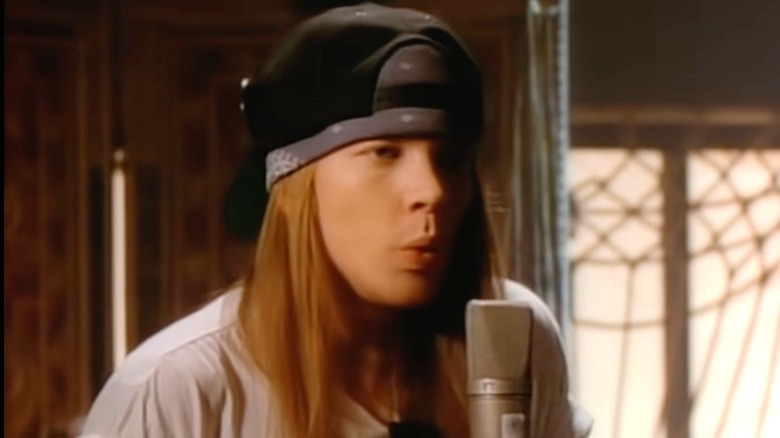
The most prevalent instrument in rock music isn't a guitar or drums — it's the human voice. And while the best singers are able to manipulate their respiratory systems to create emotion-packed notes on the musical scale that carry meaningful lyrics, sometimes rock stars also use their mouths to imitate actual, physical musical instruments: They whistle, and they whistle loudly, clearly, and with a lot of passion. While not as prominent as guitar solos that changed rock music forever, or even rock history's greatest keyboard solos, whistling moments are the best and most memorable parts of numerous classic rock songs.
Organic whistling can serve many purposes for the musicians who make all kinds of rock. It can playfully evoke birds or the wind, create mystery, propel a hypnotic melody, or just cleverly fill space. Some performers did it better than others — big hits by disparate acts like Paul Simon, Scorpions, Guns N' Roses, Peter Bjorn and John, and Otis Redding were all made better by the gentle propulsion of air through an artist's lips. Here are five whistling moments that we consider to be the best and most memorable in the history of rock, ranked in no specific order.
Paul Simon -- Me and Julio Down by the Schoolyard
A Paul Simon song that ought to be required listening for younger generations, "Me and Julio Down by the Schoolyard" is a mischievous and playful song about fondly remembered youthful shenanigans. It's in the vein of folk rock, and while it's a zippy and bouncy number, there's only so much an acoustic guitar can do in terms of showing off in a rock 'n' roll fashion.
When this song hit No. 22 on the Billboard Hot 100 in 1972, hard rock characterized by epic electric solos was in fashion, and in a song like "Me and Julio Down By the Schoolyard," a showcase moment on the gentle guitar just wouldn't cut it. Simon found a solution by just putting his lips together and blowing. Yes, the most memorable and inviting element of "Me and Julio Down by the Schoolyard" is Simon's acrobatic whistling. He goes up and down the register with softly and rapidly cooed notes, providing a pretty decent imitation of an agitated songbird.
Wind of Change – Scorpions
Metal band Scorpions were the source of many German songs that dominated the U.S. charts in the 1980s, and when the decade was over, they reflected on the tremendous political and cultural change of the era with the anthemic and inspiring power ballad "Wind of Change." Their biggest hit in the U.S., it made it up to No. 4 on the Billboard Hot 100 in August 1991, the same week a failed coup in the Soviet Union led to the eventual demise of European communism — wind of change indeed.
While all musicians by definition can write or perform a melody, it's the smart ones who know precisely how to play that line to maximize its impact. The through-line that powers "Wind of Change" is one of nervous and tenuous hope, giving off a sense that the Scorpions understand the world is in a period of great historical transition and that's both glorious and a little scary. Only an ominous whistle would work to convey those feelings. It doesn't require any lyrics, and it's as simple and organic as music can get to just whistle it without any adornments, effects, or human-made instruments.
Guns N' Roses – Patience
Following their monumental 1987 debut LP "Appetite for Destruction" that sold more than 18 million copies in America, Guns N' Roses had to release something to satisfy their hefty fanbase awaiting the next proper album. That stopgap filler was "G N' R Lies," a short collection of somewhat random tracks. The only single off "G N' R Lies" was "Patience," an original that set Guns N' Roses apart from all the hair metal bands with whom they were once strongly compared. A No. 4 hit in 1989, it showed that the singer Axl Rose's band had true musical acumen with all of the metal trappings and macho bluster stripped away.
With "Patience," Guns N' Roses didn't need electric guitars, a wall of amps, or even drums to make a song that got under its listeners' skin. It turns out all they needed to impress was basically just an acoustic guitar and Rose patiently delivering soft-spoken lyrics. However, he took this performance to the next level with whistling. It's a soothing, sweet, and kind break from the usual Guns N' Roses bombast, and reminiscent of the kind of absent-minded whistling a grandparent may commit.
Peter Bjorn and John – Young Folks
When cool, distant, indie rock became the sound of the early 2000s, one of the genre's anthems was "Young Folks" by Swedish trio Peter Bjorn and John. The 2006 single was a Top 20 hit in the U.K., but while it missed the Hot 100 in the U.S., it became a tone-setting media staple stateside, popping up in hip TV shows including "Gossip Girl," "Nip/Tuck," and "How I Met Your Mother," and the movies "21" and "Bandslam."
There are two hallmarks that propel "Young Folks" — a frenetic opening drum solo that settles into a mid-tempo dance beat, and a haunting whistle. Reminiscent of the kind of tune that kids, or young folks, would use on the playground in a mocking fashion, the "Young Folks" whistle acts as an instant hook when it comes in at the beginning of the song, and it's welcome when it repeatedly returns. The same melody is used on the lyrical verses of "Young Folks," but those aren't as fun or as easy to follow along with as the whistling.
Otis Redding – (Sittin' On) The Dock of the Bay
On December 9, 1967, Otis Redding departed Cleveland, where he and his band, The Bar-Kays, taped an episode of the national music show "Upbeat." They were flying in a small plane for a scheduled show in Madison, Wisconsin. The plane fell into a lake on the way, and Redding died in the accident at the age of 26. In the wake of the tragedy, Redding's label, Volt Records, released the single "(Sittin' On) The Dock of the Bay." Showcasing Redding's soulful vocals and lyrics touching on boredom, loneliness, and hopelessness. It had a drum-forward, guitar-powered backing as well as a lengthy whistling solo, which closes out the track.
It reportedly took Redding three takes to get the whistle to sound good, even though it wasn't supposed to be part of the song. That portion was actually supposed to be another verse, but Redding hadn't written those lyrics before the session and blanked when it came time to improvise. The production staff planned to return to the track when Redding had the words, but he died before that could happen (via Rolling Stone). The whistling bits, which express the themes of the song in a very human and primal way, were so compelling that they had a part in sending the song to No. 1 for four weeks in the spring of 1968. Postmortem, Redding's whistling felt especially poignant.