

The 5 Best One-Hit Wonders Of Country Rock
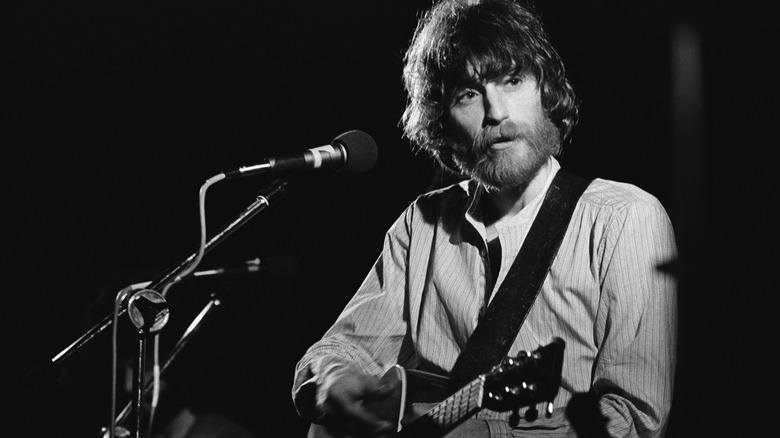
Country rock enjoyed a prolonged moment of greatness and cultural relevance in the 1970s. Courtesy of experimental musicians bored with the confines of country and put off by the trite elements of rock 'n' roll, they blended the best parts of the two worlds, favoring acoustic instruments played with a jangle or a twang, vocals that embraced harmonies and high notes, and lyrics that were expressive, emotional, and revelatory. As fate would have it, some of country rock's most exciting acts landed exactly one song in the Top 40 of the pop chart.
We picked the best country rock one-hit wonders based on how they deftly and evenly mixed those elements — they're the twangiest, most harmonious, and moving songs marked by the most rhythmic rock n' roll guitar parts, and never successfully followed up. Of all the one-hit wonders who deserve more than 15 minutes of fame, it's these innovators of country rock who audaciously played around with two established genres and created something wholly new and very compelling.
Country rock was dominated by a handful of acts, leaving high-charting one-hit wonders in the genre rare. So while our picks from acts such as the Souther-Hillman-Furay Band, B.W. Stevenson, and Nick Lowe didn't all hit the Top 10 or even the Top 20, they were still the greatest one-hit wonders to ever take on the country-rock style.
Fallin' in Love – Souther-Hillman-Furay Band
Well before he was the leading name of the captivating trio that made "Fallin' in Love" a modest hit, JD Souther was among the most influential yet overlooked figures in country rock. Standard bearers like the Eagles made hits out of his compositions, including "New Kid in Town" and "Best of My Love," and he frequently collaborated with Linda Ronstadt. As a performer, he's a two-time one-hit wonder both under his own name, with the lilting, soft country rocker "You're Only Lonely" making the Top 10 in 1979, and as part of the Souther-Hillman-Furay Band with "Fallin' in Love."
Souther headlined the act that also included Chris Hillman of the Byrds and the Flying Burrito Brothers, and Richie Furay of Poco and Buffalo Springfield, but an abundance of talent doesn't necessarily equal blockbuster success. As such, the Souther-Hillman-Furay Band appeared in the Top 40 just once, in 1974 with "Fallin' in Love," a No. 27 success.
Don't be fooled by the winding guitar assault that opens the song, as the hard rock softens soon enough. The track hits its stride with the trio's achingly sunny harmonies and complementary guitar noodling as they chug along with the bright love song, which features edgy, feedback-laden electric guitar solos and furious country-style acoustic riffing.
My Maria – B.W. Stevenson
Too propulsive and forceful with its rock intentions to be a country song, but too loaded up with country strumming and yodeling to fall in with early '70s arena rock, "My Maria" split the difference and was warmly embraced by both pop and adult contemporary radio stations. On the Hot 100, B.W. Stevenson took the song to No. 9, while on the soft rock list, "My Maria" hit No. 1.
"My Maria" is a country rock classic that doesn't shy away from classic country elements, yet keeps up a rocking pace. Stevenson lets his vocals soar to a high-pitched croon, reminiscent of old-time country singers like Jimmie Rodgers and Slim Whitman, while the simmering guitars and drums drive the song forward.
Stevenson was formerly a rock artist from Texas who incorporated country into his act just in time for his 1972 eponymous album. The joyful and unpretentious "My Maria" was the only song from any of Stevenson's LPs to earn a high chart placement, although in 1973 Three Dog Night reached No. 3 with "Shambala," a tune Stevenson issued around the same time. In 1996, superstar duo Brooks & Dunn's faithful cover of "My Maria" topped Billboard's country chart, but sadly, Stevenson wasn't around to enjoy the reconsideration, having died at age 38 in 1988.
Joanne – First National Band
It's a strange but little-known fact about the Monkees that the members of the popular '60s bubblegum band largely struggled without each other, and only Michael Nesmith placed a hit in the Top 40. After recording an album on his own while still a Monkee, Nesmith departed in 1969 to chase country rock, creating and fronting the First National Band alongside drummer John Ware, bassist John London, and, to get that rich and undeniable country feel, acclaimed steel guitarist Red Rhodes. Their initial single, "Joanne," hit No. 21 on the Hot 100 in 1970.
Written by Nesmith, "Joanne is a gorgeous, lovelorn ballad played expertly and precisely by its seasoned musicians, enhanced by Nesmith's passionate singing that threatens to turn into a yodel, and sounds like a forgotten folk song reinvented by young country rock agitators. Two more singles by Nesmith and his band hit the chart in 1970 and 1971, but neither made the Top 40. Nesmith occasionally recorded for decades but spent most of his time with multimedia company Pacific Arts and the cable TV show "PopClips," which directly led to the creation of MTV.
American City Suite – Cashman & West
Primarily songwriters, Terry Cashman and Tommy West together formed the act Cashman & West in the early '70s, whose debut album was "A Song or Two"; it generated one hit, "American City Suite," which topped out at No. 27 in 1972.
In the single release, "American City Suite" consists of three thematically linked song sketches — "Sweet City Song," "All Around the Town," and "A Friend is Dying" — strung together. While there are some epic, bittersweet, slow, and soulful parts, there's a through-line of country rock running through the whole piece in the form of sweet, earnest vocals and jaunty, ringing, old-fashioned guitar.
The pair then became occupied with producing folky singer-songwriter Jim Croce. They released two more Cashman & West LPs, including 1974's "Lifesong," which would serve as the namesake for the record label they created before deciding to focus on their respective solo endeavors.
Cruel to Be Kind – Nick Lowe
Throughout the 1970s, Nick Lowe tried on different musical styles. In 1979, he earned the biggest hit of his life — and his sole Top 40 smash in the United States — when he mashed a bunch of those ideas together. In the first half of the decade, he was part of the gritty roots rock band Brinsley Schwarz, then moved on to Rockpile, who recorded some of the best songs that nail '70s power pop. Lowe wrote "Cruel to Be Kind" while part of Brinsley Schwarz and was going for a soul-rock sound, and unsure about it, later remade it.
When Lowe included it on his second solo album, 1979's "Labour of Lust," he'd nailed it: "Cruel to Be Kind" was a hard-charging country rock song about a complicated relationship, powered by aggressive acoustic guitar and featuring a big solo reminiscent of a steel guitar. Lowe's single spent 10 weeks on the Hot 100 chart, peaking at No. 12. He never saw the Top 40 again.