

The 5 Best One-Hit Wonders Of Psychedelic Rock
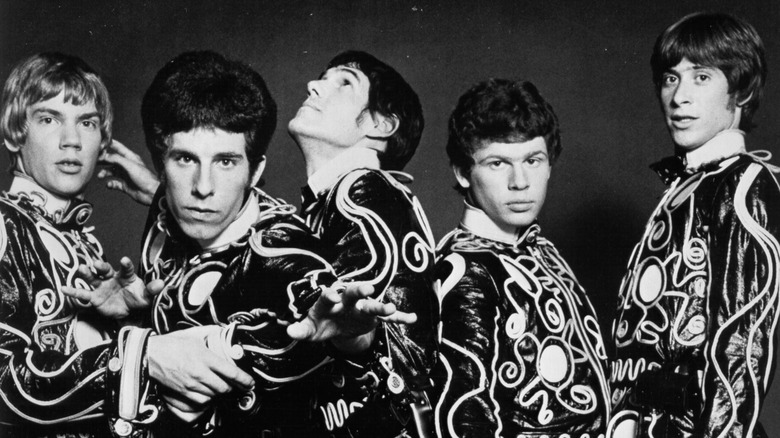
A rock genre all but left for dead at the dawn of the 1970s, psychedelic rock was characterized by buzzing, swirling, dreamy, feedback-laden guitars, as well as freewheeling, often improvised synthesizers and organs, hard-charging drums, and lyrics about expanding one's mind. Psychedelic rock, as performed by many '60s musicians we completely forgot about, is dramatic, dangerous, and expansive, and some of its bands never saw the Top 40 a second time after one big impactful hit.
Psychedelic rock didn't make for long careers, and few bands besides the Doors, Jefferson Airplane, and the Grateful Dead lasted the distance. Instead, the genre is littered with numerous short-lived bands that landed just one smash single, and we've picked the best of them. The ones we chose are those that charted the highest on the Hot 100 pop chart at the time of their initial release, as well as remaining on the playlists of classic rock radio and in the public consciousness. Here are the only Top 40 hits ever for the psychedelic rock bands the Lemon Pipers, Iron Butterfly, the Blue Magoos, the Amboy Dukes, and Bubble Puppy.
Green Tambourine – The Lemon Pipers
In the mid-1960s, lyricist Shelley Pinz put together a piece inspired by an article about a one-man band who busked outside a bank and collected donations in a tambourine, placing the phrase "green tambourine" in her head. An interested production company teamed her up with composer Paul Leka, and their "Green Tambourine" garnered the interest of Buddah Records, a producer of studio-generated, radio-ready, and youth-oriented rock known as bubblegum pop. It was earmarked for a young band called the Lemon Pipers, who preferred to play more psychedelic music, and so they deftly merged the two distinctive styles. The result is one of the most infectious songs of the only decade where such a musical marriage could even occur.
With a jagged, stop-and-start rhythm and bright and chugging guitar line, "Green Tambourine" is an intriguing pop song. The use of exotic effects, echo, sitar, and inscrutable lyrics makes "Green Tambourine" fully psychedelic. Not only is "Green Tambourine" a template of what a psychedelic rock song ought to sound like, it's also one of the most successful hits of its time and place. It spent a week in 1968 as the No. 1 song in the United States.
In-A-Gadda-Da-Vida – Iron Butterfly
One of the most famous and perhaps most notorious songs of the 1960s, "In-A-Gadda-Da-Vida" just barely fails to cross over into a parody of psychedelic rock and hippie culture. The title track on Iron Butterfly's 1968 album runs more than 17 minutes and took up the entire B-side of the LP, and a significant portion of that gets taken up by a lengthy, unhinged solo on the organ, one of the stereotypical instruments that bands used to turn their rock combo into a psychedelic one. "In-A-Gadda-Da-Vida" is a thesis statement for psychedelic rock, because it's so excessive and progressive, not to mention loud and heavy.
But the song brings the goods at such a high volume, in several senses of the word, that it's a classic rock milestone. "In-A-Gadda-Da-Vida" – a slurred attempt at "In the Garden of Eden" — compares the biblical paradise to love and just undeniably shreds. It's so sludgy and powered by fuzzy guitar, including one of the most famous, hard, and catchy riffs ever captured, that it's essentially a precursor to heavy metal. "In-A-Gadda-Da-Vida" is objectively outré, and yet it was also a hit single. A severely edited, sub-three-minute radio-friendly release climbed to No. 30 on the Hot 100, into which Iron Butterfly never flew again.
(We Ain't Got) Nothin' Yet – The Blues Magoos
By 1967, the decade's best year for psychedelic rock, certain clichés and tropes of the sub-genre had already solidified, and the Blues Magoos unabashedly adopted many of them. As carefully constructed as a bubblegum pop band, they were a garage rock group more than a little enamored with the blues, and became a fixture in Greenwich Village clubs as the Bloos Magoos earlier in the '60s. Then they changed their name to the Blues Magoos, let themselves be marketed as an East Coast version of the edgy, weird, and drug-referencing California bands, and came out with the pleasantly by-the-numbers LP "Psychedelic Lollipop," which featured their one and only hit, "(We Ain't Got) Nothin' Yet."
Listeners knew exactly what they were in for with the record, a collection of all the nuggets and tricks that made psychedelic rock so novel and fun. These are all synthesized in the lead-off track and single "(We Ain't Got) Nothin' Yet," with its sing-songy vocals, desperate guitars, and droning keys. The song was such a sign of the times, and an effective summation of them, that it made it all the way to No. 5 in 1967. This psychedelic rock one-hit wonder dropped those techniques by the end of the 1960s, and then the band faded away entirely by 1972.
Journey to the Center of the Mind – The Amboy Dukes
A decade before he made a name for himself as a lascivious rock 'n' roll wild man in the 1970s, Ted Nugent started a psychedelic band in the '60s called the Amboy Dukes. The band's second incarnation became a big deal in the Detroit rock scene when they embraced a blistering guitar sound, courtesy of Nugent, paired with typically psychedelic lyrics, as heard on the 1968 single "Journey to the Center of the Mind." In the heady, counterculture-dominated era, such songs could be radio hits, and indeed, "Journey to the Center of the Mind" peaked at No. 16 in 1968.
The song itself is a rapid-fire and joyous musical attack, full of psychedelic rock elements like roundabout guitars and heavily effected vocals that entice and warn listeners about what it's like to take a trip into the darkest recesses of the mind. And unlike most other psychedelic rock, "Journey to the Center of the Mind" wants people to dance and groove. After a string of unsuccessful albums that yielded no more Top 40 hits, most of the band quit or were fired by Nugent, who then used the Amboy Dukes to segue into his solo career, which dropped the psychedelic vibes altogether.
Hot Smoke & Sasafrass – The Bubble Puppy
Many of the more prominent psychedelic rock bands heard on the radio in the late 1960s had a polished, refined sound played by musicians who'd already honed their chops to a professional level. The Bubble Puppy, on the other hand, came up in the post-British Invasion era, and were inspired to just get some instruments and see where it went. They started off as a garage trio in Texas called the Bad Seeds before adding a second guitarist, and that newfound depth of sound allowed them to explore the intriguing and murky depths of psychedelic rock. Their first release, "Hot Smoke & Sasafrass," grooved up to No. 14 in 1969.
"Hot Smoke & Sasafrass" is a definitive one-hit wonder of the '60s because it serves as a condensed history of the decade's music. The Bubble Puppy hadn't yet lost its raw, amateurish, and exciting aura, even when they started to traverse the trickier and sound-collage elements of psychedelic rock. There's also a strong blues through-line in what's essentially a jam session. Nevertheless, three more singles from the Bubble Puppy didn't sell, and not even a name change to Demian helped keep the foursome together past 1971.