

5 Motown Artists Who Found Even Bigger Success After Leaving The Label
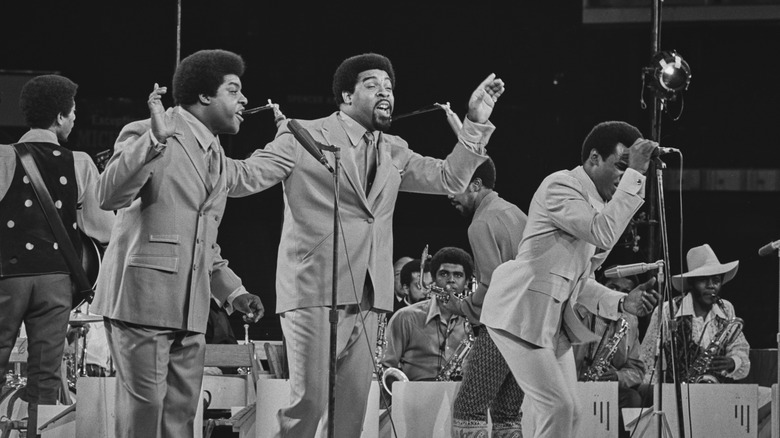
Motown Records has a legendary track record in producing terrific, classic R&B, soul, and pop in the 1960s, 1970s, and early 1980s. Berry Gordy's Detroit-based entity, which utilized factory-like precision and in-house techniques for a successful formula, more than earned its nickname of Hitsville U.S.A., making superstars out of a great many of its acts, including Diana Ross, Lionel Richie, Stevie Wonder, Smokey Robinson, the Four Tops, and the Temptations. But along with those successes came some professional losses: Motown couldn't manage to hang onto some of its most illustrious acts, who, after establishing themselves with Gordy's label, moved on to other record companies. Adding insult to injury, they were wildly successful in those new places.
Here are the stories of how Motown was the former — but not permanent — home of luminaries like Michael Jackson and the Jackson 5, Gladys Knight & the Pips, Marvin Gaye, the Isley Brothers, and Meat Loaf. As it turned out for these artists, the mighty Motown was just a stepping stone to bigger things.
Michael Jackson (and the Jackson 5)
At the dawn of the 1970s, the Jackson 5 enjoyed an unlikely but meteoric rise. Brought to Motown Records via Gladys Knight, the brother act made their debut at label-mate Diana Ross' birthday party, presented as the latter's discovery. Their first LP, "Diana Ross Presents the Jackson 5" included the No. 1 hit "I Want You Back," quickly followed by three more chart-toppers, "ABC," "The Love You Save," and "I'll Be There." Motown launched member Michael Jackson's solo career in 1971 with the Top 5 hit "Got to Be There."
In about five years, the Jackson 5 sold 60 million albums for Motown, which executed such a low royalty rate, 2.8%, that in 1975, the group jumped to Epic Records, which promised a 20% royalty. Jermaine Jackson, married to the daughter of Motown boss Berry Gordy, stayed at the label, where he developed a solid solo career. But over at Epic, the renamed Jacksons (with Randy Jackson subbing in for Jermaine) did just fine, landing five Top 40 hits including "Enjoy Yourself" and "Shake Your Body (Down to the Ground)." Epic was also the forever home of Michael Jackson, where he released numerous monster hit albums that made him one of the best-selling artists in pop history. "Off the Wall" sold 10 million, "Bad" 11 million, "Dangerous" eight million, and "Thriller," a staggering 34 million.
Gladys Knight & the Pips
Motown Records didn't break Gladys Knight & the Pips, but they made them better known than ever before. Between 1961 and 1964, the impeccable vocal soul group from Atlanta had three Top 40 hits on three different labels — Vee-Jay, Fury, and Maxx — before they landed a deal with Soul Records, under the Motown corporate umbrella, in 1966. The following year, they released the first popular recording of "I Heard it Through the Grapevine," written and later covered by Marvin Gaye. Altogether, on the Soul imprint, Gladys Knight & the Pips hit the pop Top 40 with 13 singles, including enchanting classics like "If I Were Your Woman" and "Neither One of Us (Wants to Be the First to Say Goodbye)."
When Motown moved its headquarters from Detroit to Los Angeles in 1973, Gladys Knight & the Pips opted to move from Motown to Buddah Records. That's where the combo became pop superstars. In 1973 and 1974, Knight belted out four Top 5 soul pop gems, including "Best Thing That Ever Happened to Me," "On and On," and the No. 1 smash "Midnight Train to Georgia."
Marvin Gaye
Marvin Gaye and Motown Records helped put each other on the map in the early 1960s. He released his first single for the label's Tamla imprint in 1961, "Let Your Conscience Be Your Guide," and had his first hit the next year with "Stubborn Kind of Fellow." While also working as a songwriter and session drummer, Gaye began to regularly hit the Top 20 in 1963. He'd land there often in the 1960s, and went to No. 1 once with "I Heard It Through the Grapevine." In the 1970s, Gaye found social consciousness and explored sexuality with smashes like "What's Going On" and "Let's Get It On," respectively.
After a move to Europe to avoid paying taxes, Gaye ended work on the album "Love Man" in favor of a different project. Motown allegedly made efforts to swipe the masters of the newer, not-finished LP. After a heavily edited version hit stores under the name "In Our Lifetime" in 1981, he ended his professional relationship with Motown. Columbia Records put out Gaye's 1982 LP "Midnight Love," which included the single "Sexual Healing." A sensual bit of smooth, synth-powered R&B that sounded like Gaye but updated for the '80s, it was among Gaye's most significant songs. In 1983, it reached No. 3 on the pop chart and spent a whopping 10 weeks at No. 1 on the R&B list. Sadly, Gaye's return came to a tragic end when he was murdered by his father in 1984, the day before he turned 45.
The Isley Brothers
Lasting over the decades with a lineup that changed when it needed to, the Isley Brothers first got together in the 1950s. During their long history, they made some signature Motown music for the record company. When one thinks of the powerfully cool Isley Brothers, several songs come to mind, soul and funk standards like "It's Your Thing," "That Lady (Part 1)," or "Fight the Power — Part 1," for example. Those are their highest-charting hits, all reaching the Top 10 of the Hot 100, all in the first half of the 1970s, and all released by T-Neck Records.
Prior to forming that label themselves at the very end of the 1960s, the Isley Brothers were a Motown group. Their time with the company was brief and surprisingly lackluster. Only two LPs by the group were produced for and released on Motown's Tamla label. The title track of the first, "This Old Heart of Mine," is a '60s gem, and it peaked at No. 12 hit in 1966, making it their sole hit single for Motown.
Meat Loaf
Motown Records had many subsidiaries, most of them devoted to R&B and soul. In 1968, the label signed the band Rare Earth and created a rock-focused division in their name and honor. Three years later, the Rare Earth imprint became the home of hippie rock duo Stoney & Meatloaf. Stoney was Shaun Murphy, and Meatloaf was Marvin Aday, two members of the rock scene in Motown's hometown of Detroit who both got discovered playing in a local production of the popular rock 'n' roll musical "Hair." Among the songs on their one, self-titled album recorded for the Motown conglomeration was the single "What You See is What You Get."
The duo didn't last long with Motown because of a label offense. Motown leader Berry Gordy cut the song "Who is the Leader of the People?" off Stoney & Meatloaf's finished album and handed it over to more prominent performer Edwin Starr. "I actually smashed my shoe on Berry Gordy's desk because of it," Meat Loaf told Billboard of his reaction. After Stoney & Meatloaf departed Rare Earth and Motown, Meatloaf became theatrical rock icon Meat Loaf and in 1977 released "Bat Out of Hell," a best-selling classic rock album that never actually hit No. 1 that also sold 14 million copies. It further enriched the coffers of Epic Records by generating three Top 40 hits.