

Famous Bands Where More Than One Member Became A Solo One-Hit Wonder
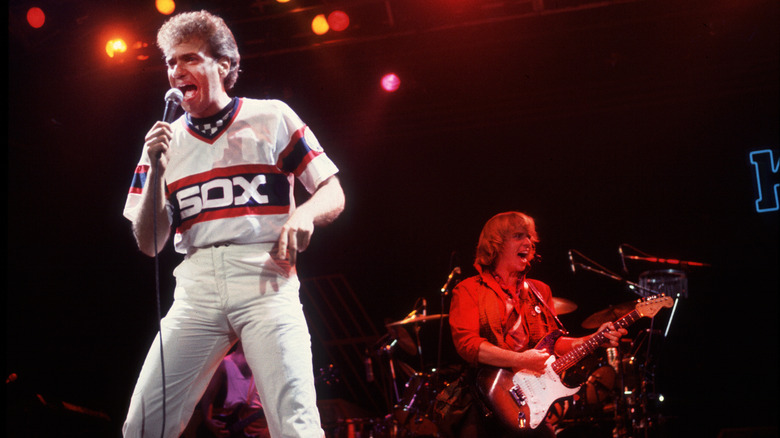
When music groups came together in the '60s, '70s, or '80s with the express purpose to rock and/or entertain the masses, they hit it big with classic albums and standout singles that have stood the test of time. But sometimes stars abandon their bands for a solo career. Often, they make it work, carrying the goodwill earned from the group situation into lengthy and fulfilling creative pursuits under their own name. But in other instances, those rock stars leave their successful bands for flop solo projects and they wind up becoming one-hit wonders. To a rarified handful of some of the biggest bands ever, the pursuit of solo fame results in multiple members only ever landing a single Top 40 hit.
Here are the stories of the breakaway members of the Cars, the Jackson 5, Duran Duran, Styx, and ABBA, who realized that the public only wanted to see them on a crowded stage or surrounded by familiar voices and instruments. They're the bands where more than one member went solo and scored a one-hit wonder.
The Cars
Throughout its reign as one of the leading keyboard-based New Wave bands of the late 1970s and early 1980s, the Cars had two lead singers: Ric Ocasek and Benjamin Orr. Ocasek's vocals are prominent on hits like "You Might Think" and "Magic," while Orr carried "Just What I Needed" and "Drive," for example. It was well acknowledged that they had similar singing styles — the pair were in multiple bands with one another well before the Cars formed, and thus they had a similar musical development.
But neither Ocasek nor Orr could manage a hefty career without the rest of the Cars or each other. Just after the Cars announced a break of an indeterminate length in 1985 (which evolved into a full split in 1988), both singers released a solo album with a lead-off single that explored a different element of their band's sound. In 1986, Ocasek drove his synth-pop rave-up "Emotion in Motion" to No. 15 on the pop chart. Months later, Orr released his solo debut, "The Lace," and with it the shiny, glitzy, "Drive"-like ballad "Stay the Night." That song did quite well, peaking at No. 24. Ocasek never made the Top 40 again, and neither did Orr.
The Jackson 5
After the Jackson 5's unlikely meteoric rise in the early 1970s, the family act from Indiana, and many of its members, stayed at the top for decades in one form or another. After four straight No. 1 hits in 1970 and concurrent to the Jackson 5, Motown Records launched significant solo careers for both Jermaine Jackson and Michael Jackson. The former regularly scored moderate hits on the Hot 100 and big hits on the Billboard R&B chart in the '70s and '80s, while the latter became the best-selling artist in pop.
Other members of the Jackson 5, later renamed the Jacksons, didn't fare quite as well on their own, despite big pushes from their corporate handlers. Initially a lead vocalist alongside Michael, Jackie Jackson's first, self-titled solo album in 1973 flopped, but his next LP, released 16 years later, generated "Stay," which squeaked into the R&B Top 40 at No. 39. Another Jackson 5/Jacksons singer, Marlon Jackson, waited until 1987 to try a solo stint, and his Capitol Records effort "Don't Go," got up to an impressive No. 2 on the R&B chart, his only Top 40 appearance on a major Billboard list.
Duran Duran
Duran Duran spent the early 1980s riding the New Wave wave into a position as one of the most popular and visible bands around. After a string of massive hits that included No. 1s like "The Reflex" and a "A View to a Kill," Duran Duran embraced their big moment in 1985 with a long break. Two members each recorded a movie theme song, and they would be their only respective solo hits. Bassist John Taylor co-wrote and recorded "I Do What I Do" for "9 ½ Weeks." A sleek, slinking piece of start-and-stop, sophisticated '80s keyboard pop, it made it up to No. 23 in the U.S. in 1986. As for guitarist Andy Taylor, his track from the gymnastics drama "American Anthem," "Take It Easy," performed about as well, landing at No. 24 in 1986. He indeed made an American anthem, in that it's a hook-filled, guitar-heavy hair metal song.
Meanwhile, the other three musicians in Duran Duran teamed up for a side project. Singer Simon Le Bon, drummer Roger Taylor, and keyboard player Nick Rhodes formed Arcadia. That band, more heavy on the pop themes than Duran Duran ever was, is barely a two-hit wonder, with the No. 9 charting "Election Day" and low-30s entry "Goodbye is Forever."
Styx
Styx was often a band at odds over its creative direction. Two capable singer-songwriters in the group made for lots of strain, and throughout the '70s and '80s, it was almost like there were two different bands that both called themselves Styx. When Dennis DeYoung got his way, the band made grandiose love ballads like "Lady," "Babe," and "The Best of Times." When rocker and guitarist Tommy Shaw led the way, that's when Styx produced fare like "Renegade" and "Too Much Time on My Hands." However, when Shaw and DeYoung got out of one another's way, Styx fans showed they preferred it when the musicians worked together, because a solo career was a commercial non-starter for both.
In 1984, DeYoung released his first solo album, "Desert Moon," and the results seemed promising. The title track made it into the Top 10 of the Billboard Hot 100. He wasn't able to ever reach the Top 40 again with solo works issued in 1986 and 1994. Shaw also unveiled a solo project in 1984, and similarly landed a hit with the title track — "Girls with Guns" peaked at No. 33. No other Shaw work would ever rate that high on the pop chart.
ABBA
ABBA is one of the best pop supergroups of all time, as all four members of the Swedish vocal group/pop-rock band combo had success well before they founded one of the world's biggest acts of the 1970s. After ABBA broke up in 1982 — not long after the two married couples in the group all divorced — everyone returned to their paths. Main songwriters Benny Andersson and Björn Ulvaeus created the hit stage musical "Chess," which spawned the synth-pop hit "One Night in Bangkok." As sung by Murray Head, it made Anderson and Ulvaeus one-hit wonders as post-ABBA songwriters.
The female stars of ABBA also struggled to get American audiences interested in their independent material. It took three singles from Agnetha Fältskog's 1983 LP "Wrap Your Arms Around Me" to get any chart traction. The bouncy, synth-powered soft rock jam "Can't Shake Loose" made it up to No. 29 on the Hot 100, in her only solo appearance there. Her mononymous ABBA cohort Frida enlisted the production assistance of Phil Collins at the height of his '80s success and influence. "I Know There's Something Going On," which sounded very much like an '80s Collins song, was a smash, reaching No. 13 in 1983. No more hit singles followed.