

'80s Song Lyrics That Left Everyone Scratching Their Heads
In the 1980s, the vibe often mattered more than the dictionary. Between the rise of abstract music videos and a general love for poetic (and sometimes chemically-enhanced) surrealism, we were gifted with some truly baffling lyrical gems. Some songs simply lost us in translation. Men at Work's "Down Under" is packed with Australian slang and a Vegemite sandwich. But once we understand the slang, it makes a lot more sense.
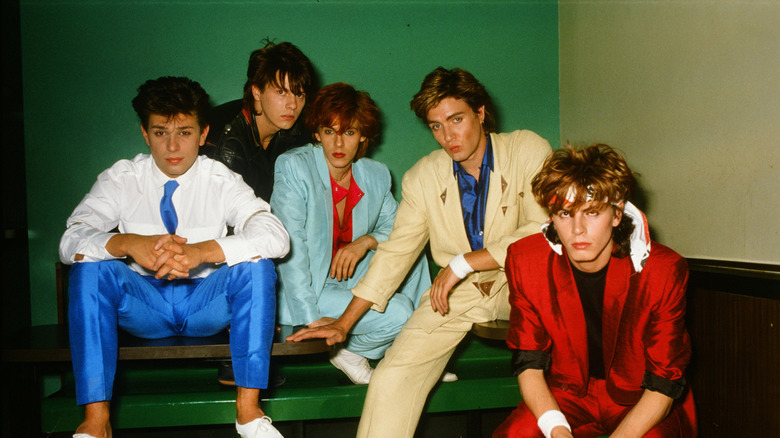
Other tracks left us utterly confused because, well, we simply didn't understand what the lyrics were trying to say. The meaning went right over our heads, even if we were sporting big '80s hair. One such example is Duran Duran's "The Reflex," which makes about as much sense as wearing leg warmers year-round in Los Angeles. But that was the '80s for you. So in the spirit of celebration and slight confusion, grab your Walkman and get ready to mutter, "Wait, what?"
Men at Work – Down Under
With a catchy blend of upbeat sounds and a singable chorus, Men at Work's "Down Under" topped charts across the globe, sold millions of copies in the U.S., and became a staple on early '80s MTV. But for many American listeners, singing along was one thing — understanding what they were singing? That's a whole other story.
The song relies on Australian slang, starting with the opening line: "Traveling in a fried-out Kombi on a hippie trail, head full of zombie." A Kombi is a classic Volkswagen van. "Fried-out" means it's seen better days. The hippie trail refers to a once-popular network of travel routes from Europe through places like Afghanistan, India, and Nepal. And "zombie"? Add that to the long history of slang terms for cannabis. According to what lead singer Colin Hay told Songfacts, zombie was a particularly potent strain of marijuana in Australia. So, put that all together and, translated loosely, the opening line amounts to something like: "Cruisin' in a beat-up VW bus, chasing wanderlust, mind fried to dust." But "head full of zombie" has a lot more flair, so let's leave the songwriting to Hay and other Men at Work.
Hopefully, those men won't chunder, as men do in the song: "I come from a land down under, where beer does flow and men chunder." If only "chunder" were a dance move. Unfortunately, it's Australian slang for vomit. Without knowing the slang, you're just happily belting out lyrics about bodily functions, blissfully unaware.
Madonna – Like a Virgin
Before anyone even got around to debating the real meaning of Madonna's "Like a Virgin," listeners were scratching their heads. The song is called what? Just saying "virgin" on the radio was shocking at the time. Songwriter Billy Steinberg, who cowrote the track with Tom Kelly, said on his website that he knew the word "virgin" would be "provocative." When they first shopped the song around, they were told no one would sing "that lyric" — as Steinberg explained. Rewrite it. Change the title. But the song didn't need changing. It just needed Madonna, someone who would build a career out of challenging mainstream ideas about sexuality.
When Madonna sang "touched for the very first time," she sparked confusion and awkward conversations. Is it about literal sex? Emotional renewal? Fame? Reinvention? Or exactly what it sounds like? According to "Madonna: The Complete Guide to Her Music," Madonna liked the ambiguity and let the confusion do the marketing.
Madonna did provide some clarity after Quentin Tarantino's character in "Reservoir Dogs" offering him a particularly crude (and anatomically focused) take on the song in the early '90s. According to what Tarantino told Empire, Madonna said her song "Like a Virgin" is not about being physically overwhelmed. It was about a woman with a bruising romantic past who finally meets someone who treats her with love and care. That interpretation aligns with Steinberg, who wrote the song from personal experience. He'd been hurt in the past, but was starting a new relationship — old wounds were healing, and everything was feeling new and good.
Duran Duran – The Reflex
"The reflex is a lonely child." Is this a lost Freud quote? Political commentary? A malfunctioning metaphor generator? No one really knows. But whatever it is, it worked. Despite lyrics that sound like they were pulled from a dream journal, "The Reflex" became Duran Duran's first No. 1 hit in the U.S.
Keyboardist Nick Rhodes admitted in an interview on YouTube that he doesn't even remember how the band landed on the word "reflex," and he said often fields questions about the song's meaning. Duran Duran Bassist John Taylor explained that the lyrics fit the artsy, ambiguous style of the early '80s. He likes that people are always trying to figure out what "The Reflex" is about and describes the song as paranoid and dark (via Duran Duran).
Certainly, the way the song personifies a biological reaction is a bit creepy. "The Reflex" isn't just some involuntary muscle response. It's a shadowy character "waiting by the park" and "hiding all the cards." The song's lyrics even tell on themselves when they say, "Every little thing the reflex does, leaves you answered with a question mark." That might be Duran Duran's way of saying, "Don't worry if you're confused. We are, too."
Starship – We Built This City
It might not be the part that gets stuck in your head, but there's a line in "We Built This City" that'll leave you scratching your head: "Marconi plays the mamba." Music commentator Bob Lefsetz once posted an email from Starship vocalist Mickey Thomas, who explained that he knew people would wonder about that line. In the email, Thomas said he asked lyricist Berni Taupin about it. But even Taupin, one of the song's cowriters, told Thomas he didn't know what "Marconi plays the mamba" meant.
It's been suggested that "Marconi" probably refers to Guglielmo Marconi, the Italian inventor who sent the first transatlantic radio signal, but it's unclear why he "plays the mamba" — one of the world's most terrifying snakes. Perhaps "Marconi plays the mamba" is a sinister metaphor about something slithering through the airwaves. That interpretation sort of fits with the song's potential message. Cowriter Martin Page told Songfacts, "I saw the words as almost like a rebellion lyric: it was like live music has been taken away from the city."
Or maybe "mamba" was supposed to be "mambo." According to GQ, Thomas tried singing "mambo" instead of "mamba," but eventually went back to the snake version. That's just as well, because "mambo" doesn't make much sense either. Marconi died in Rome in 1937. Mambo was just getting started in 1930s Cuba. Unless Marconi moonlighted in Havana nightclubs during his final years, it's unlikely he ever played mambo (or mamba).