

5 Forgotten No. 1 Songs By The Beatles
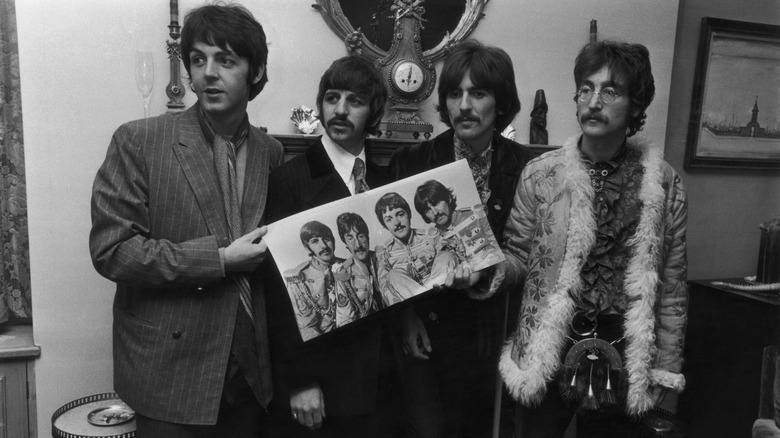
It sounds counterintuitive to suggest that The Beatles, the most celebrated band of all time, has forgotten songs, and even more so to suggest the group has forgotten No. 1 hits. In fact, interest in the Fab Four has remained incredibly high in the decades since the band broke up back in 1970. But as the years have passed, the popularity of individual songs within The Beatles' discography has fluctuated. If we look at the numbers of streaming platforms such as Spotify, we can see at the time of writing that some of the band's iconic singles, such as "Hey Jude" and "Let It Be" — both of which hit the top spot on the Billboard Hot 100 — continue to attract a huge listenership. Yet many of the most popular Beatles songs were not singles at all but album tracks that have aged particularly well, such as "Here Comes the Sun" and "In My Life."
With that in mind, we're revisiting five of the 20 Beatles singles that topped the charts in the United States but whose popularity has waned slightly within the band's discography. Don't get us wrong: These songs still have tens of millions of plays on streaming platforms (it's The Beatles, after all). But the truth is they no longer have a seat at the top table in terms of listener numbers in the way, say, "Come Together" or "Yesterday" have, and you might have even forgotten they were No. 1 singles at all.
Love Me Do
"Love Me Do" remains instantly recognizable as an early Beatles classic, but if we're honest, there is plenty to justify modern listeners' comparative lack of interest in the song. Unlike other early hits like "She Loves You" and "Can't Buy Me Love," the pace of the 1964 U.S. No. 1 is glacial rather than explosive. The lyrics are also exceptionally simple, even by the standards of early Beatles singles.
The song it resembles most among the early No. 1's is "I Want To Hold Your Hand," The Beatles' breakthrough single in America, which arguably beats "Love Me Do" on almost all metrics. But the truth is that "Love Me Do" is the one that started it all — well, in the U.K. at least, where it was The Beatles' first single. And it has to be noted that though the track may sound utterly inoffensive now, in the context of the very early '60s, it would have been something of a bombshell: A stripped-back love song featuring raw vocals that, when you actually listen to them, are subtly seductive.
"Love Me Do" was from one of the first batches of songs that the newly signed Beatles brought to producer George Martin in 1962, who rated it above John Lennon and Paul McCartney's other songwriting efforts at the time. Little did he know, perhaps, that McCartney had come up with the basics of the song years earlier, when he was just 16. We can thank Martin for encouraging Lennon to drop some vocal duties in favor of the mouth organ, which provides some of the song's most memorable moments.
I Feel Fine
The pace at which The Beatles was churning out hit tracks in its early years as John Lennon and Paul McCartney's confidence as songwriters grew is astonishing. "I Feel Fine," which was recorded in October 1964 and released as a chart-topping single two months later, is a case in point. Apparently written during the recording session for "Eight Days a Week" (another U.S. No. 1) around a John Lennon guitar riff, the track has a Latin-infused R&B rhythm and a strong vocal melody that saw it enter the charts at No. 1. The single sold 1 million copies within a month of release.
Though the song may seem like just one of many Beatles earworms from 1964, Lennon was especially proud of the subtle guitar feedback at the start of the song. He created it by using an electric pickup on his semi-acoustic and leaning into his amp without switching the electrics off. The excitable Fab Four decided to petition George Martin to keep the sound in the song, despite Parlophone explicitly banning the intentional use of feedback at the time. It has come to be one of the Beatles' most iconic intros, akin to the opening chord of "A Hard Day's Night."
As John Lennon told David Sheff in one of his insightful "Playboy Interviews": "I defy anybody to find a record — unless it's some old blues record in 1922 — that uses feedback that way. I mean, everybody played with feedback on stage, and the Jimi Hendrix stuff was going on long before. In fact, the punk stuff now is only what people were doing in the clubs. So I claim it for The Beatles. Before Hendrix, before The Who, before anybody. The first feedback on any record."
We Can Work It Out
Though "We Can Work It Out" was recorded on October 20, 1965, in just two takes, it actually took hundreds of minutes in the recording booth to perfect the vocal overdubs on the two-minute track. The song saw The Beatles add new elements of complexity to their by-then masterful songwriting, with an unusual arrangement and ambitious vocal harmonies. Is it an obvious choice for a single? Perhaps not, seeing as the song switches into a waltz for the middle eight, complete with darker lyrics reminding us that "life is very short." But the public ate it up, and it spent three weeks at the top of the Billboard Hot 100 in January 1966 as the more popular track on a double A-side with the John Lennon-led "Day Tripper."
The song was primarily written by Paul McCartney on an acoustic guitar in the house in Cheshire, U.K., that he had bought for his father, with the lyrics reflecting the growing difficulties he was experiencing in his relationship with his girlfriend Jane Asher. Compared to many other rock songs of the mid-'60s, "We Can Work It Out" shows a remarkable amount of level-headedness and emotional maturity in its lyrical exploration of reconciliation within relationships. It's enough to make you feel reflective at any age.
Paperback Writer
Paul McCartney famously embraced the image of him as the writer of universally loved romantic ditties with his smash single "Silly Love Songs," released with his band Wings in 1976. But in the early days of The Beatles, he actively sought to widen the scope of subject matter in his writing. Indeed, according to legend, he was challenged by his own Aunt Lil to write a song that wasn't about love in some way. The result was "Paperback Writer," a No. 1 hit in June 1966.
It was recorded around the time the Fab Four was entering the height of its powers during the "Revolver" sessions, and McCartney was inspired by an article about an aspiring writer he read in the newspaper on the way to a recording session with John Lennon. It takes the form of a formal query letter, beginning "Dear Sir or Madam," and bounces along on a single chord, which is interspersed with those iconic vocal harmony breaks and guitar licks.
Though these features may be what initially stand out about "Paperback Writer," the song is also notable for pushing the boundaries of how bass guitar sounded on record. Engineer Geoff Emerick recalled (via "The Beatles Recording Sessions"): "'Paperback Writer' was the first time the bass sound had been heard in all its excitement. ... Paul played a different bass, a Rickenbacker. Then we boosted it further by using a loudspeaker as a microphone. We positioned it directly in front of the bass speaker and the moving diaphragm of the second speaker made the electric current." The result is a crisp and powerful rhythm section that elevated "Paperback Writer" to the top of the charts.
Hello, Goodbye
By the time The Beatles wrote and recorded "Hello, Goodbye," its members had firmly entered the psychedelic era. This period was defined by the release of "Sgt. Pepper's Lonely Hearts Club Band," which brought the band to even greater heights of critical acclaim. On its surface, "Hello, Goodbye" is a playfully psychedelic "po-tay-to, po-tah-to" track that could have worked for other bands of the period, such as, say, The Monkees.
However, its seemingly nonsensical lyrics also reveal something about the experience of being a Beatle in 1967. Because although the band was on top of the world, things were beginning to fall apart with the tragic death of manager Brian Epstein. As Paul McCartney recalled in "The Lyrics: 1956 to the Present": "An interesting thing about this song, especially in the context of the time, is that it's also playing with certainties: yes and no, stop and go — there's little ambiguity in those words. The song was being written at a time when we had just lost our manager and guiding star, Brian Epstein, to an accidental overdose. There was suddenly a lot of uncertainty in our lives."
More than that, McCartney suggests that the song may have also reflected the "binary tension" within his working relationship with songwriting partner John Lennon. Though their bond was for the most part vital to what made The Beatles great, it is also true that shortly after this, the famous duo found themselves growing apart. Indeed, Lennon was reportedly upset that "Hello, Goodbye" had been chosen as the A-side for the single rather than his own "I Am The Walrus," which was the B-side. Though they would go on to have further successes — and No. 1's — from here, The Beatles would never be the same again.