

5 Rockers Who Trashed Organized Religion In Their Music — And Paid The Price
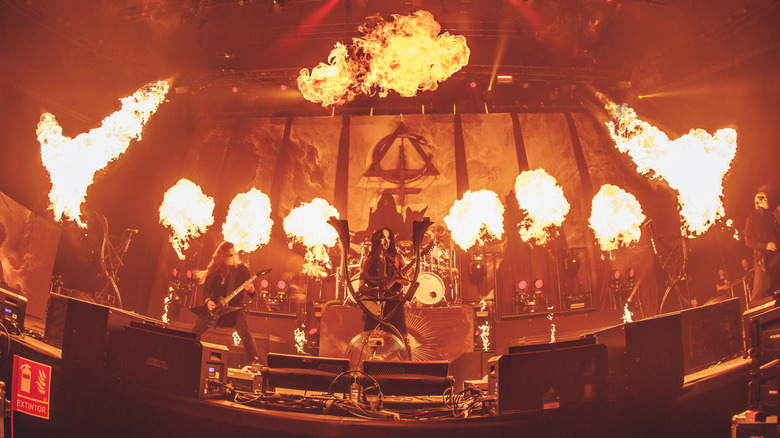
We all know that rock and rebellion go hand-in-hand, right? Not just rock, but all forms of extreme music, particularly metal. Whether musicians want to defy something as vague as "the system," flip the bird at social norms, or directly antagonize organized religion, rockers play the much-needed role of societal skeptic. Sometimes, though, institutions bite back — especially religious ones. And in some cases, rockers pay the price.
But first, when we say "pay the price," we don't mean that musicians suffered divine retribution at the hands of a cosmic deity. We just mean that they incurred some real-world consequences beyond mudslinging and hurtful words. If a conflict with a church led to concerts getting canceled, for instance, then it negatively impacted a musician's livelihood. It's much more difficult to gauge the impact of bad press, contrarily, unless there's some obvious and dramatic effect. In the case of the "Bigger than Jesus" Beatles, the group was too big to fail, and the Vatican forgave it in 2010. Black Sabbath got flak for being "satanic" back in the day (and also for being cursed by Satanists), but it never really affected any of its members' careers. Besides, nowadays it's a badge of honor amongst certain extreme music circles (especially black metal) to run afoul of the Catholic Church, specifically.
But in some cases, musicians who took pot shots at organized religion had to deal with some setbacks, even if only temporarily. Maybe they attacked through song lyrics, actions at performances, merchandise, or just their overall ethos. Examples include Marilyn Manson, the all-around poster child of such conflicts, and Nergal of Behemoth, who got prosecuted by Polish authorities multiple times. We've also got Slayer, Johnny Rotten, and Cradle of Filth to round things out.
Marilyn Manson's been the poster child of musician-church conflicts
We're going to start with what is simultaneously the most well-known of anti-religious (Christian, in this case) musical figures and also the vaguest of our cases. Marilyn Manson's conflict with Christianity started with 1996's "Antichrist Superstar," an album that fueled the fears of those who considered him "satanic" (and also led to people blaming him for the 1999 school shooting at Columbine). One year later, at the 1997 MTV Video Music Awards (viewable on YouTube), Manson delivered a speech. "My fellow Americans: We will no longer be oppressed by the fascism of Christianity," he said, before performing "The Beautiful People" in assless chaps. But the fairly mild limits of his anti-Christian work came in 2000's "The Fight Song:" "But I'm not a slave / To a God that doesn't exist."
Come 2003, Swiss authorities launched a criminal inquiry into Manson following accusations of inciting religious violence at a concert, but the inquiry was dropped two weeks later. In 2005, Catholic priests in Croatia tried to ban a Manson concert because "Manson fans turn the site of his concerts into Sodom and Gomorrah," per the BBC. The concert happened, anyway. In 2025, Mexico's Archbishop Jorge Cavazos Arizpe of San Luis Potosi demanded that another of the singer's concerts be banned because it promotes "situations of evil," per Catholic Weekly. Again, the concert went on anyway.
All of these incidents and more, collectively, have dogged Manson over the course of his career. He's become a public boogeyman and go-to target for public backlash. But as Manson told The Guardian back in 2003, "The people who hate you make it all worthwhile."
Nergal from Behemoth got prosecuted in Poland
Next we've got what is definitely the most serious of our entries, if only because the subject has faced actual prison time multiple times over. We're talking about Adam "Nergal" Darski of the Polish blackened death metal band, Behemoth. Nergal has been legally prosecuted in Poland and has faced potential prison time again and again for anti-Christian messaging, but each time he has managed to stay free.
The first time Nergal ran afoul of religious sensibilities in Poland was way back in 2007 when he tore a Bible on stage and called the Catholic Church "the most murderous cult on the planet" (per The Guardian). This is before he became a judge on the Polish version of "The Voice," it should be humorously noted. Later, in 2018, he posted a photo online of an erect Jesus on a cross, and in 2019, he took a photo of himself stepping on a picture of the Virgin Mary, which netted him an immediate fine of €3,340. None of these instances led to prison time, though. And in case the reader was wondering, yes, Behemoth's lyrics attack the church, ranging from poetically indirect ("Smash thy [Jesus'] will/ Ye pale dominion fades away") to poetically blunt ("Eat my flesh, drink my blood, I am the s*** ov God").
Much of Nergal's trouble comes from the strict enforcement of blasphemy laws that, in a country besides Poland, might be disregarded. But as The Guardian quotes Nergal regarding his own motivations, "I am part of that anti-government tide, that massive wave of people saying: 'F*** no. You're not going to make us slaves to your agenda. You're not going to make it a Catholic state.'"
Cradle of Filth's bassist got arrested over a T-shirt
Now we come to a tale that's legendary amongst metal circles but not too widely known outside of them — unless, perhaps, you were one of those arrested. Arrested for what, you ask? For the most reprehensible crime of them all: Wearing a T-shirt.
The band in question is Cradle of Filth, a group that blends symphonic and black metal elements, led by singer, lyricist, and founder Dani Filth. As he described to Rolling Stone, members of the English act were sitting around a table back in the early days of their career in 1993, thinking of merch designs before heading out on tour with black metal legends Emperor. As Filth recalls, someone pitched the phrase "vestal masturbation" to howls of laughter. Bent on causing controversy back in those days, Filth ran with the idea. During an appearance on the "Stoke The Fire" podcast, he described his motivation: "Who could you poke with a stick more than anybody else, and it have an overarching effect?" Hence the notorious T-shirt emblazoned with the tagline, "Jesus is a c***," featuring a topless, masturbating nun.
After the shirt went to print, Cradle's drummer Nicholas Barker got arrested for wearing it on counts of public disorder and resisting arrest but was released within 2 hours. This relatively meager trip-up was followed by a Florida man getting arrested for wearing the shirt in 1997 and being subsequently acquitted — the Catholic League called it a "victory for sickos." Another English T-shirt wearer got arrested in 2004 and paid a fine of £150, while another got arrested in 2005 and paid £40 plus did 80 hours of community service. No matter the T-shirt's negative effects, Loudwire reports that the band summarized the experience by saying, "Any publicity is good publicity."
Johnny Rotten couldn't participate in his brother's confirmation
Ahem, and Classic Rock quotes punk legend Johnny Rotten of the Sex Pistols: "Organized religion is evil pollution. A parasite on our good nature that lulls us into a false sense of security and it stops us thinking for ourselves. Just like left- or right-wing politics." Well, there you have it. But one time, at least, such sentiments proved more than mere words and caused real-life trouble for Rotten.
Rotten, real name John Lydon, is no stranger to causing mischief and snubbing the powers that be, whether they be governmental, societal, religious, or whatever. After all, that's what punk is all about. Without a doubt, Sex Pistols' infamous, British Crown-mocking "God Save the Queen," off the group's one and only studio album, 1977's "Never Mind the Bollocks, Here's the Sex Pistols," proved to be its most controversial work. But when the Pistols broke up and Rotten formed Public Image Ltd., he penned the spoken word track, "Religion," in which he targeted the Catholic Church. The song's more tame lyrics include, "Fat pig priest / Sanctimonious smiles / He takes the money, you take the lies." Later in 2010, on stage at the Irish music festival Electric Picnic, Rotten bluntly said, "The Pope protects pedophiles" (per Quietus).
Not too, too much happened to Rotten because of his opinions and words, but the Church did disallow him from participating in his brother Martin's confirmation (a Catholic sacrament and rite). As Lydon told The Telegraph in 2008, "The church refused outright. They couldn't have the anti-Christ Johnny Rotten walk down the aisle. How dare they make a moral judgment on me."
Slayer got banned in India for an album cover
We couldn't let thrash maniacs Slayer off this list, could we? "Jesus Saves," off the group's 1986 album, "Reign in Blood," targeted the Catholic Church, but more as a lament of how the institution had gone astray: "The gates of pearl have turned to gold / It seems you've lost your way." But by the time we get to 2006's "Christ Illusion," the album targeted the Church not with a pistol, but a nuke.
Samples of lyrics from various songs on "Christ Illusion" include, "The pestilence is Jesus Christ / There never was a sacrifice ... Beware the cult of purity / Infectious imbecility," "Confession finds the lonely child / God preys on the weak," "Your faith has atrophied / And rots in hell's asylum," and more. You'd think that lyrics like this are what caused controversy, but no. It was "Christ Illusion's" album cover, which depicted Jesus with a crown of thorns on his head and blood dripping down (and wearing an eyepatch) — much like what you'd see on life-size crucifixes in churches. And it didn't even cause trouble in Christian-majority countries like the U.K. or U.S., but in India, where a mere 4.9% are Christian, per a 2023 report from the U.S. Department of State.
"Christ Illusion" got straight-up removed from circulation following outcry from India's Catholic Secular Forum. The institution even spoke up for Muslims and said that the album's song, "Jihad," would offend them as well. In response, Slayer's record label simply redid the cover with the Slayer logo plastered on top of the original image. While the band might have suffered some sales troubles because of this incident, we're not quite sure how big the Slayer fan population in India is or was.